#1 Social Media Marketplace
Accelerate Your Social Media Growth with SocialWick. Quickly gain real followers, viewers, likes & more with our blend of marketing tactics. SocialWick is known for its fast delivery, premium quality, and low prices. With over a million satisfied customers since 2017, trust SocialWick to take your social media game to the next level.
1.4 M
Customers
13 M
Orders
362 M
Followers sold
1.8 B
Likes sold
Creating Brand Guidelines for Social Media Marketing
Published on 20.05.2026 by Tracey Chizoba Fletcher
According to one study, consumers engage with a brand for between six and eight interactions before they are willing to consider making a purchase. This is why brands need to be consistent on multiple platforms. However, when mastering social media branding in 2026, one challenge you are likely to face is maintaining a unified brand identity.
If you have no clear guidelines, you will slowly become inconsistent and lose your level of trust and recognition. This is where brand guidelines help: they serve as the blueprint that ensures all your social media interactions remain consistent. In this article, we will walk you through the steps to create brand guidelines that deliver a strong, cohesive, and instantly recognizable brand identity.
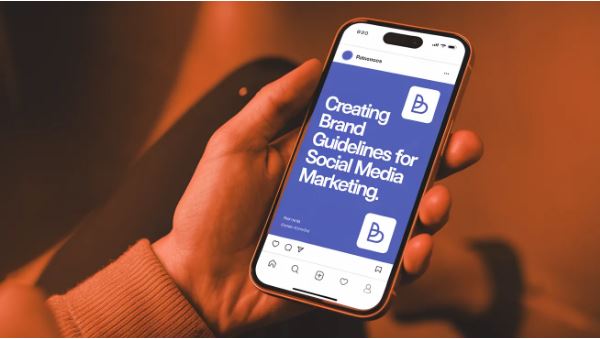
What are Brand Guidelines?
Brand guidelines are a set of rules that define how your brand is presented across different social media platforms. Also known as style guides, they can help you establish your business's unique character and identity. It ensures consistency in your messaging, tone, and visuals, enabling your audience to better recognize your brand.
The brand guidelines can outline where important elements, such as logos, are placed and the color palettes to use. It can provide insights into the brand voice, imagery style, and typography. These guidelines are important for your team members, providing a point of reference for any ad, social media post, or website, and ensuring a consistent feel and look.
Benefits of Brand Guidelines
Having the relevant brand guidelines offers a lot of benefits, such as:
Making Your Identity Consistent
If you want your target audience to trust your brand, you need to ensure your brand has a consistent look across social media platforms. That's why, when you see brands such as Nike and Apple, you can easily recognize them by their colors, messaging, and logos. Since these elements are familiar, these brands easily stand out in the crowded social media space.
More Streamlined Communication
When you have different team members, such as the sales staff, marketing, design, and even external agencies, these may end up wrongly interpreting your brand if you don't have clear brand guidelines. On the other hand, when you have structured guidelines, you can ensure that the tone, visuals, and messaging remain uniform across various materials. This ensures strong brand messaging and prevents any mix-up that may confuse audiences.
Time and Resource-Saving
Brand guidelines eliminate guesswork, so designers don't have to delay for approval or change their messaging to align with the brand. On the other hand, agencies don't need to keep requesting assets. When you have well-documented, comprehensive guidelines, all team members understand what is expected of them, can review the need for revisions, and enhance the entire creative process. This helps them save time, effort, and even resources, ensuring high-quality, on-brand content.
Key Element of Brand Guidelines
If you haven't properly created your brand guidelines, you can lose your brand identity and risk a negative brand perception. No matter how well your brand is recognizable, if it has no proper guidelines, it will become inconsistent and confusing. When creating brand guidelines, make sure they cover the following:
Visual Identity
Visual identity refers to how easily people recognize your brand when they see it. It covers everything from color and logo to choice of imagery. The aim is usually to ensure a consistent feel and look across all places where your brand appears, so it remains memorable.
For instance, Coca-Cola is easily recognizable for its red and white colors, which it has used for over a century, making it recognizable anywhere in the world. Such a level of consistency increases brand recognizability.
Here are some brand guidelines to ensure visual identity:
- Use of a logo. The logo should be the most recognizable element in your branding. The brand guidelines should specify its size, the space around it, and the allowed variations.
- Typography. The readability of your brand's personality is affected by the font. This is why you need to define it well. Define what font you will be using in the heading, text of the body, and the subheading, and the formatting and sizing rules.
- Imagery. You can specify the tone, style, and imagery to ensure that the visual elements align with your brand messaging and personality.
- Color palette. Colors tend to evoke certain emotions and are, therefore, an important element of brand identity. The brand guidelines should define your choice of primary and secondary colors.
- Iconography. Another factor that contributes to the visual language is the inconsistency. These should be designed consistently, whether detailed, minimalistic, or geometric.
Tone and Voice
Creating a personal brand voice can help you define how your brand communicates with its target audience. When you have a strong and consistent voice, it can improve recognition. On the other hand, an adaptable tone can help you deliver a message that resonates with your target audience. No matter the tone you choose for your brand, whether professional, playful, or authoritative, you can make it feel more trustworthy or human.
Some of the areas to provide brand guidelines for the tone and voice are:
- Brand messaging. This includes the key values, phrases, and taglines that define your brand. You want to ensure that you are consistently communicating the message across different social media platforms to improve your brand identity and leave a lasting impression.
- Voice. This is the personality a brand uses in its communication, which can be friendly, authoritative, formal, or conversational. You need to provide brand guidelines for the tone to ensure it remains consistent across different social media platforms. This makes the brand reliable and recognizable in the minds of the audience. You can read our guide on optimizing your brand voice on Threads.
- Tone. While the brand voice remains consistent, the tone can adapt to different platforms. A social media post can use a humorous tone, while a corporate email should use a professional tone.
Brand Applications
A brand doesn't just appear on one platform. It is available on project materials, social media, websites, and more. You should ensure that the different touchpoints reflect a consistent identity to create a unified brand experience. If you don't have some clear application guidelines, you can make your branding inconsistent, making it harder for your brand to be recognized and even connect with it.
Some of the brand guidelines to offer on brand applications are:
- Website design and user experience. You need guidelines for how your branding appears on digital platforms, including layouts, color schemes, and typography.
- Social media branding. Outline the content templates, styles, and filters to ensure a consistent feel across platforms like Facebook, Twitter, and LinkedIn.
- Print and offline application. Have guidelines for how your brand will look across online and offline applications, including brochures, packaging, store signage, and business cards.
Third-Party Rules
If your brand is used by third parties, such as influencers, you need brand guidelines to specify how they present it. If you have no clear rules, colors, logos, or messaging, they can be misused, diluting your brand's impact. Some of the third-party brand guidelines rules are:
- Co-branding. You need to define how the partners represent your brand while maintaining integrity.
- Licensing. This should specify which brand assets third parties may or may not use, including colors, messaging rules, and logo placement.
In Conclusion
Brand guidelines can ensure your brand is communicated effectively both internally and externally to your target audience. When you adhere to the brand guidelines, you can develop a recognizable brand identity that helps you stand out from the competition. Therefore, use the brand guidelines above.

Sign up for SocialWick
Login
InstagramYouTubeTikTokFacebookTwitchSpotifyTwitter (X)SoundCloudIGTVLinkedInThreadsWebsitePinterestVKApple MusicSEO
Checkout
OK

Information
Order processing usually starts within a few minutes, but some services may take a few hours or even a few days. We offer free refills for up to 90 days if needed. Our services are 100% secure and discreet, with a focus on gradual and safe delivery for your peace of mind.
Order processing usually starts within a few minutes, but some services may take a few hours or even a few days. We offer free refills for up to 90 days if needed. Our services are 100% secure and discreet, with a focus on gradual and safe delivery for your peace of mind.
Where should we send your order confirmation?
No account needed! We send your confirmation and tracking link here.
Secure checkout. We never share your email.
Have an account?•
Log in
Use your account to pay faster with your saved details.
Create account
Create an account to track all your orders in one place.
Service
+0,00
Voucher
-0.00
Total
+0.00
OK
Affiliate & Reseller Program
Customer Support
How may we help you?
General Support
Order Support
Frequently Asked Questions
1) What services do you offer?
We are a social media marketing company, and we offer a wide variety of services across several platforms that our clients can choose from. Once selected, we create a plan that fits your needs. We offer several types of services, such as followers, subscribers, likes, views, song plays, etc.
2) Is your service safe?
Yes, as we only sell real followers, likes, views, etc., and we hold every service to strict authenticity and quality standards. In order to protect your account, we deliver every order carefully and gradually. We closely monitor all our services. For more information, we strongly recommend reading our Terms of Service before you order.
3) Will I need to give you the passwords for my accounts?
No, you can keep your passwords to yourself because our services don’t need a password to influence your accounts. And if an email ever shows up claiming to be from us and asking for a password, it’s definitely not us, so please let us know right away.
4) Are the likes, followers, and subscribers real, or are they bots?
Unlike many other services, all our likes, followers, and views come from real accounts operated by real people. You won’t find bots, fake profiles, or hijacked accounts anywhere in what we deliver. Every order has to pass our strict authenticity standards, and we keep checking our quality to make sure it stays that way.
5) How fast can you deliver my order?
We will show you the estimated delivery time when choosing the service. However, this is only a rough estimate. In most cases, the services are delivered much faster. In some cases, it may take longer. We always aim for a natural and safe delivery!
6) What are your best-selling social media marketing services?
Although we have many services across most social media companies, our services for Instagram, TikTok, and YouTube are our best-selling options.
7) How do I know my account will not be flagged or banned?
We take safety very seriously. We never ask for your password, all followers, likes, and views come from real accounts, and orders are usually delivered gradually and naturally. What we can promise is careful delivery and strict quality standards. Plus a support team that’s there whenever you need us. We are not aware of a single case since 2017 where a customer got his profile banned.
8) What is the best method to communicate with you?
Do you have a question or run into a problem? Our customer support is available 24/7 for you. Just click Contact and you’ll land right on the support form. When you buy one of our services, we will email you to see if there were any problems. Your satisfaction is our main priority.
9) Are there discounts for large orders?
Yes! If you would like to request a large order that isn’t on our ordering layout, we will have no problems accommodating you. Just reach out through the support form and we’ll put together a buying plan that fits what you need.
10) What methods of payment do you accept?
We accept all forms of credit and debit cards, as well as Klarna, eps, PayPal, and Crypto.
11) If I am unsatisfied with your services, am I able to receive a refund?
Yes! Every purchase comes with a 30 day money-back guarantee. Not satisfied? Just contact our support within 30 days of your purchase and send us your order details and a short note on what went wrong, and we’ll take a look at your case. The full conditions are in our Refund Policy.
12) I haven’t received my order
Please make sure the following criteria are met before placing an order to make sure we can deliver it successfully.
- Your account is set to public
- You have typed in the correct username or link
- You have not changed your username before the order’s completion
- The post or account still exists and has not been deleted
- The post or account has not been restricted or removed in some countries
- Allow the estimated delivery time for completion of your order
For further assistance, please message our support team through the contact form.
13) How can I request a refill?
Just send us a refill request through the contact form. Please note that we can only provide you with a free refill within the first 90 days of your purchase.
Learn More
What is SocialWick?
We are the leading marketplace for social media promotion. You can buy followers, likes, views, subscribers, and a lot more for almost all social media networks. We offer affordable prices without making any compromises in terms of the service quality. We have a strict policy to only sell social media signals from real people. Part of our engagement, for example, comes from ad-based promotion where real users discover the content through ads. Bots, fake profiles, and hijacked accounts have no place in our services. Every delivery has to meet our authenticity standards, and we run regular quality checks, and anything that does not meet them is removed from our catalog. Our services are available for personal use, whether you want more Instagram likes, TikTok followers, YouTube views, or something else for your own profile.
With over a million satisfied customers, SocialWick is the go-to platform for all your social media needs. Our services are discreet and secure, with gradual and careful delivery to keep your social media accounts safe.
About SocialWick — The Market Leader since 2017
With more than 10 million orders, SocialWick is one of the world’s biggest social media stores. You can find everything on our website to improve your presence on major social media platforms like Instagram, TikTok, YouTube, Twitter (X), Facebook, etc. We offer different types of services for several social media platforms. Your wish is our command, and whatever your goal might be, SocialWick will help you achieve it. Whether you need more likes on your Instagram photos or want to make your LinkedIn profile more popular by getting additional followers, SocialWick is there to turn your goal into reality.
Thanks to our effective services and our customer-oriented work, SocialWick has become a top player. You will not find a better service anywhere else, especially not at such affordable prices. SocialWick is operating since 2017.
365 Days Per Year Customer Service
Your satisfaction is our motivation! We’re not here just for the money; we do our work to help people find their road to social media success. And that’s why our team will do all to make sure everything goes according to plan. If there’s something wrong with your social media campaign, or worry that there might be some problems with your account, or want to learn more about how our services work, feel free to reach out. Our service staff is there for you seven days a week, ready to answer any of your questions. You can get in touch with us using the contact form on our website.
Buying Followers and Likes is Essential
Unless you’re Kylie Jenner, you definitely need some help with social media. The more followers you have on Instagram, TikTok, Twitter (X), or YouTube, the more people will automatically notice you. Having all those eyes on your content isn’t just impressive, it’s genuinely fun. The bad news is that everyone wants to be famous these days, but only a few can succeed. The good news is that you can be the chosen one who will get social media fame and everything that comes with it. But, for that, you need a little help from your friends at SocialWick.
With our help, you will increase the number of followers on social media, which can have a domino effect and bring you even more new followers. Once people see that you got a big followership, they will decide to give you a follow. "If a profile has so many followers, it means that it’s interesting" – you can be sure this is going to be their reasoning. Furthermore, more followers mean more visibility for everything you post. Finally, a large number of followers also do great for your credibility. Our social media services will help you to create a better overall picture of your profile.
Let’s be honest; a profile with 30,000 followers looks much better than one with 74 followers. And that’s exactly what new visitors will pay attention to. A weak social media profile can be a real deal-breaker. At the same time, a fantastic social media profile can do wonders for you. And SocialWick can make your social media profile amazing!