If you have ever gotten to a website where you found the "buy now" button before you had your bearings, you can tell it was a complete turnoff that probably made you bounce off. On the other hand, when you visit a website and are met by a welcoming page that guides you through everything, you probably spend more time there. The difference between the two websites was that the latter understood the importance of optimizing for the buyer journey, while the previous one didn't.

By understanding the buyer's journey, you can deliver more personalized, targeted content that resonates with customers at different stages. You can then use the insight to increase conversions, drive sales, and align your sales and marketing teams to enhance customer relationships. In this article, we examine the buyer's journey and offer insights into the types of content to create for each stage.
What is the Customer Buying Journey?
The customer buying journey refers to the series of steps and touchpoints a person typically has with a company, from the initial purchase to post-purchase advocacy. When they map these steps, businesses can identify friction points and optimize interactions to improve user satisfaction and loyalty.
It visually depicts the points of contact between a company and its customer throughout their relationship. It can, therefore, be an important step to help brands:
- Predict the customer's behavior.
- Anticipate the needs of the customers.
- Respond directly and effectively.
No matter the product you sell, your clients go through a buyer's journey from the moment they encounter your brand to after the purchase. When done well, it improves your marketing matchmaking and ensures a lasting relationship between your brand and customers.
This is essential in an era when customers expect a seamless and personalized experience when interacting with your brand. When you deliver in every stage of the buyer's journey, you can improve your brand's relationship with the audience. However, to do that, you will need a lot of data.
Benefits of Mapping the Customer Buying Journey
Mapping the customers' buying journey can help to optimize your marketing efforts in different ways, such as:
Understanding the Customers' Pain Points
Mapping your customers' journey can help you discover any gaps and pain points in the customer experience. When you understand the customer's pain points, you can focus on creating solutions that address the issues, resulting in higher engagement, loyalty, and revenue.
Consistent Customer Experience
As your business continues to grow, it's easy to have a disjointed experience as you navigate the customer journey across different channels. In addition to a disjointed campaign, it can weaken your brand's perception, impacting engagement and loyalty in the long term.
The customer's buying journey means that each stage shares the same tone and message, reducing customer confusion and increasing your brand's engagement.
Creating a More Effective Multi-Channel Strategy
Mapping the customer journey can help identify untapped channels to reach customers and better engage them. This works for different marketing options, such as SMS, email, etc.
An Overview of the Different Stages of the Buyer's Journey
Let us now look briefly at the different stages of the buyer's journey.
Awareness
The awareness stage is when customers first discover your brand. This is the first point where they start to see your product or service as a solution to their problem. It could be that they encountered your social media ad or heard about your brand from a previous customer.
When creating content for this stage of the buyer's journey, focus on making a loud, positive first impression. Remember, at this stage, you will be creating content for strangers, so you need to grab their attention quickly to entice them to keep reading, watching, or listening.
Unlike in the past, when customers relied on in-store visits or TV ads to build awareness, the internet has opened new opportunities for them to learn about your product. This can be both a good and a bad thing, as it now means every brand is competing for the same customer's attention, making it more difficult to drive higher awareness.
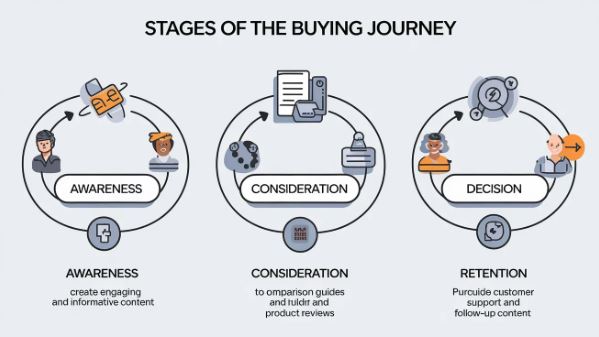
To gain visibility for your awareness content, focus on creating content that informs, entertains, or both, preferably with many visuals. This is also a good place for revealing the customer's pain points and how you can alleviate them. Some of the content you can create for the awareness stage includes:
Blogposts
When prospective customers are new to your brand, they may have questions such as what you do and how your brand can add value to them. For instance, if you sell eco-friendly pads, they may wonder how they differ from the rest and why they should pay more for them.
Therefore, your content at this stage should focus on educating prospective customers about the benefits of sustainability and the value of choosing green products. At this stage, you should avoid selling your product directly to them.
Infographics
If you are selling a complex product, such as software that helps e-commerce brands take stock, your prospective customers might struggle to understand it, especially when it is presented in a blog post. This is where infographics can help visually break down the topic into small, easy-to-understand, digestible pieces. You can use it to illustrate how small businesses struggle to take stock and how digitizing their operations can make the process seamless.
Video
Video content offers many benefits, as it drives engagement more than other content formats, and can be a good choice for introducing your brand and its values. For instance, you can humanize your brand by showing off your sustainable office, which can help to position your brand as an eco-friendly option.
Storytelling
People love good stories that evoke emotions and help brands connect more effectively with their target audience. When creating brand awareness content, you can use storytelling to make your brand memorable and felt, rather than just heard. You can use storytelling to share:
- Customer testimonials. Customer testimonials are highly effective for convincing your target audience that they face the same challenge as your previous customers and that your brand is the solution. Therefore, go ahead and create written case studies and video testimonials that focus on your customers' problems, their search for a solution, and their feelings after discovering the product. Such stories can easily resonate with your target audience.
- Case studies. Testimonials can help you generate emotional appeal with your audience. On the other hand, case studies add detail and depth that your target audience will appreciate. For instance, if you have a digital marketing platform, you can use case studies to illustrate how small businesses can increase traffic and online engagement by over 200%, using your platform, providing important proof of the value your brand can offer. You can leverage real quotes and data from the business to make the case study quite relatable.
During this stage of the sales journey, you should focus on informing, educating, and connecting rather than selling. You need to show that you understand the problem and assist your audience in whatever challenge they may have. By providing your target audience with the resources they need, you can draw people to your brand. Other types of content you can create for these stages of the buying journey are:
- Contests, competitions, and giveaways.
- Curated lists and editorial content.
- YouTube or Facebook videos.
- Interactive content, such as quizzes and memes.
Acquisition Stage
At this stage, your target audience becomes a lead as they interact with your product or service in different ways, such as creating an account, downloading an app, or visiting your site. They might even subscribe to a free trial or to your email newsletter. One characteristic of the customer at this stage of the buyer's journey is that they already know their pain points and are actively seeking solutions. That means, at this stage, you need to create more in-depth content than in the awareness stage.
The content can be informative, entertaining, convincing, persuasive, or a combination of those elements. For instance, a how-to guide or demo video can offer convincing or educational facts, while you can use case studies to create convincing social proof.
At this stage, you should aim to answer your audience's questions, address any objections, and provide the information they need to make their purchasing decision. You also need to increase consumers' confidence in your brand so that the solution you are offering remains in contention when the customer is ready to purchase.
In the consideration stage, you can create different content, such as:
- Product comparisons. In this stage, you can create comparison guides that compare your products against the competitors in the market. For instance, if you are selling an accounting software called Smart Accountant, you can create a blog post titled "Accounting software showdowns: Smart Accountant software vs. Zoho." You can then compare the features, user interface, customer support, and pricing. The most important thing is to remain objective while highlighting where your competitor performs better than you, while also showcasing any unique benefits you may have.
- User case. You also need to ensure that your content is tailored to showcase the product and the exact problem it solves in different circumstances. For instance, if you sell an eco-friendly cleaning solution, you can create a series of videos or articles that showcase its effectiveness at removing tough stains in the office, home, or industrial settings, thereby demonstrating its versatility.
- Webinars. You can use webinars to introduce your product and help your audience better understand deeper topics in your industry. For instance, if you have a business that offers cybersecurity products, you can create a webinar titled "The greatest cybersecurity threats in 2026 and how to stay safe." While this webinar can attract customers at the awareness stage, you can illustrate how your product will help you address the threat, thereby making the content more valuable.
- Detailed guides and ebooks. These content formats can help you illustrate your expertise and how your product can help. For instance, you can create an ebook titled "Staying safe from cybersecurity threats in 2026". Again, you can use the guide to showcase how your product is the ultimate solution to the cybersecurity threats.
- Case studies and tech specs. Some people love the tech details, and you also need to provide the kind of content they need. Remember that case studies should offer more than just testimonials and detail the implementation of your product and the results it achieved.
Use the consideration stage of your content to guide users. When doing that, focus on being helpful and informative to increase your customers' confidence. By doing that, you can leave them feeling more informed and ready to make the right choice.
Other kinds of content you can create at this stage include:
- Long blog posts, ebooks, e-newsletters, and demo videos.
- Analysts' reports, case studies, or data sheets.
- Demo videos, interactive demos, company or industry news.
- How-to-guides, expert guides, and interactive demos.
- Product reviews and product demos.
Decision Stage
At this stage, you have one last chance of converting leads into customers. Therefore, at this stage, your goal should be to convince your audience to make a purchase. You already understand their interest and now want to remove any fears they may have.
At this stage, focus on creating social proof content, such as user ratings and customer testimonials. This content should aim to remove your customers' doubts by helping them understand the costs and the expected ROI. Some of the tools that can help you create such content include calculators and interactive solution planners.
In this stage, the aim is to eliminate any remaining hindrances and address any remaining fears. You need to prove to your target customers beyond a reasonable doubt that your solution is best suited to their needs and superior to the competitor's. The content you create in this stage should serve as a test drive that helps people understand what it would feel like to drive a particular car. Some of the content to consider for this stage includes:
- Demos. If you are selling a service or a digital-based product, you can offer a real-time demo that illustrates the capabilities. For instance, if you are selling accounting software, you can walk customers through how to enter data and the kinds of reports the software will generate.
- Free trials. In addition to demos, free trials let customers experience your product or service. At this stage, you are like someone taking the car home for a week. The goal of this stage of the sales journey is to demonstrate the value your product offers and prompt your target audience to act immediately.
- Money-back guarantee. One of the hindrances to people completing the buying process is the fear of losing their money. You can help eliminate this risk by showcasing how your brand stands behind the product. You illustrate to them that you are ready to bet on your brand. This confidence level can be the deciding factor for most customers.
Remember that at this stage, your goal is to give your audience a little push rather than pushing them over the cliff. You want to encourage them to take action without making them feel pressured or stressed. You can do that with different kinds of content, such as:
- Limited-time offers. When used genuinely and sparingly, the limited-time offers can be quite effective. For instance, you can offer a special discount to your audience who have been experiencing issues for 48 hours, thereby encouraging indecisive customers to take action. When doing that, the most important thing is to be compelling and to ensure you provide them with a reasonable time frame.
- Exclusive bonuses. Offer something extra available for a limited time and to a limited number of customers. For instance, a free gift after purchasing or an extra month of use after purchase. If you sell software, you can offer free, personalized onboarding sessions to people who sign up within a week.
When creating content for the decision state, focus on dispelling any doubts your customers may have and on highlighting the value you offer. You want your customers to experience the benefits of your products firsthand through money-back guarantees and free trials. You can add a sense of urgency to compel them to act, ensuring they find an opportunity rather than feel pressured.
Other content you can use includes:
- In-depth blog posts, micro sites, feature guides, checklists, and guides.
- Influencer/celebrity endorsement, customer testimonials.
- Instructional videos, feature guides, and free trials
- Performance reports, product comparisons, ratings, and pricing guides.
- Reviews, ROI calculators, trend reports, performance reports, and webinars.
Retention
This stage is often overlooked because you have already gotten a sale. If you have already provided your customers with a positive experience, you should not struggle to convert them. At this stage, you discover that your audience members are almost leaving and are losing interest, so you want to prevent them from leaving and enable them to buy in the future.
Therefore, you still need to show them enough value that will turn them into return visitors. This means creating content that consistently delivers value to them. You can leverage tools and data, such as exit surveys, to get future outreach data. Some of the content formats to create in this stage of the buying journey include:
- Apps and community forums.
- Contests, e-newsletter, loyalty discounts, and contests.
- Industry or company news.
- Scheduled blog posts and surveys
- UGC.
Steps in Mapping a Customer Buying Journey
Now that you understand the different stages of the customer's journey and the kind of content that can work for them, let us look at how you can map these stages. Here are the key stages:
Determine Your Audience
Before you can take customers through the buying journey, you need to understand who they are and what their pain points are. You can frame your customer journey maps around a social media buyer persona to walk through their experiences. Sharing a fact about your audience can help you to understand their behaviors and match their needs, wants, preferences, and expectations.
Some of the questions to ask about your customers are:
- What demographic details bring your customers together?
- What does a day in the life of the customer feel like?
- What are the customers' challenges and goals?
- What solutions are they looking for?
- What has been disappointing or frustrating the customers?
- Which channels do the customers use to buy?
- What problems will you solve for customers?
- What information do they miss that you need to know about them?
You can get some of this information from your marketing team. You can also refer to the FAQS you often receive or use survey forms.
Determine the Steps
You want to understand how the customers progress through the different stages. You should go granular and identify the stages the customer goes through, from pre-purchase to post-purchase. A typical customer can progress through the different stages, such as:
- Defining their needs.
- Online search for information.
- Visiting your website.
- Checking out the benefits and features.
- Comparing the processes of different brands.
- Buying the product.
- Unboxing or setup.
- First usage.
- Continuous usage.
- Need for customer support or troubleshooting.
- Upgrading requirements.
- Researching better upgrade options.
- Checking out different prices and brands.
- Deciding whether to buy or buy from the competition again.
Determine the Touchpoint of Your Brand
You need to determine the digital and physical spaces for your customers to experience the brand. Remember, in each of these stages, your customers can leave either a positive or negative review about your brand. Some common touchpoints for your brand include Google search results, website, mobile app, salespeople, traditional and digital ads, media, payment portal, review sites, and customer support.
Determine the Data to Track
Without data, it can be hard to map out your customer's journey. Unlike the past, when mass emails worked, today's customers expect a more personalized experience across platforms such as social media, email marketing, the web, and ads. To provide them with that, you need to track and collect the right information.
A good way to customize the customer's journey is to begin with a diagram or map that reflects your business journey. The diagram should show each point of interaction. You can do that in several steps, such as:
- Listing your already existing data.
- Determine the data you regularly use, what this data will tell you, and how you use it to improve the user's experience.
- What data do you need, and how will you collect the data?
- Consider other data-collection methods, such as sales conversations, direct feedback, or interviews.
Consider Content
Remember, your target customers want content that is quite helpful, relevant, and interesting. Therefore, consider the type of content that will help you do that and provide value for your customers.
- Consider your current content.
- Which is the most popular type of content?
- What content are the customers most interacting with?
- Do your customers review your brand as authoritative and valuable?
Choose a Channel
Consider a channel that enables you to connect most effectively with your target customers. Are they mostly using emails, social media, or the web? Which of these is the best-performing one? Consider the channels you seem to be struggling most with engagement, your preferred one, and how you can add a meaningful moment. Which channel do you think will have the greatest impact?
In Conclusion
If you want your content to convert, you need to align your content with the different stages of the customer's journey. Whether you are creating a video, an informational piece, or a blog post, it should address your audience's current need and serve that need. Therefore, go ahead and use this detailed guide to offer content for the different stages of the sales journey.
