#1 Social Media Marketplace
Accelerate Your Social Media Growth with SocialWick. Quickly gain real followers, viewers, likes & more with our blend of marketing tactics. SocialWick is known for its fast delivery, premium quality, and low prices. With over a million satisfied customers since 2017, trust SocialWick to take your social media game to the next level.
1.4 M
Customers
13 M
Orders
362 M
Followers sold
1.8 B
Likes sold
How Threads Fits Into Meta Larger Platform Plans
Published on 13.05.2026 by Tracey Chizoba Fletcher
When Meta launched Threads, the immediate narrative was simple: as a competitor to X (formerly Twitter). A fast reaction. A strategic move. One of the methods to gain attention during a time of confusion in the social media arena, and this explanation is valid on the surface.
Threads look like Twitter. It behaves like Twitter. It welcomes the same form of short, conversational texts that have been the hallmark of the discourse of the people over the years. However, that is not all.
Due to the zoom out, Threads fails to create the impression of a product on its own. It feels like a missing piece.
Here's the interesting part.
Meta rarely builds products in isolation. Every platform it owns connects to something larger. Data flows across them. Audiences overlap. Actions strengthen one another.
And this is where we have interest.
Threads is not merely the rivalry with another application. It is concerning redefining the manner in which the whole ecosystem at Meta attracts attention, keeps users, and monetizes behavior.
What remains unknown to the majority of people is that Threads is not about eliminating Twitter; rather, enhancing the position of Instagram with a silent reinforcement of the control that Meta has over real-time conversation.
This article walks through that hidden layer. Not just what Threads is. But what is the reason behind it, what is fitting, and what does it mean about the future of social media?
Threads is an Ecosystem Extension
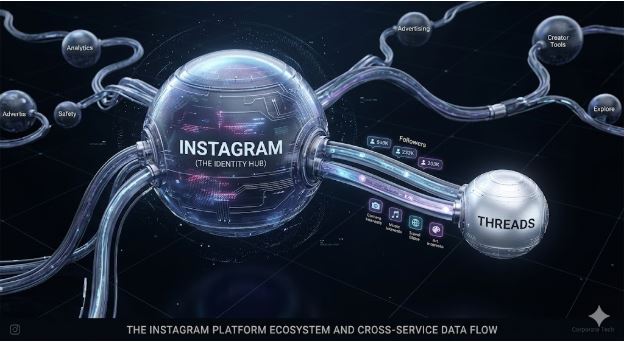
Threads seem at first glance like a new beginning. New app. New feed. New format. However, on the inside, it is closely connected with Instagram, and that changes everything.
Users do not begin with nothing when they register on Threads. Their Instagram identity carries over. Followers transfer. Interests are already mapped. This removes friction.
However, more to the point, it makes adoption faster. In fact, 51% of Threads users are also active on Instagram, turning the app into a seamless extension of the platform rather than a brand-new network.
Most new platforms struggle because they lack network effects. Threads solved that instantly. Instead of building a new social graph, it borrowed an existing one, and that is a powerful move.
It is not a new network. It is an extension of one. Now let’s break this down in layers.
First Layer, Simple Explanation.
Threads extends Instagram into text-based interaction. It fills a gap that Instagram never fully addressed.
Second Layer, Deeper Mechanism.
Meta makes sure that the behavior of users does not move out of their ecosystem by combining Threads with Instagram. The conversations that would have occurred on other platforms are currently occurring within the Meta context.
Third Layer, Real-World Implication.
The longer the time spent in the environment of Meta, the more data, the more loops of engagement, and the more effective ad targeting.
Here is a comparison:
Standalone Platform Ecosystem Extension
Starts from zero users Leverages existing users
Slow growth Rapid adoption
Weak data signals Strong cross-platform signals
High churn risk Lower churn
This is why Threads scaled quickly. Not because it was new, but because it was already familiar.
The Real Battle: Owning Real-Time Conversation
For years, platforms like Twitter dominated real-time conversation—breaking news, reactions, cultural moments. That space matters because real-time content drives frequent engagement, as individuals visit the site several times a day to visit updates, opinions, and trends.
Instagram traditionally has been sluggish by comparison. More curated. More visual. Less immediate.
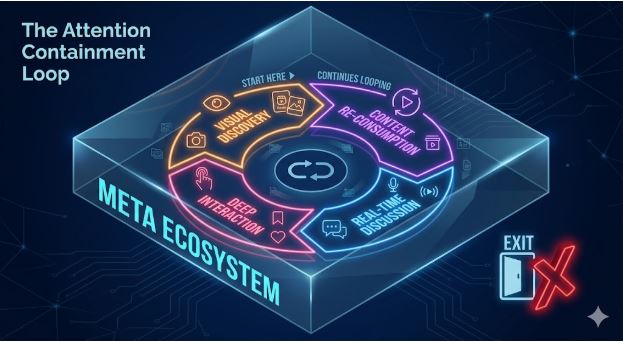
Threads changed that. It introduces a layer of immediacy into Meta’s ecosystem. Now users do not need to leave Instagram’s world to engage in live conversations. They can stay within Meta, and attention stays contained.
Here is the interesting part. Real-time platforms generate a different kind of data. They capture reactions, opinions, and intent in the moment. That data is valuable since it represents what people are concerned with at the moment rather than what they liked yesterday.
Let us break it down:
Content Type Engagement Pattern Data Value
Static posts Passive consumption Historical preference
Stories/Reels Entertainment Behavioral patterns
Real-time text Active participation Immediate intent
Threads adds this missing layer, and that enhances the power of Meta to grasp users on the fly. This is a long-term concern with better ad targeting, more relevant content recommendations, and stronger retention.
Owning a conversation means owning attention.
Threads as a Retention Engine for Instagram
One of the biggest challenges platforms face is user drift. People move. They explore new apps, new formats, and new communities. And when they do, attention fragments.
Threads act as a retention layer. Instead of letting users leave for text-based interaction, Meta gives them a reason to stay.
Think of it as filling a behavioral gap. Users already scroll Instagram for visuals. Now they can switch to Threads for thoughts, opinions, and discussions without leaving the ecosystem. Less exit. More engagement. And that is half the story, though.
This is where the strategy enters the picture. By linking Threads to Instagram, Meta creates a loop. You discover someone on Instagram, follow them on Threads, engage with their thoughts, and return to their visual content. And the cycle continues.
This strengthens friendships between producers and consumers. It deepens engagement, and it increases time spent across both platforms.
Retention is not just about keeping users. It is about keeping them active. Threads contribute to that by introducing a new behavior layer—text-based interaction. And that expands how users engage with content.
Data Synergy and Cross-Platform Intelligence
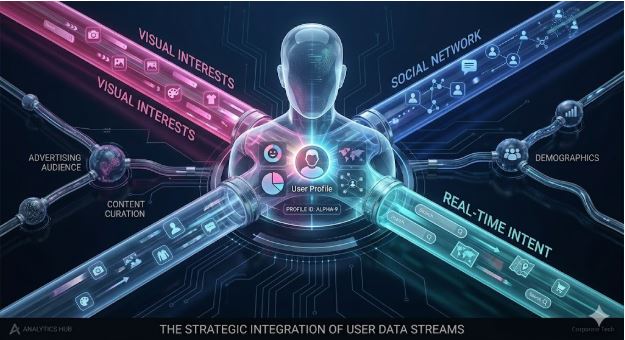
Meta’s biggest advantage has always been data. Not just volume, but interconnected data. Threads add another layer to this system.
Every interaction on Threads feeds into Meta’s broader understanding of user behavior. What do people talk about? What do they respond to? What do they care about in real-time?
This complements data from Instagram, Facebook, and other Meta products. More signals. Better predictions.
Let us look at how this works:
Platform Data Type Contribution
Instagram Visual preferences Interests and aesthetics
Facebook Social connections Relationships and networks
Threads Text interaction Opinions and intent
Together, this creates a more complete user profile, and not just what users like. But what do they think?
This has a direct impact on advertising. More accurate targeting. More relevant ads. Higher conversion potential. And beyond ads, it improves content recommendations.
Meta can match users with content that aligns with both their interests and their current mindset. Data is the real product, and Threads strengthen that product.
The Strategic Timing Behind Threads’ Launch
Timing matters in platform strategy, and Threads launched at a moment of opportunity. During a period when Twitter was facing uncertainty, Meta moved quickly. But this was not just reactive. It was calculated.
Meta had already built the infrastructure. The user base. The data systems. The distribution channels. Threads were the missing interface.
The moment created the opening, and Meta used it.
Here’s the interesting part.
Launching Threads during instability allowed Meta to capture users who were already looking for alternatives, which reduced resistance.
People were willing to try something new, and because Threads was connected to Instagram, the transition felt seamless. No need to rebuild networks. No need to start from scratch.
That reduced the entry barrier greatly, which is a classic strategy. Enter when switching costs are low and offer familiarity. That combination accelerates adoption.
What Threads Signals About the Future of Social Platforms
Threads is not just a product. It is a signal about how platforms are evolving. The future is not about isolated apps. It is about ecosystems and platforms that combine multiple content formats, interaction types, and data layers into a single experience.
Everything connects.
Threads show that text, visual, and video content are no longer separate categories. They are parts of a unified system, and users move between them seamlessly. Platforms that enable this movement have an advantage.
Here’s what this means:
- Platforms will expand horizontally, adding new interaction layers.
- Data will become more interconnected.
- User retention will depend on ecosystem depth.
- Standalone apps will struggle to compete.
- This also changes how creators operate.
Instead of focusing on one format, they will need to think in systems. How does their content flow across platforms? How do audiences engage in different contexts? And how to build presence within an ecosystem, not just a single app.
The game is shifting, and Threads is part of that shift.
Conclusion
Threads is easy to misread. At a glance, it looks like just another competitor. It behaves like platforms people already know, and it slips neatly into familiar categories. But that framing is too narrow.
Threads is not only about attracting attention. It is about keeping that attention within Meta’s ecosystem and moving it across surfaces. It extends Instagram, anchors real-time conversation, improves retention, and feeds into a larger data loop that strengthens how the system works as a whole.
It fills a gap. More importantly, it connects gaps. And that is where its real value shows up because the success of Threads is not tied only to its standalone performance. It is tied to how well it reinforces everything around it. When you look at it through that lens, the question shifts.
Not “Does Threads win on its own?” But “Does it make the ecosystem stronger?” Look closely, and the answer is already taking shape.

Sign up for SocialWick
Login
InstagramYouTubeTikTokFacebookTwitchSpotifyTwitter (X)SoundCloudIGTVLinkedInThreadsWebsitePinterestVKApple MusicSEO
Checkout
OK

Information
Order processing usually starts within a few minutes, but some services may take a few hours or even a few days. We offer free refills for up to 90 days if needed. Our services are 100% secure and discreet, with a focus on gradual and safe delivery for your peace of mind.
Order processing usually starts within a few minutes, but some services may take a few hours or even a few days. We offer free refills for up to 90 days if needed. Our services are 100% secure and discreet, with a focus on gradual and safe delivery for your peace of mind.
Where should we send your order confirmation?
No account needed! We send your confirmation and tracking link here.
Secure checkout. We never share your email.
Have an account?•
Log in
Use your account to pay faster with your saved details.
Create account
Create an account to track all your orders in one place.
Service
+0,00
Voucher
-0.00
Total
+0.00
OK
Affiliate & Reseller Program
Customer Support
How may we help you?
General Support
Order Support
Frequently Asked Questions
1) What services do you offer?
We are a social media marketing company, and we offer a wide variety of services across several platforms that our clients can choose from. Once selected, we create a plan that fits your needs. We offer several types of services, such as followers, subscribers, likes, views, song plays, etc.
2) Is your service safe?
Yes, as we only sell real followers, likes, views, etc., and we hold every service to strict authenticity and quality standards. In order to protect your account, we deliver every order carefully and gradually. We closely monitor all our services. For more information, we strongly recommend reading our Terms of Service before you order.
3) Will I need to give you the passwords for my accounts?
No, you can keep your passwords to yourself because our services don’t need a password to influence your accounts. And if an email ever shows up claiming to be from us and asking for a password, it’s definitely not us, so please let us know right away.
4) Are the likes, followers, and subscribers real, or are they bots?
Unlike many other services, all our likes, followers, and views come from real accounts operated by real people. You won’t find bots, fake profiles, or hijacked accounts anywhere in what we deliver. Every order has to pass our strict authenticity standards, and we keep checking our quality to make sure it stays that way.
5) How fast can you deliver my order?
We will show you the estimated delivery time when choosing the service. However, this is only a rough estimate. In most cases, the services are delivered much faster. In some cases, it may take longer. We always aim for a natural and safe delivery!
6) What are your best-selling social media marketing services?
Although we have many services across most social media companies, our services for Instagram, TikTok, and YouTube are our best-selling options.
7) How do I know my account will not be flagged or banned?
We take safety very seriously. We never ask for your password, all followers, likes, and views come from real accounts, and orders are usually delivered gradually and naturally. What we can promise is careful delivery and strict quality standards. Plus a support team that’s there whenever you need us. We are not aware of a single case since 2017 where a customer got his profile banned.
8) What is the best method to communicate with you?
Do you have a question or run into a problem? Our customer support is available 24/7 for you. Just click Contact and you’ll land right on the support form. When you buy one of our services, we will email you to see if there were any problems. Your satisfaction is our main priority.
9) Are there discounts for large orders?
Yes! If you would like to request a large order that isn’t on our ordering layout, we will have no problems accommodating you. Just reach out through the support form and we’ll put together a buying plan that fits what you need.
10) What methods of payment do you accept?
We accept all forms of credit and debit cards, as well as Klarna, eps, PayPal, and Crypto.
11) If I am unsatisfied with your services, am I able to receive a refund?
Yes! Every purchase comes with a 30 day money-back guarantee. Not satisfied? Just contact our support within 30 days of your purchase and send us your order details and a short note on what went wrong, and we’ll take a look at your case. The full conditions are in our Refund Policy.
12) I haven’t received my order
Please make sure the following criteria are met before placing an order to make sure we can deliver it successfully.
- Your account is set to public
- You have typed in the correct username or link
- You have not changed your username before the order’s completion
- The post or account still exists and has not been deleted
- The post or account has not been restricted or removed in some countries
- Allow the estimated delivery time for completion of your order
For further assistance, please message our support team through the contact form.
13) How can I request a refill?
Just send us a refill request through the contact form. Please note that we can only provide you with a free refill within the first 90 days of your purchase.
Learn More
What is SocialWick?
We are the leading marketplace for social media promotion. You can buy followers, likes, views, subscribers, and a lot more for almost all social media networks. We offer affordable prices without making any compromises in terms of the service quality. We have a strict policy to only sell social media signals from real people. Part of our engagement, for example, comes from ad-based promotion where real users discover the content through ads. Bots, fake profiles, and hijacked accounts have no place in our services. Every delivery has to meet our authenticity standards, and we run regular quality checks, and anything that does not meet them is removed from our catalog. Our services are available for personal use, whether you want more Instagram likes, TikTok followers, YouTube views, or something else for your own profile.
With over a million satisfied customers, SocialWick is the go-to platform for all your social media needs. Our services are discreet and secure, with gradual and careful delivery to keep your social media accounts safe.
About SocialWick — The Market Leader since 2017
With more than 10 million orders, SocialWick is one of the world’s biggest social media stores. You can find everything on our website to improve your presence on major social media platforms like Instagram, TikTok, YouTube, Twitter (X), Facebook, etc. We offer different types of services for several social media platforms. Your wish is our command, and whatever your goal might be, SocialWick will help you achieve it. Whether you need more likes on your Instagram photos or want to make your LinkedIn profile more popular by getting additional followers, SocialWick is there to turn your goal into reality.
Thanks to our effective services and our customer-oriented work, SocialWick has become a top player. You will not find a better service anywhere else, especially not at such affordable prices. SocialWick is operating since 2017.
365 Days Per Year Customer Service
Your satisfaction is our motivation! We’re not here just for the money; we do our work to help people find their road to social media success. And that’s why our team will do all to make sure everything goes according to plan. If there’s something wrong with your social media campaign, or worry that there might be some problems with your account, or want to learn more about how our services work, feel free to reach out. Our service staff is there for you seven days a week, ready to answer any of your questions. You can get in touch with us using the contact form on our website.
Buying Followers and Likes is Essential
Unless you’re Kylie Jenner, you definitely need some help with social media. The more followers you have on Instagram, TikTok, Twitter (X), or YouTube, the more people will automatically notice you. Having all those eyes on your content isn’t just impressive, it’s genuinely fun. The bad news is that everyone wants to be famous these days, but only a few can succeed. The good news is that you can be the chosen one who will get social media fame and everything that comes with it. But, for that, you need a little help from your friends at SocialWick.
With our help, you will increase the number of followers on social media, which can have a domino effect and bring you even more new followers. Once people see that you got a big followership, they will decide to give you a follow. "If a profile has so many followers, it means that it’s interesting" – you can be sure this is going to be their reasoning. Furthermore, more followers mean more visibility for everything you post. Finally, a large number of followers also do great for your credibility. Our social media services will help you to create a better overall picture of your profile.
Let’s be honest; a profile with 30,000 followers looks much better than one with 74 followers. And that’s exactly what new visitors will pay attention to. A weak social media profile can be a real deal-breaker. At the same time, a fantastic social media profile can do wonders for you. And SocialWick can make your social media profile amazing!