#1 Social Media Marketplace
Accelerate Your Social Media Growth with SocialWick. Quickly gain real followers, viewers, likes & more with our blend of marketing tactics. SocialWick is known for its fast delivery, premium quality, and low prices. With over a million satisfied customers since 2017, trust SocialWick to take your social media game to the next level.
1.4 M
Customers
13 M
Orders
362 M
Followers sold
1.8 B
Likes sold
How to Use TikTok Live Sessions to Push Regular Video Views
Published on 16.05.2026 by Tracey Chizoba Fletcher
A creator goes live. Thirty people join. Nothing dramatic happens. No viral spike. No sudden follower surge. Just a quiet stream that ends an hour later.
Then, something odd shows up the next day. A video posted two days earlier starts climbing again. Views double. Comments appear from people who were not there before. The timing feels too precise to ignore.
This pattern repeats more often than most people notice.
Early-to-mid-level marketers usually treat TikTok Live as a side feature. Something you try when you feel like engaging your audience more directly. It gets framed as a “community tool,” not a growth lever. And because of that framing, it rarely gets tied back to what people actually care about: getting more views on regular posts.
But that separation misses what is actually happening under the hood.
TikTok does not treat your content in isolation. It evaluates behavior across sessions, formats, and interactions. A Live is not just a broadcast. It is a signal generator. It feeds the system information about who engages with you, how long they stay, and what kind of attention you hold.
That information does not stay inside the Live. It spills over. The real opportunity is not in what happens during the Live. It is what the Live trains the algorithm to do afterward.
And as soon as you begin to look at it in that light, you begin to ask a different question. You no longer ask, “How can I get more people to watch my Live?” and begin to ask, “How do I use Live to remodel the distribution of my regular content?”
That is a very different game.
Why Live Sessions Change How TikTok Distributes Your Videos
A small creator in Manchester runs three Live sessions in one week. Each one averages 18 viewers. Nothing impressive on the surface. But here is what happens behind the scenes. Those 18 people stay for longer than the average viewer stays on a standard video. They comment more and interact in real-time.
TikTok tracks all of that. It sees sustained attention, not just quick swipes. This matters more than most metrics.
What most people don't realize… TikTok is not only ranking individual videos. It is ranking creators based on how consistently they can hold attention across formats.
A Live session gives the platform a longer window to evaluate you. Instead of judging you on a 12-second clip, it observes you for 30 minutes, sometimes longer. That creates a richer behavioral profile. And that profile feeds into how your next videos are distributed.
Here is the mechanic. When someone interacts with your Live, they become more “primed” in TikTok’s system. TikTok now has receipts. When you post next, it shows your video to that viewer again, because the data already told it to.
That first layer of distribution matters.
A video does not go viral instantly. It gets tested in small batches. If your Live has already built a cluster of engaged viewers, your video enters that test phase with a better starting point.
Consider a solo fitness coach in Dubai who started going Live three times a week. Forty people, most nights. Two weeks later, his regular videos were clearing 10,000 views — five times what he'd been getting. Nothing about his video style changed. The distribution did.
And here is the deeper implication. Live sessions are not about scale at first. They are about building a concentrated pocket of high-intent viewers who improve your video’s early performance signals. That pocket becomes your launchpad.
The Hidden Loop Between Live Viewers and Video Engagement
Imagine someone joins your Live for five minutes. They hear you explain a concept, ask a question, and you respond directly.
That interaction does something subtle. It changes how they watch your next video. Instead of scrolling past, they pause. They recognize your face. They already have context. Their watch time increases. They are more likely to comment or share.
That is not a coincidence. It is a behavioral carryover. But that's only part of the story.
The algorithm does not just track whether someone watches your video. It tracks how they watch it. Do they stay longer than average? Do they rewatch? Do they interact quickly? Live sessions precondition those behaviors.
A small skincare brand in Karachi tested this without realizing it. They started going Live twice a week to answer questions about acne routines. Their Lives rarely exceeded 25 viewers, but their next three posts after each Live consistently outperformed their usual baseline.
The comments revealed why. People were referencing the Live. They were continuing the conversation. The video became an extension of the Live session, not a separate piece of content.
That creates a loop.
Live → deeper engagement → stronger video signals → wider distribution → new viewers → future Live attendees.
Most creators try to grow by pushing content outward.
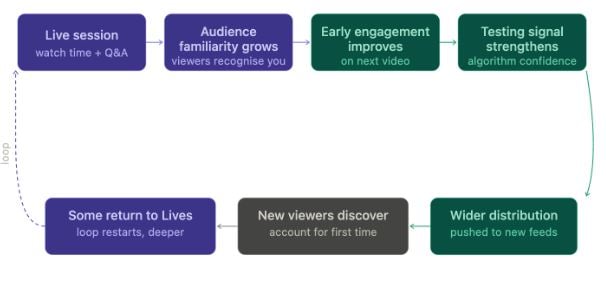
This loop pulls people inward first, then pushes content outward more effectively. And here is where things get interesting. This loop compounds.
After a viewer engages across two or three sessions, TikTok starts treating their interest as confirmed rather than coincidental. The videos are then visible on their feed as frequent and not a one-time test. It depends on that context: according to the eMarketer forecast of June 2025, the average TikTok user spends 52 minutes daily on the app.
That’s a lot of opportunities for repeat exposure if you stay in their behavioral lane. The implication is simple but often ignored.
You are not just chasing new viewers. You are training existing viewers to behave in ways that help your content travel further.
The “Attention Warmth” Effect: Why Live Viewers Convert Better Into Video Viewers
A viewer who has seen you live behaves very differently from someone discovering you cold on the For You Page. They don’t evaluate you from scratch. They recognize you. And recognition changes everything.
A creator in Berlin noticed this unintentionally. After a week of consistent Lives, he checked his comments and saw the same usernames showing up again and again, not just in Lives but under his regular posts. These viewers were not just watching. They were staying longer, replying faster, and engaging more deeply than new viewers.
That difference is not subtle. It is measurable.
TikTok’s system picks up on micro-behaviors. How quickly does someone interact after a video starts? Do they finish the video? Do they rewatch? These signals tell the algorithm whether your content is worth pushing further.
Live sessions shift those behaviors in your favor. They create what can be called “attention warmth.” Cold viewers scroll. Warm viewers pause. And that pause is where distribution begins.
But here is where most people underestimate the effect. Warm viewers do not just improve engagement rates. They reduce volatility.
The 1,000-view days don't disappear, but the 20,000-view spikes stop being flukes you can't explain because a portion of your audience is now reliably engaging early. That stability is what allows growth to compound.
As warm viewers accumulate, something shifts. You stop needing a viral moment to hit decent numbers. You are no longer hoping for breakout moments. You are building a system where each post has a higher baseline probability of performing well.
That is a very different kind of growth curve. Not explosive, but controlled.
Why Most Live Strategies Fail to Impact Video Views
A creator goes Live and starts talking about random topics. A bit of personal chat. A few questions. Some dead air in between.
It feels natural and “authentic.” It also does very little for video performance.
The problem is not the Live itself. It is the lack of alignment between the Live and the content you want to push.
TikTok does not reward random attention. It rewards consistent patterns.
Weak Live Strategy Strong Live Strategy
Random chat topics Topic tied to next videos
Audience comes for personality only Audience comes for the same problem your videos solve
No content bridge Live references recent or upcoming videos
Engagement stays inside the Live Engagement carries into regular posts
Mixed signals for TikTok Clear topical identity
If your Live attracts one type of audience and your videos target another, the signals become fragmented. The algorithm struggles to categorize you. Distribution becomes inconsistent.
Here’s a common example.
A digital marketer from Toronto goes Live to talk casually about daily life, then posts structured content about paid ad strategies. The Live audience engages with the personality, not the topic. When the next video drops, that audience does not engage as strongly.
The signals weaken, and TikTok notices.
According to Sprout Social’s 2026 TikTok Algorithm guide, relevance and retention are the two key signals that determine wider distribution on short-form platforms. When your content doesn’t align with audience interests or fails to hold attention, videos quickly stall in testing and see sharply reduced reach over time.
This is where most Live strategies break. They treat Live as a separate channel instead of an extension of their content system.
In my view, this is one of the most overlooked mistakes in TikTok growth. A Live should not just “engage your audience.” It should prime your audience for the exact type of content you want to distribute next.
That means the topics, tone, and even the examples you use in your Live should connect directly to your upcoming videos. Otherwise, you are building attention that does not convert into performance.
Designing Live Sessions That Feed Your Content System
Take a founder in London — a SaaS tool, small retailers — couldn't get a single video past 5,000 views. For months. Then he changed one thing.
He stopped treating Live sessions as open conversations. Instead, he structured them around the same problems his videos addressed.
Each Live had a clear theme. Inventory mistakes. Pricing errors. Customer retention gaps. He would explain one idea in depth. Then, without explicitly promoting anything, he would mention that he had posted a related breakdown earlier that week.
People would go watch it. Here's the interesting part… The Live did not just drive traffic directly. It improved how those viewers engaged with the video, which then improved how TikTok distributed it to others.
That is the difference between traffic and signal amplification. The mechanic is simple but powerful.
When your Live and your videos share the same narrative thread, viewers move between them naturally. TikTok observes that behavior. It sees content clusters forming around your account, and it rewards that consistency.
Think of your Live as the long-form version of your short-form content. You are expanding on the same ideas, answering deeper questions, and giving people a reason to care more. Then your videos become the distilled version of that experience.
A solo operator in Lahore tested this by running weekly Lives focused on one topic, then posting three videos that broke that topic into smaller pieces. Over a month, his average views doubled, even though his posting frequency stayed the same.
The system changed. Not the effort. And the deeper implication is this—you are not just creating content, you are creating a content ecosystem where each format strengthens the other.
Using Live to “Train” the Algorithm on Your Content Identity
TikTok does not fully understand your content immediately. It learns over time. And most creators confuse this learning process by being inconsistent. One day, they post educational content. The next day, something entertaining. Then a random trend or a personal story.
Each piece might work individually. Together, they create noise. A Live session cuts through that noise because it forces focus.
A consultant in Singapore who struggled with inconsistent reach tested a simple shift. Three Lives in one week, all orbiting the same idea: pricing strategy for freelancers. The angle shifted each time. The core didn't.
Then he posted five videos on that same theme. The result was not immediate virality. It was something more valuable. Clarity.
TikTok began categorizing his content more consistently. His videos started reaching a more relevant audience. Comments became more specific. Questions aligned with his niche. The system had learned.
But that learning did not come from the videos alone. It came from the combined signal of sustained attention during Lives and repeated topical consistency across posts. And this is where most people miss the opportunity.
They try to “tell” the algorithm what their content is about through captions and hashtags. But TikTok does not rely heavily on what you say. It relies on how people behave.
Live sessions generate stronger behavioral data than short videos alone. If multiple viewers stay for 20 minutes while you talk about one topic, TikTok gains high-confidence information about your niche. When your videos reinforce that same topic, the signals align, and alignment accelerates distribution.
In my view, this is one of the most strategic uses of Live that rarely gets discussed. You are not just engaging your audience.
Every post teaches the algorithm something. Do it consistently, and it stops misreading you.
Timing, Frequency, and the Compounding Effect
Posting more often does not automatically mean better results. Sometimes, it just means more noise. Going Live more randomly does not either. What matters is how these actions stack.
A creator in Sydney experimented with going Live every day for a week. No noticeable change in video views. Then, they switched to a different pattern. Two Lives per week, each followed by a video within 12 hours.
The difference was immediate. The videos posted after the Live consistently outperformed others. Timing creates context.
When someone watches your Live, your content sits fresh in their mind. Post shortly after, and that same viewer becomes warmer or more likely to watch, comment, or share. Early interaction is more important than most creators assume, since that is precisely an indicator that TikTok relies on to determine whether the video will receive a broader promotion.
This is not about chasing peak hours. It is about sequencing attention.
A 12-person marketing agency in Austin tested this with client accounts. They scheduled Lives in the evening, when users are more active, then posted videos later that night or early the next morning. Over four weeks, they saw a consistent lift in early engagement metrics.
The pattern held across different niches. Consistency doesn't just help — it multiplies what's already working.
Each Live builds on the last. Each video benefits from accumulated signals. The longer you stay consistent, the cheaper you become to categorize. TikTok stops guessing. You're not rebuilding context from scratch every time you post. You are building momentum.
The implication is easy to miss. Growth is rarely just about what you post. It is about how your actions connect over time.
Conclusion
Most TikTok advice focuses on what happens inside a video—hooks, edits, trends. Those matter. But they are only part of the system.
Live sessions operate outside that frame. They influence how your audience behaves, how TikTok understands your content, and how your videos are distributed afterward.
That influence is indirect, which is why it gets ignored. But once you see it, it becomes hard to unsee.
A Live is not just a broadcast. It is a training session for both your audience and the algorithm. It shapes expectations. It builds familiarity. It creates a group of viewers who are more likely to engage with your next post in meaningful ways. And those early signals are what determine whether your content travels.
The shift is simple. Stop asking how to grow your Live audience and start asking how your Live can improve the performance of your next three videos.
When you design with that in mind, everything aligns differently. Your topics become more focused. Your timing becomes more intentional. Your content starts to feel connected rather than scattered. And over time, that connection compounds.
Not overnight. But in a way that feels far more predictable than chasing isolated viral hits.

Sign up for SocialWick
Login
InstagramYouTubeTikTokFacebookTwitchSpotifyTwitter (X)SoundCloudIGTVLinkedInThreadsWebsitePinterestVKApple MusicSEO
Checkout
OK

Information
Order processing usually starts within a few minutes, but some services may take a few hours or even a few days. We offer free refills for up to 90 days if needed. Our services are 100% secure and discreet, with a focus on gradual and safe delivery for your peace of mind.
Order processing usually starts within a few minutes, but some services may take a few hours or even a few days. We offer free refills for up to 90 days if needed. Our services are 100% secure and discreet, with a focus on gradual and safe delivery for your peace of mind.
Where should we send your order confirmation?
No account needed! We send your confirmation and tracking link here.
Secure checkout. We never share your email.
Have an account?•
Log in
Use your account to pay faster with your saved details.
Create account
Create an account to track all your orders in one place.
Service
+0,00
Voucher
-0.00
Total
+0.00
OK
Affiliate & Reseller Program
Customer Support
How may we help you?
General Support
Order Support
Frequently Asked Questions
1) What services do you offer?
We are a social media marketing company, and we offer a wide variety of services across several platforms that our clients can choose from. Once selected, we create a plan that fits your needs. We offer several types of services, such as followers, subscribers, likes, views, song plays, etc.
2) Is your service safe?
Yes, as we only sell real followers, likes, views, etc., and we hold every service to strict authenticity and quality standards. In order to protect your account, we deliver every order carefully and gradually. We closely monitor all our services. For more information, we strongly recommend reading our Terms of Service before you order.
3) Will I need to give you the passwords for my accounts?
No, you can keep your passwords to yourself because our services don’t need a password to influence your accounts. And if an email ever shows up claiming to be from us and asking for a password, it’s definitely not us, so please let us know right away.
4) Are the likes, followers, and subscribers real, or are they bots?
Unlike many other services, all our likes, followers, and views come from real accounts operated by real people. You won’t find bots, fake profiles, or hijacked accounts anywhere in what we deliver. Every order has to pass our strict authenticity standards, and we keep checking our quality to make sure it stays that way.
5) How fast can you deliver my order?
We will show you the estimated delivery time when choosing the service. However, this is only a rough estimate. In most cases, the services are delivered much faster. In some cases, it may take longer. We always aim for a natural and safe delivery!
6) What are your best-selling social media marketing services?
Although we have many services across most social media companies, our services for Instagram, TikTok, and YouTube are our best-selling options.
7) How do I know my account will not be flagged or banned?
We take safety very seriously. We never ask for your password, all followers, likes, and views come from real accounts, and orders are usually delivered gradually and naturally. What we can promise is careful delivery and strict quality standards. Plus a support team that’s there whenever you need us. We are not aware of a single case since 2017 where a customer got his profile banned.
8) What is the best method to communicate with you?
Do you have a question or run into a problem? Our customer support is available 24/7 for you. Just click Contact and you’ll land right on the support form. When you buy one of our services, we will email you to see if there were any problems. Your satisfaction is our main priority.
9) Are there discounts for large orders?
Yes! If you would like to request a large order that isn’t on our ordering layout, we will have no problems accommodating you. Just reach out through the support form and we’ll put together a buying plan that fits what you need.
10) What methods of payment do you accept?
We accept all forms of credit and debit cards, as well as Klarna, eps, PayPal, and Crypto.
11) If I am unsatisfied with your services, am I able to receive a refund?
Yes! Every purchase comes with a 30 day money-back guarantee. Not satisfied? Just contact our support within 30 days of your purchase and send us your order details and a short note on what went wrong, and we’ll take a look at your case. The full conditions are in our Refund Policy.
12) I haven’t received my order
Please make sure the following criteria are met before placing an order to make sure we can deliver it successfully.
- Your account is set to public
- You have typed in the correct username or link
- You have not changed your username before the order’s completion
- The post or account still exists and has not been deleted
- The post or account has not been restricted or removed in some countries
- Allow the estimated delivery time for completion of your order
For further assistance, please message our support team through the contact form.
13) How can I request a refill?
Just send us a refill request through the contact form. Please note that we can only provide you with a free refill within the first 90 days of your purchase.
Learn More
What is SocialWick?
We are the leading marketplace for social media promotion. You can buy followers, likes, views, subscribers, and a lot more for almost all social media networks. We offer affordable prices without making any compromises in terms of the service quality. We have a strict policy to only sell social media signals from real people. Part of our engagement, for example, comes from ad-based promotion where real users discover the content through ads. Bots, fake profiles, and hijacked accounts have no place in our services. Every delivery has to meet our authenticity standards, and we run regular quality checks, and anything that does not meet them is removed from our catalog. Our services are available for personal use, whether you want more Instagram likes, TikTok followers, YouTube views, or something else for your own profile.
With over a million satisfied customers, SocialWick is the go-to platform for all your social media needs. Our services are discreet and secure, with gradual and careful delivery to keep your social media accounts safe.
About SocialWick — The Market Leader since 2017
With more than 10 million orders, SocialWick is one of the world’s biggest social media stores. You can find everything on our website to improve your presence on major social media platforms like Instagram, TikTok, YouTube, Twitter (X), Facebook, etc. We offer different types of services for several social media platforms. Your wish is our command, and whatever your goal might be, SocialWick will help you achieve it. Whether you need more likes on your Instagram photos or want to make your LinkedIn profile more popular by getting additional followers, SocialWick is there to turn your goal into reality.
Thanks to our effective services and our customer-oriented work, SocialWick has become a top player. You will not find a better service anywhere else, especially not at such affordable prices. SocialWick is operating since 2017.
365 Days Per Year Customer Service
Your satisfaction is our motivation! We’re not here just for the money; we do our work to help people find their road to social media success. And that’s why our team will do all to make sure everything goes according to plan. If there’s something wrong with your social media campaign, or worry that there might be some problems with your account, or want to learn more about how our services work, feel free to reach out. Our service staff is there for you seven days a week, ready to answer any of your questions. You can get in touch with us using the contact form on our website.
Buying Followers and Likes is Essential
Unless you’re Kylie Jenner, you definitely need some help with social media. The more followers you have on Instagram, TikTok, Twitter (X), or YouTube, the more people will automatically notice you. Having all those eyes on your content isn’t just impressive, it’s genuinely fun. The bad news is that everyone wants to be famous these days, but only a few can succeed. The good news is that you can be the chosen one who will get social media fame and everything that comes with it. But, for that, you need a little help from your friends at SocialWick.
With our help, you will increase the number of followers on social media, which can have a domino effect and bring you even more new followers. Once people see that you got a big followership, they will decide to give you a follow. "If a profile has so many followers, it means that it’s interesting" – you can be sure this is going to be their reasoning. Furthermore, more followers mean more visibility for everything you post. Finally, a large number of followers also do great for your credibility. Our social media services will help you to create a better overall picture of your profile.
Let’s be honest; a profile with 30,000 followers looks much better than one with 74 followers. And that’s exactly what new visitors will pay attention to. A weak social media profile can be a real deal-breaker. At the same time, a fantastic social media profile can do wonders for you. And SocialWick can make your social media profile amazing!