#1 Social Media Marketplace
Accelerate Your Social Media Growth with SocialWick. Quickly gain real followers, viewers, likes & more with our blend of marketing tactics. SocialWick is known for its fast delivery, premium quality, and low prices. With over a million satisfied customers since 2017, trust SocialWick to take your social media game to the next level.
1.4 M
Customers
13 M
Orders
362 M
Followers sold
1.8 B
Likes sold
Leveraging LinkedIn Polls to Understand Your Professional Audience
Published on 10.08.2025 by Tracey Chizoba Fletcher
Let’s face it. Running a business and even growing your personal brand on LinkedIn can feel quite overwhelming. Not only are you posting content, but you’re also trying to connect with others. Amidst all of that, you’re also trying to stay on top of the changing trends.
But the real challenge doesn’t start there. The real challenge is understanding what your audience cares about, and that’s why LinkedIn Polls are so important.
Now, you may have come across LinkedIn Polls before. Many professionals use it to gain insight into what others are thinking, and some even use it to initiate interactions.
But what happens after that?
For many, nothing. The poll ends, and everyone moves on. That’s a huge missed opportunity. Polls might look like another way for you to grab some engagement, but that’s not all it has to be.
When you understand what people want, it becomes easier to provide for them while growing your business. That’s the LinkedIn strategy to follow in a nutshell.
As you read on, you’ll learn how to use LinkedIn Polls to learn more about your audience. You’ll also get to know how you can shape your content accordingly.
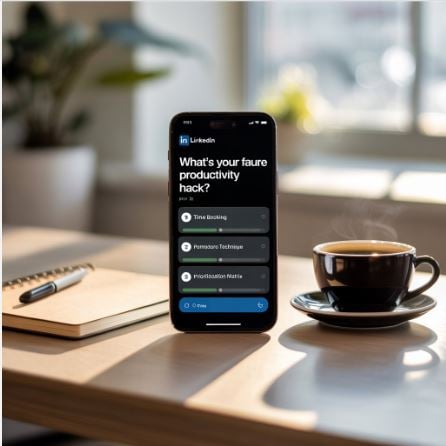
Why Polls Are Different From Other Content
For many years, posting content on LinkedIn has been quite straightforward. You casually share a link to an article, post a quick update, or even upload a photo with a long caption. Engagement used to be measured in likes and occasional comments.
However, the platform has matured, as have the users of LinkedIn. The app has become more crowded, and it’s harder to gain people’s attention because of the sheer saturation in the market.
This is why polls have emerged as a powerful tool. Unlike boring and non-interactive posts, polls don’t just invite people to react passively. It is a way of directly getting people to interact, and it’s done without making it feel forced or inconvenient.
That small shift from being passively online to active involvement changes everything. When you ask a question to others, you not only share your perspective but also give the public audience a voice to hear them out.
The Unique Advantage LinkedIn Polls Provide
Quick Engagement
The beauty of LinkedIn Polls is that they combine something so simple with something that gets an immediate reaction. People can respond in a single click, and they don’t even need to think about what to write in the comment section.
Easy Access
LinkedIn Polls come with a visibly low barrier to entry, and that’s a reason why polls consistently do better than other types of posts in engaging audiences. In addition, LinkedIn’s team has designed the algorithm to give polls that extra boost.
This means that your question can travel further if you are lucky enough. It could even reach a second or third-degree connection, which makes it an easy way to get new followers.
Provides Clear Data
Apart from the quick interactions and increased reach, the clarity of data you get is second to none. Instead of sorting through a pile of subjective responses, you get structured insights from a large sample.
Through the responses to your poll, you can also get an idea about what your audience is thinking. It provides info on how much of your audience follows along with the things you post.
What You Need to Know Before You Start Posting Polls
Before creating your first poll, it’s important to know a few key pointers that could pave the way for you. In the long run, this would help build trust and loyalty in a way that one-way communication rarely does.
First, you’ll need a clear idea of who and where you want to hear from. Not every poll needs to address your entire network. Sometimes, you’ll want opinions from potential clients, peers, or bigger firms.
With the right audience, you can create the right questions. Once you’ve got the topic noted, you have to make your poll topic clear and relevant. If it takes more than a few seconds to understand what you are asking, most people will scroll away.
Thirdly, you should always have a personal goal for every poll that you create. Try to figure out what you’ll be doing with the data. Are you developing a new idea or tailoring your idea to align with everyone’s responses?
Lastly, sharing the poll results with your audience can also generate discussions from the people who genuinely care about your topic. In this way, you continue to get responses and engagements from those who replied. Then, you can also find out things in depth while creating awareness for your brand or product.
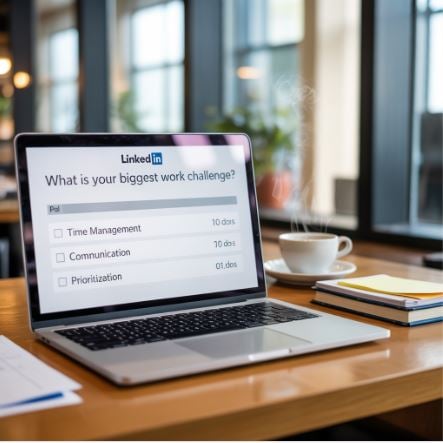
Setting Up Your LinkedIn Poll Correctly
When you’re ready to create your poll, these steps will help you set everything up the right way.
Step 1 – Create a Question
The best questions are:
- Short, preferably under 150 characters
- Clear and concise
- Relevant to your audience’s work
Clear questions attract better quality data. They also remove any chances of doubt in your mind and the audience’s mind.
Step 2- Provide Useful Answer Options
For your polls, it’s better to limit yourself to three or four options. Too many choices can overwhelm participants, and that can lead to lower responses.
Try to make each answer distinct so that they are clear enough for respondents not to get confused. Make sure your options:
- Cover the main possibilities
- Are mutually exclusive
- Don’t show bias in the outcome
- Include relevant keywords
Step 3 – Add Context to Your Post
Don’t just drop your poll on your audience. Everything on LinkedIn requires some context.
Make sure to include at least two to three lines about where your poll stems from. You can even let them know what their responses will be used for.
Having context within your polls helps your audiences feel included in something bigger. In turn, this can get them to respond more often.
Step 4 – Choosing the Right Duration
LinkedIn lets you pick from:
- 1 Day
- 3 Days
- 1 Week
- 2 Weeks
For most purposes, one week is ideal and carries a good balance between people finding your post and having enough time to reply to it.
Leaving your poll on for too long can help it get lost amongst people’s feeds. They’ll forget they ever responded to the poll, and that can ruin your chances of turning the poll into something meaningful.
Step 5 – Posting and Engaging
The work isn’t done when your poll has gone live. You have to make sure to:
- Share it with your connections
- Reach out to relevant individuals privately
- Tag experts, groups, or companies related to your niche
- Respond to comments to keep discussions going
- Analyze engagement metrics to understand your audience
Turning Poll Results Into Insights and Content
Once your poll ends, it's all about using the responses properly. Knowing this info allows you to make targeted content for specific groups within your network.
It’s easy to focus solely on the final percentages. But quite often, the real value lies in the comments that your audience leaves. These comments can reveal why people respond to your polls and what they’re thinking about your post.
You can also consider following up your content with references and summarizing your poll. This kind of follow-up shows that you’re listening to your audience and that the poll isn’t for show.
Your LinkedIn Polls can also help you segment and distribute your audience. By putting up these polls on various themes, you can see exactly what part of your audience is engaging with which topics.
Measuring the Impact of Your Polls
While watching the votes come in is exciting, it’s even more important to measure whether your polls are supporting your broader goals or not. A simple way to track the impact of your poll is to keep looking at the number of votes, comments, and shares. You’ll notice patterns for which topics gain the most traction, and by looking over the comments, you’ll get an idea about why.
You can also measure the downstream effects. This includes polls bringing in more profile views, connection requests, or inquiries about your services.
If you’re putting up polls to pique interest in new products, make sure to put follow-up posts. These follow-up posts can start up conversations about your products. By combining engagement data with business approaches, you can easily adapt your strategy and focus on the polls that truly help your goals.
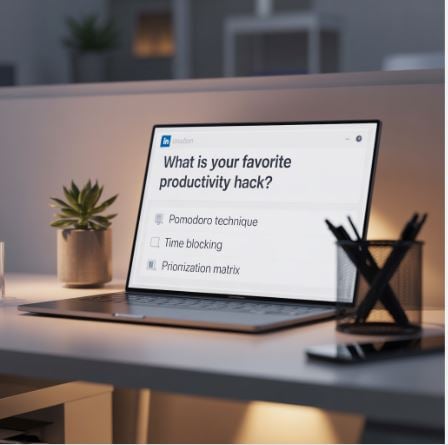
The Bottom Line
By now, you’ve learnt how LinkedIn Polls are more than just a trendy engagement tool. They are a direct line into the minds of your audience. In an online space where everyone is trying to be heard, polls allow you to truly listen.
They offer a low-effort yet high-reward method to gather real inputs and shape content that resonates. You can’t expect engagement unless you’re also engaging with others.
If used with the right intention and effort, polls can build deeper connections. But it’s not just about asking a question; it’s also about knowing why you are asking it and getting your audience engaged.
So, whether you’re a creator or a brand, polls give you a chance to build something that truly connects. That connection can go a long way for your reach!

Sign up for SocialWick
Login
InstagramYouTubeTikTokFacebookTwitchSpotifyTwitter (X)SoundCloudIGTVLinkedInThreadsWebsitePinterestVKApple MusicSEO
Checkout
OK

Information
Order processing usually starts within a few minutes, but some services may take a few hours or even a few days. We offer free refills for up to 90 days if needed. Our services are 100% secure and discreet, with a focus on gradual and safe delivery for your peace of mind.
Order processing usually starts within a few minutes, but some services may take a few hours or even a few days. We offer free refills for up to 90 days if needed. Our services are 100% secure and discreet, with a focus on gradual and safe delivery for your peace of mind.
Where should we send your order confirmation?
No account needed! We send your confirmation and tracking link here.
Secure checkout. We never share your email.
Have an account?•
Log in
Use your account to pay faster with your saved details.
Create account
Create an account to track all your orders in one place.
Service
+0,00
Voucher
-0.00
Total
+0.00
OK
Affiliate & Reseller Program
Customer Support
How may we help you?
General Support
Order Support
Frequently Asked Questions
1) What services do you offer?
We are a social media marketing company, and we offer a wide variety of services across several platforms that our clients can choose from. Once selected, we create a plan that fits your needs. We offer several types of services, such as followers, subscribers, likes, views, song plays, etc.
2) Is your service safe?
Yes, as we only sell real followers, likes, views, etc., and we hold every service to strict authenticity and quality standards. In order to protect your account, we deliver every order carefully and gradually. We closely monitor all our services. For more information, we strongly recommend reading our Terms of Service before you order.
3) Will I need to give you the passwords for my accounts?
No, you can keep your passwords to yourself because our services don’t need a password to influence your accounts. And if an email ever shows up claiming to be from us and asking for a password, it’s definitely not us, so please let us know right away.
4) Are the likes, followers, and subscribers real, or are they bots?
Unlike many other services, all our likes, followers, and views come from real accounts operated by real people. You won’t find bots, fake profiles, or hijacked accounts anywhere in what we deliver. Every order has to pass our strict authenticity standards, and we keep checking our quality to make sure it stays that way.
5) How fast can you deliver my order?
We will show you the estimated delivery time when choosing the service. However, this is only a rough estimate. In most cases, the services are delivered much faster. In some cases, it may take longer. We always aim for a natural and safe delivery!
6) What are your best-selling social media marketing services?
Although we have many services across most social media companies, our services for Instagram, TikTok, and YouTube are our best-selling options.
7) How do I know my account will not be flagged or banned?
We take safety very seriously. We never ask for your password, all followers, likes, and views come from real accounts, and orders are usually delivered gradually and naturally. What we can promise is careful delivery and strict quality standards. Plus a support team that’s there whenever you need us. We are not aware of a single case since 2017 where a customer got his profile banned.
8) What is the best method to communicate with you?
Do you have a question or run into a problem? Our customer support is available 24/7 for you. Just click Contact and you’ll land right on the support form. When you buy one of our services, we will email you to see if there were any problems. Your satisfaction is our main priority.
9) Are there discounts for large orders?
Yes! If you would like to request a large order that isn’t on our ordering layout, we will have no problems accommodating you. Just reach out through the support form and we’ll put together a buying plan that fits what you need.
10) What methods of payment do you accept?
We accept all forms of credit and debit cards, as well as Klarna, eps, PayPal, and Crypto.
11) If I am unsatisfied with your services, am I able to receive a refund?
Yes! Every purchase comes with a 30 day money-back guarantee. Not satisfied? Just contact our support within 30 days of your purchase and send us your order details and a short note on what went wrong, and we’ll take a look at your case. The full conditions are in our Refund Policy.
12) I haven’t received my order
Please make sure the following criteria are met before placing an order to make sure we can deliver it successfully.
- Your account is set to public
- You have typed in the correct username or link
- You have not changed your username before the order’s completion
- The post or account still exists and has not been deleted
- The post or account has not been restricted or removed in some countries
- Allow the estimated delivery time for completion of your order
For further assistance, please message our support team through the contact form.
13) How can I request a refill?
Just send us a refill request through the contact form. Please note that we can only provide you with a free refill within the first 90 days of your purchase.
Learn More
What is SocialWick?
We are the leading marketplace for social media promotion. You can buy followers, likes, views, subscribers, and a lot more for almost all social media networks. We offer affordable prices without making any compromises in terms of the service quality. We have a strict policy to only sell social media signals from real people. Part of our engagement, for example, comes from ad-based promotion where real users discover the content through ads. Bots, fake profiles, and hijacked accounts have no place in our services. Every delivery has to meet our authenticity standards, and we run regular quality checks, and anything that does not meet them is removed from our catalog. Our services are available for personal use, whether you want more Instagram likes, TikTok followers, YouTube views, or something else for your own profile.
With over a million satisfied customers, SocialWick is the go-to platform for all your social media needs. Our services are discreet and secure, with gradual and careful delivery to keep your social media accounts safe.
About SocialWick — The Market Leader since 2017
With more than 10 million orders, SocialWick is one of the world’s biggest social media stores. You can find everything on our website to improve your presence on major social media platforms like Instagram, TikTok, YouTube, Twitter (X), Facebook, etc. We offer different types of services for several social media platforms. Your wish is our command, and whatever your goal might be, SocialWick will help you achieve it. Whether you need more likes on your Instagram photos or want to make your LinkedIn profile more popular by getting additional followers, SocialWick is there to turn your goal into reality.
Thanks to our effective services and our customer-oriented work, SocialWick has become a top player. You will not find a better service anywhere else, especially not at such affordable prices. SocialWick is operating since 2017.
365 Days Per Year Customer Service
Your satisfaction is our motivation! We’re not here just for the money; we do our work to help people find their road to social media success. And that’s why our team will do all to make sure everything goes according to plan. If there’s something wrong with your social media campaign, or worry that there might be some problems with your account, or want to learn more about how our services work, feel free to reach out. Our service staff is there for you seven days a week, ready to answer any of your questions. You can get in touch with us using the contact form on our website.
Buying Followers and Likes is Essential
Unless you’re Kylie Jenner, you definitely need some help with social media. The more followers you have on Instagram, TikTok, Twitter (X), or YouTube, the more people will automatically notice you. Having all those eyes on your content isn’t just impressive, it’s genuinely fun. The bad news is that everyone wants to be famous these days, but only a few can succeed. The good news is that you can be the chosen one who will get social media fame and everything that comes with it. But, for that, you need a little help from your friends at SocialWick.
With our help, you will increase the number of followers on social media, which can have a domino effect and bring you even more new followers. Once people see that you got a big followership, they will decide to give you a follow. "If a profile has so many followers, it means that it’s interesting" – you can be sure this is going to be their reasoning. Furthermore, more followers mean more visibility for everything you post. Finally, a large number of followers also do great for your credibility. Our social media services will help you to create a better overall picture of your profile.
Let’s be honest; a profile with 30,000 followers looks much better than one with 74 followers. And that’s exactly what new visitors will pay attention to. A weak social media profile can be a real deal-breaker. At the same time, a fantastic social media profile can do wonders for you. And SocialWick can make your social media profile amazing!