#1 Social Media Marketplace
Accelerate Your Social Media Growth with SocialWick. Quickly gain real followers, viewers, likes & more with our blend of marketing tactics. SocialWick is known for its fast delivery, premium quality, and low prices. With over a million satisfied customers since 2017, trust SocialWick to take your social media game to the next level.
1.4 M
Customers
13 M
Orders
362 M
Followers sold
1.8 B
Likes sold
An Insider Look at How TikTok Interest Graph Actually Builds Audience
Published on 07.05.2026 by Tracey Chizoba Fletcher
Initially, TikTok could be somewhat random. You launch the application, scroll a bit, and suddenly, you are viewing the stuff that seems to be where you belong.
Productivity tips. Street interviews. Highly specific niches you did not even know existed five minutes ago.
And yet, it all feels… relevant. That is where most people stop thinking.
They assume TikTok is just “good at recommendations,” or that growth on the platform comes down to trends, timing, or luck. Post at the right moment, use the right sound, and hope something sticks.
However, that is not what is actually going on beneath. Behind that interminable scroll, there is a lot more than meets the eye. A system that does not behave like traditional social media at all.
It is at this point that the situation begins to change a little. Instagram or Facebook tend to create audiences in a typical manner, but TikTok does not. It does not rely on who you follow. It does not prioritize your network. And it does not reward you simply for having a large audience.
It runs on a completely different idea. An interest graph. It does not seem a tremendous change but it turns out to influence much.
It transforms the nature of content sharing, how individuals discover you, and why a person with zero followers might unexpectedly receive thousands or even millions of views. What tends to be ignored is what is going on beneath.
TikTok isn’t just pushing content out. It’s constantly reading how people behave and using that to figure out who should see what.
Once you see that clearly, the platform feels a lot less random. It starts feeling engineered.
What an Interest Graph Actually Means in Practice
Most social platforms are built on a fairly simple idea. Connections drive reach. You follow people. They follow you back. Your content spreads through that network. On most platforms, the more people you’re connected to, the more reach you get.
Clean. Predictable. Linear.
TikTok breaks that model completely. Instead of asking “Who do you know?” TikTok focuses on something else.
What actually holds your attention? Simple shift. Massive implications.
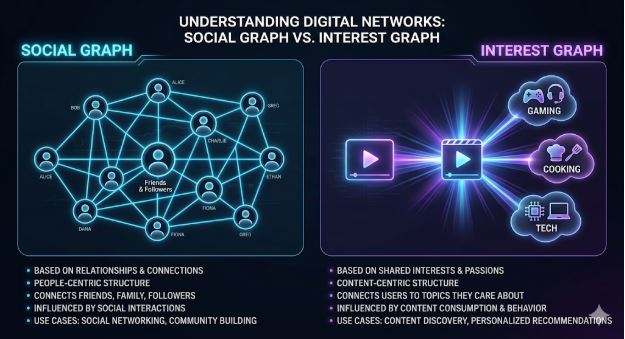
An interest graph maps behavior instead of relationships. It focuses on who is viewing, the duration of viewing, the videos being re-watched, those being skipped, and even those few seconds when one is indecisive about scrolling off.
Every micro-action matters. And over time, these actions form patterns. Those patterns are not random. They are grouped, clustered, and refined into highly specific audience segments. As shown in the comparison below, while the Social Graph relies on a web of people, the Interest Graph creates a direct highway between content and the clusters that crave it.
Let’s break this down in layers.
Layer 1: The Simple Explanation
TikTok presents people with more content that they appear to like, instead of content creators.
Layer 2: The Mechanism
The platform collects behavioral signals such as:
- Watch time
- Rewatches
- Likes, comments, shares
- Scroll speed
- Pause duration
Over time, these signals get grouped into patterns, connecting people with similar interests even if they’ve never interacted.
Layer 3: The Deeper Insight
These clusters are not static categories like “fitness” or “business.” They are fluid. They evolve. They get more precise over time.
Someone might start in a broad “fitness” cluster, but eventually shift into something far more specific, like “home workout routines for beginners” or “body recomposition journeys.” And TikTok tracks that shift.
Layer 4: The Real Implication
Your audience isn’t sitting there waiting for you. It develops as time goes by, based on the way individuals respond to what you post.
DataReportal reports that people spend more time on TikTok than on the majority of other sites. The additional time provides TikTok with more data to utilize, and this allows it to optimize what it presents people with much more quickly. This is where the system begins to look out of place with other platforms.
Once TikTok understands a cluster, it does not just serve content to it. It actively tests new content against it.
How TikTok Tests Content Before It Decides Who Sees It
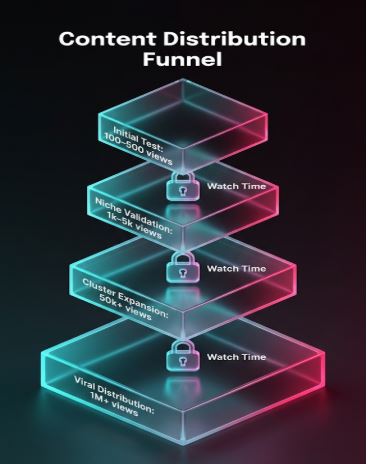
The majority believe that making posts on TikTok is like broadcasting. You post a video, and it gets viral or vanishes. That is not all about the story. TikTok is not starting with scale. It begins with testing.
When you post a video, it is first shown to a small group of users. This group is not random. It is selected based on predicted alignment with your content.
Then the system observes. Not you. The audience.
It measures:
- How long people watch
- Whether they complete the video
- Whether they replay it
- Whether they engage
- How quickly they scroll away
These signals determine what happens next. If performance is strong, the video is pushed to a larger group. If it continues to perform, it expands again.
This creates a step-by-step distribution model.
Stage Audience Size Goal
Initial Test Small group Measure baseline engagement
Expansion 1 Medium group Validate consistency
Expansion 2 Larger group Confirm scalability
Broad Reach Massive audience Push viral distribution
The part that matters more is this. TikTok isn’t just judging whether a video is good. It’s trying to figure out whether the right people are seeing it.
A video might fail not because it is bad, but because it was shown to the wrong audience cluster first. For example:
A highly technical finance video shown to a general audience may underperform, but the same video shown to a niche audience interested in investing could perform exceptionally well.
Nothing about the video changed. Only the audience did, and that changed everything. That distinction matters because it means growth is not purely about improving content quality. It is about aligning with the right audience signals early in the process.
The Hidden Signals That Actually Build Your Audience
At the surface level, it looks like likes and shares drive TikTok performance. They do, but they are not the core drivers. The real drivers are quieter, less visible, and far more powerful.
Watch time. Completion rate. Rewatch behavior. These signals reveal something deeper than engagement. They reveal attention, and attention is the core currency of the interest graph.
To see why, a little dissection would help.
On the surface
Likes, comments, shares.
These are visible metrics. They indicate interaction.
What TikTok prioritizes:
Retention signals.
- Did the viewer stay until the end?
- Did they replay the video?
- Did they pause before scrolling?
What this actually means:
TikTok is not optimizing for interaction. It is optimizing for sustained attention. It is an entirely different goal.
A video that has fewer likes but is strong in terms of watch time may perform better than a video that has thousands of likes and a poor watch time, but it reflects how the platform measures value.
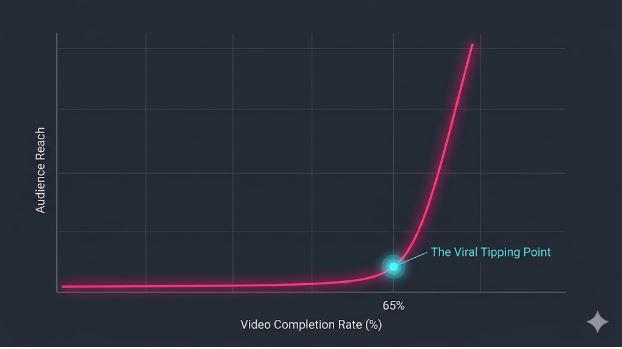
As shown in the graph above, the relationship between completion and reach isn't linear. Most videos stay in the 'testing' phase (the flat part of the curve) until they cross a specific threshold—often around 65%—at which point the algorithm identifies the content as high-value and triggers mass distribution because attention signals stronger interest than passive engagement.
Here is a simple comparison:
Metric What It Signals Importance
Likes Surface approval Medium
Comments Interaction Medium
Shares Virality potential High
Watch Time Attention depth Very High
Completion Rate Content quality Critical
According to Swydo, videos on TikTok need 75% completion or higher to receive significant algorithmic distribution. Once you see that pattern, something becomes clear.
TikTok cares less about whether people liked a video and far more about whether they stayed with it.
Why Follower Count Matters Less Than You Think
On most platforms, follower count defines reach. More followers means more visibility. More visibility means more growth. Simple.
TikTok breaks that logic. Completely.
You can have zero followers and still reach thousands. You can have thousands and still struggle to get views. That disconnect confuses a lot of creators, but it makes sense when you understand this.
TikTok does not scale accounts. It scales individual pieces of content.
Every post is treated as a new experiment. A new test. A new opportunity. Let’s break it down.
Layer 1: The Simple Idea
Followers do not guarantee reach.
Layer 2: The Mechanism
Each video is evaluated independently based on performance signals.
Layer 3: The Deeper Insights
TikTok separates distribution from social proof.
Your past success does not guarantee future reach.
Your audience does not “carry” your content.
Your content earns its own distribution.
Layer 4: The Implication
Growth is not linear. It is episodic. One video can outperform your entire account history.
That is why creators often experience sudden spikes and sudden drops because TikTok is not building a stable audience first. It is continuously redistributing attention based on performance.
According to Statista, most content consumption on TikTok comes from the For You feed, not follower-based feeds, which leads to a surprising conclusion.
You do not build an audience, then distribute content. You distribute content, then the platform builds the audience around it.
The Feedback Loop That Turns Content Into Growth
Here is where everything connects. TikTok’s system is not static. It evolves continuously.
Every piece of content you post feeds back into the algorithm, and that feedback shapes your future distribution.
The process usually unfolds in a pattern like this:
You post a video. It gets shown to a small group. It is there that TikTok monitors the responses of people, modifies them, and then determines whether to take it a notch higher.
Then the cycle repeats, but a little more accurately every time. Gradually, this begins to accumulate. With time, TikTok gets improved by matching your content to the appropriate audience. But only if your signals are consistent. And this is where many creators struggle.
Consistency is not just about posting frequency. It is about signal clarity. If your content jumps across unrelated topics, TikTok struggles to categorize you.
And when it cannot categorize you… It cannot scale you.
For example:
- A creator posting fitness content one day, finance the next, and comedy after that sends mixed signals
- The algorithm cannot confidently assign them to a specific cluster
- Distribution becomes inconsistent
Here is a simple breakdown:
Content Behavior Algorithm Response Importance
Consistent niche Strong audience matching Medium
Mixed topics Weak clustering Medium
Clear themes Faster growth High
Random posting Slower distribution Very High
Completion Rate Content quality Critical
And herein lies the point of interest. TikTok is not merely about learning about your audience. It is learning about your identity as a creator, including your patterns, positioning, and signals.
Conclusion
The interest graph is not only one of the features of TikTok, but it forms the basis of the work of the application. It helps to change the emphasis to more connections and followers, to behavior, attention, and unceasing testing of material.
Once that shift becomes clear, the way content works starts to make sense. Content is no longer about chasing trends blindly; it is about aligning with attention.
Audience growth is not about building a following first; it is about creating signals the system can recognize and scale. What matters more is this: your audience doesn’t come first; it forms around your content as it performs.
That might feel unstable at first, but it is also what makes TikTok powerful. It allows anyone to enter the system and find an audience, not through connections, but through alignment. And once that alignment clicks, growth stops feeling random and starts feeling engineered.

Sign up for SocialWick
Login
InstagramYouTubeTikTokFacebookTwitchSpotifyTwitter (X)SoundCloudIGTVLinkedInThreadsWebsitePinterestVKApple MusicSEO
Checkout
OK

Information
Order processing usually starts within a few minutes, but some services may take a few hours or even a few days. We offer free refills for up to 90 days if needed. Our services are 100% secure and discreet, with a focus on gradual and safe delivery for your peace of mind.
Order processing usually starts within a few minutes, but some services may take a few hours or even a few days. We offer free refills for up to 90 days if needed. Our services are 100% secure and discreet, with a focus on gradual and safe delivery for your peace of mind.
Where should we send your order confirmation?
No account needed! We send your confirmation and tracking link here.
Secure checkout. We never share your email.
Have an account?•
Log in
Use your account to pay faster with your saved details.
Create account
Create an account to track all your orders in one place.
Service
+0,00
Voucher
-0.00
Total
+0.00
OK
Affiliate & Reseller Program
Customer Support
How may we help you?
General Support
Order Support
Frequently Asked Questions
1) What services do you offer?
We are a social media marketing company, and we offer a wide variety of services across several platforms that our clients can choose from. Once selected, we create a plan that fits your needs. We offer several types of services, such as followers, subscribers, likes, views, song plays, etc.
2) Is your service safe?
Yes, as we only sell real followers, likes, views, etc., and we hold every service to strict authenticity and quality standards. In order to protect your account, we deliver every order carefully and gradually. We closely monitor all our services. For more information, we strongly recommend reading our Terms of Service before you order.
3) Will I need to give you the passwords for my accounts?
No, you can keep your passwords to yourself because our services don’t need a password to influence your accounts. And if an email ever shows up claiming to be from us and asking for a password, it’s definitely not us, so please let us know right away.
4) Are the likes, followers, and subscribers real, or are they bots?
Unlike many other services, all our likes, followers, and views come from real accounts operated by real people. You won’t find bots, fake profiles, or hijacked accounts anywhere in what we deliver. Every order has to pass our strict authenticity standards, and we keep checking our quality to make sure it stays that way.
5) How fast can you deliver my order?
We will show you the estimated delivery time when choosing the service. However, this is only a rough estimate. In most cases, the services are delivered much faster. In some cases, it may take longer. We always aim for a natural and safe delivery!
6) What are your best-selling social media marketing services?
Although we have many services across most social media companies, our services for Instagram, TikTok, and YouTube are our best-selling options.
7) How do I know my account will not be flagged or banned?
We take safety very seriously. We never ask for your password, all followers, likes, and views come from real accounts, and orders are usually delivered gradually and naturally. What we can promise is careful delivery and strict quality standards. Plus a support team that’s there whenever you need us. We are not aware of a single case since 2017 where a customer got his profile banned.
8) What is the best method to communicate with you?
Do you have a question or run into a problem? Our customer support is available 24/7 for you. Just click Contact and you’ll land right on the support form. When you buy one of our services, we will email you to see if there were any problems. Your satisfaction is our main priority.
9) Are there discounts for large orders?
Yes! If you would like to request a large order that isn’t on our ordering layout, we will have no problems accommodating you. Just reach out through the support form and we’ll put together a buying plan that fits what you need.
10) What methods of payment do you accept?
We accept all forms of credit and debit cards, as well as Klarna, eps, PayPal, and Crypto.
11) If I am unsatisfied with your services, am I able to receive a refund?
Yes! Every purchase comes with a 30 day money-back guarantee. Not satisfied? Just contact our support within 30 days of your purchase and send us your order details and a short note on what went wrong, and we’ll take a look at your case. The full conditions are in our Refund Policy.
12) I haven’t received my order
Please make sure the following criteria are met before placing an order to make sure we can deliver it successfully.
- Your account is set to public
- You have typed in the correct username or link
- You have not changed your username before the order’s completion
- The post or account still exists and has not been deleted
- The post or account has not been restricted or removed in some countries
- Allow the estimated delivery time for completion of your order
For further assistance, please message our support team through the contact form.
13) How can I request a refill?
Just send us a refill request through the contact form. Please note that we can only provide you with a free refill within the first 90 days of your purchase.
Learn More
What is SocialWick?
We are the leading marketplace for social media promotion. You can buy followers, likes, views, subscribers, and a lot more for almost all social media networks. We offer affordable prices without making any compromises in terms of the service quality. We have a strict policy to only sell social media signals from real people. Part of our engagement, for example, comes from ad-based promotion where real users discover the content through ads. Bots, fake profiles, and hijacked accounts have no place in our services. Every delivery has to meet our authenticity standards, and we run regular quality checks, and anything that does not meet them is removed from our catalog. Our services are available for personal use, whether you want more Instagram likes, TikTok followers, YouTube views, or something else for your own profile.
With over a million satisfied customers, SocialWick is the go-to platform for all your social media needs. Our services are discreet and secure, with gradual and careful delivery to keep your social media accounts safe.
About SocialWick — The Market Leader since 2017
With more than 10 million orders, SocialWick is one of the world’s biggest social media stores. You can find everything on our website to improve your presence on major social media platforms like Instagram, TikTok, YouTube, Twitter (X), Facebook, etc. We offer different types of services for several social media platforms. Your wish is our command, and whatever your goal might be, SocialWick will help you achieve it. Whether you need more likes on your Instagram photos or want to make your LinkedIn profile more popular by getting additional followers, SocialWick is there to turn your goal into reality.
Thanks to our effective services and our customer-oriented work, SocialWick has become a top player. You will not find a better service anywhere else, especially not at such affordable prices. SocialWick is operating since 2017.
365 Days Per Year Customer Service
Your satisfaction is our motivation! We’re not here just for the money; we do our work to help people find their road to social media success. And that’s why our team will do all to make sure everything goes according to plan. If there’s something wrong with your social media campaign, or worry that there might be some problems with your account, or want to learn more about how our services work, feel free to reach out. Our service staff is there for you seven days a week, ready to answer any of your questions. You can get in touch with us using the contact form on our website.
Buying Followers and Likes is Essential
Unless you’re Kylie Jenner, you definitely need some help with social media. The more followers you have on Instagram, TikTok, Twitter (X), or YouTube, the more people will automatically notice you. Having all those eyes on your content isn’t just impressive, it’s genuinely fun. The bad news is that everyone wants to be famous these days, but only a few can succeed. The good news is that you can be the chosen one who will get social media fame and everything that comes with it. But, for that, you need a little help from your friends at SocialWick.
With our help, you will increase the number of followers on social media, which can have a domino effect and bring you even more new followers. Once people see that you got a big followership, they will decide to give you a follow. "If a profile has so many followers, it means that it’s interesting" – you can be sure this is going to be their reasoning. Furthermore, more followers mean more visibility for everything you post. Finally, a large number of followers also do great for your credibility. Our social media services will help you to create a better overall picture of your profile.
Let’s be honest; a profile with 30,000 followers looks much better than one with 74 followers. And that’s exactly what new visitors will pay attention to. A weak social media profile can be a real deal-breaker. At the same time, a fantastic social media profile can do wonders for you. And SocialWick can make your social media profile amazing!