One of the factors that will determine the success level of your YouTube channel is the choice of keywords. However, choosing the right YouTube keywords takes more than just typing your target terms on YouTube and waiting for the platform to provide keyword suggestions. While that is a good step toward identifying the keyword, you need to dig deeper to determine whether it is worth the time and effort. This is why mastering keyword research for YouTube is essential for beginners.

Two of the most important metrics to consider when analyzing your keywords are the search volume as well as the competition level. If you choose a keyword with zero search volume, it means nobody will watch your videos even if you rank on the first page of YouTube. On the other hand, you can choose a keyword with a high volume of searches but with very many authoritative channels targeting it, meaning it becomes difficult to rank your videos. That is why, in this article, we provide you with a guide on finding keywords you can easily rank for and that have a considerable search volume.
Understanding the Sweet Spot for Keyword Research for YouTube
The foundation of YouTube SEO is keyword research, as this is one of the key factors that will determine if your posts reach their targeted audience or stay hidden in the search results. YouTube SEO differs from traditional SEO in that the algorithm considers not only the keyword relevance but also engagement metrics. That means there is a need for creators to balance search volume as well as lower competition.
The sweet spot for top YouTube keywords is those that contain a high volume but little competition. In most cases, these keywords can have over 1000 searches, but with fewer than 50 videos competing for them. The goal of the analysis is to reveal audience demand, while the competition level aims to identify the chances of ranking for the keyword. It is also important to ensure that the keyword aligns with the search intent. When all these factors work together, you can have a good chance of ensuring that your videos remain visible consistently and your channel grows.
Understanding Keywords with High Volume of Search but Competition is Low
Keywords with a soaring search volume are often those with over 1000 searches, an indicator of genuine interest from the audience and their desired content. The keywords can include trending topics, evergreen themes, or broader topics that reflect a steady search pattern. On the other hand, low-competition keywords can have fewer than 100 videos targeting the keyword.
In addition, you need to pay attention to:
- Gaps in the way the top videos cover the keywords.
- Low engagement from top videos.
- Poor quality of production from the top video.
- Outdated information.
When you notice these factors, it shows there are possible ranking opportunities. However, the goal should be to ensure that the search volume matches a competitive positioning. Check keywords that meet the criteria above.
Top Ways to Find Little Competition Keywords
Now that you understand what low-competition keywords are, let us look at some of the top ways to find low-competition, high-search-volume YouTube keywords.
Use Keyword Research for YouTube Tools
There are many keyword research tools for YouTube that can help you find low-competition keywords. To find them, all you need to do is enter the seed keyword, and the tool will generate several keyword ideas for your videos. One of the major benefits of these tools is that they also provide important data on keyword difficulty. Therefore, all you need to do is select a keyword with a difficulty ranging from low to medium and with a considerable search volume.
YouTube Autosuggest Tool
In most cases, low-competition keywords are keywords consisting of a phrase of questions with a couple of words. For instance, while the keyword "weight loss" may be hard to rank for, a phrase like "home workout tips for beginners" can be easier to rank for. That means if you want to find something easy to rank for, you can use the Google autocomplete feature.
To do that, all you need to do is enter the keyword on YouTube and let the platform suggest other long-tail keywords that users are looking for. For instance, when you search for the keyword "weight" on Google, you get suggestions on what people are looking for, as illustrated in the image.
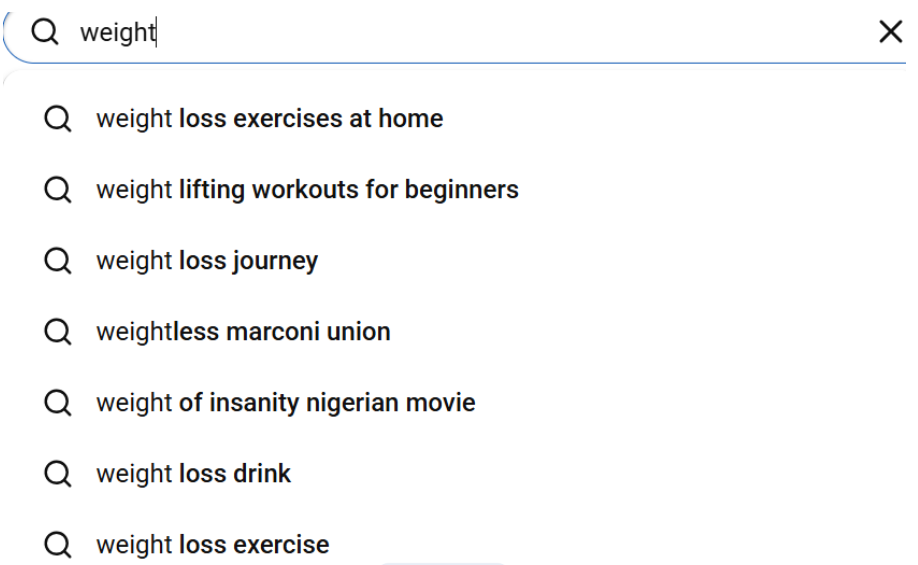
These are already keywords that people are looking for. They can, therefore, be part of your YouTube video ideas.
Niche Community and Forum
Forums such as Quora and Reddit can provide important insights into trending topics and valuable questions in your video niche. For instance, if you are in the workout niche, you can find keywords in subreddits such as r/fitness or r/homeworkout. Go ahead and filter your keywords by "hot" and "new" to discover trending topics.
You can also use a custom YouTube search using search modifiers like how, what, when, and where. You can then enter the results into a keyword research tool to get data on the search volume for each month as well as the keyword difficulty.
Organic Competitor Tracking
You can also discover little-competition keyword ideas by tracking your organic competitors on YouTube. This involves entering your organic competitors' data into an organic tool to find low-competition keywords.
How to Evaluate Low-Competition Keywords
After finding the keyword ideas, you need to evaluate them before using them in your content strategy. Here are the criteria you can use to evaluate your keywords:
Keyword Difficulty
As we noted earlier, at times you can have a keyword with a high volume of searches but one that is difficult to rank for. This is why you need to analyze the keyword difficulty. The good thing is that keyword research tools, such as VideoIQ and TubeBuddy, feature a keyword difficulty metric that shows you the possibility of ranking for a keyword.
While this metric may be inaccurate, it can provide some insight into the chances of ranking for the keyword. Therefore, use the metric you find in these tools to determine the ease of ranking for the keyword. For instance, you can check the video ranking for the keyword to see the chances of outranking it.
Track the Emerging Topic
In most cases, emerging keywords can also be a gold mine because of their lower competition level. This is because there may not be enough videos targeting the keyword. You can find more of the keywords by looking at the trending themes on platforms like X and Reddit. You can also use a tool like Google Trends for a wider reach.
Search Result Analysis
Analyzing the search results can provide insights into the competitive landscape of the keyword you find. If you find that the top result consists of high-quality videos from top channels, you may need to target a long-tail keyword that may be easier to rank for your size.
Check Related Keywords
Related keywords can also help you uncover extra opportunities to create more videos. Use the YouTube search suggestions, keyword research tool, and related video recommendations to find keywords that are related to the primary keyword.
Check Keyword Content Gap
Content gap analysis involves tracking whether the videos covering the topic fully cover the keyword. You can check for content gaps by looking at videos that are poorly produced, edited with incomplete information, outdated advice, or don't completely cover the topic.
Use Multiple Data
To comprehensively validate a keyword, check different data sources to get information on volume trends, audience demographics, and seasonal patterns to ensure the keyword ranking potential is sufficient.
Cover the Trending Topics
If you want to drive traffic, you will need to create videos on trending topics. People are always searching for trending news. When they see your videos on trending topics, they will stop to watch. Additionally, platforms also promote trending content, increasing the visibility of your video.
Balancing Keyword Research with Lasting Opportunity
For your keyword research to be effective, you need to ensure you are balancing your keyword research with lasting goals. Therefore, your focus should be on increasing topical authority by consistently covering other secondary keywords, instead of creating several unrelated topics that may leave your audience and the YouTube algorithm confused. To get the lasting growth opportunity, there is a need to understand that the keyword difficulty is constantly changing.
Even when some keywords may look difficult for your channel today, as you gain authority in your category, they may become reachable. On the other hand, a term that may have little competition today can become saturated in the long run. Therefore, plan your keyword research to align with your channel's growth trajectory.
A good idea would be to mix your keywords to include quick-win terms alongside aspirational targets and evergreen topics. Such an approach can ensure you have a steady flow of traffic.
In Conclusion
Growing your YouTube channel organically can be a cost-effective strategy. However, with reports indicating that over 500 hours of YouTube content are uploaded every day, the competition for organic visibility can be tough. Therefore, use our detailed guide to find low-competition keywords you can easily rank for.
