AI has had a tremendous impact on SERP rankings. Unlike in the past, when Google would recommend your site to answer a search query, today, Google AI overview will answer the question without the need for users to click on your website link.
That also means you need to change your SEO strategies to increase your chances of your site getting cited in the AI overview. This guide will examine the impact of Google AI and how to rank highly through generative engine optimization.
What is Google AI Overview?
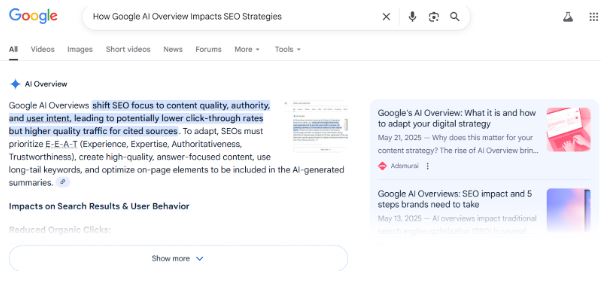
Google's AI overview is a snippet feature on Google Search that provides a conversational and summarized answer at the top of the results by gathering information from different sources, and includes links to those sites to enable users to explore the web more.
The framework, powered by the Gemini model, offers quick insights into complex topics. These AI overviews will, in most cases, appear where the search engine determines that a generative response is needed. However, Google still provides answers in the traditional search results below the AI overview. Therefore, there is a need to combine this with other tactics, such as using social media for SEO.
The State of the Google AI Overview
When AI overviews were first introduced in May 2023, they were quickly known as Search-Generative Experiences. According to a Spark Toro study, 58% of Google searches do not result in a click. This means that users no longer need to click on a website to find the information they seek.
With the continued expansion of Google AI, this trend is expected to grow further, resulting in reduced organic traffic and diminished effectiveness of SEO tactics. Another study indicates that AI overviews appear in 47% of searches, mostly on informational keywords.
However, while AI overviews impact SEO, they make it possible for brands to adapt. With Google's market share at approximately 90% and search volumes growing by 21% in 2024, four times the rate of ChatGPT, this suggests that SEO isn't dead but is evolving. You, therefore, need to have a new strategy for SEO and SEM. If your business is to thrive, it needs to also optimize for generative engines such as ChatGPT and Gemini.
How AI Overview Has Transformed SEO
Here are ways in which AI overviews have impacted SEO:
A Drop in Organic Clicks
According to a Semrush study on over 10,000 keywords, there was a significant reduction in both organic and paid click-through rates. Another MOZ study noted that AI overviews reduce organic traffic by 18%, primarily for informational keywords.
If your business relies on organic traffic to generate revenue and leads, the shift can be a source of concern. If users don't have to click through to find the information they are searching for, this will result in fewer visits, ultimately leading to lower revenues.
So, how can businesses adapt to this challenge? Here are a few tips:
Create Content That Can't Be Condensed
If you are trying to compete with AI, you might not succeed. This is why you need to create content that cannot be condensed or replicated by AI. When doing so, ensure that you provide value beyond the quick answer. Instead, you can give deep and original real-world applications.
Enhance Your Content with Depth and Complexity
One of AI's strong points is summarizing articles, but when you create deep and in-depth content, it will struggle to do so. When you have comprehensive content backed by expert content and explore different angles of a topic, it can be hard for your content to be replaced.
Use Unique Data and Original Research
AI models tend to get their information from current sources, which also means they are unable to create new data. When you add original proprietary data and research to your website, you are offering something that AI cannot replicate. Therefore, take the time to run experiments, conduct surveys, and offer firsthand insights that will make your content more valuable and harder for AI tools to summarize.
Add Real-World Applications through Case Studies
One way to add value to your readers and create unique content is to showcase real-world applications using case studies. AI-generated summaries offer some generic information, but they fail to capture real-life experiences. When your business shares in-depth success stories, failures, and lessons learned, it can provide more practical information that is both engaging and credible.
Adding a Step-By-Step Guide
AI may be effective for creating general guidelines, but they are often unable to guide users through some complex problems precisely. A good idea would be to create content consisting of clear and actionable steps. These can be especially useful when combined with interactive elements, such as video tutorials and screenshots, which can help to increase your retention and engagement.
Optimizing for the Featured Snippet
There is no doubt that an AI overview dominates search results. You can also use it to capture attention. To do that, you need to structure your content in a way that ensures Google can feature it.
This method utilizes bullet points, clear subheadings, and concise answers. Doing this, combined with a good long-term content strategy, will enable your business to remain visible in the AI overview.
Your Brand Can Be Misrepresented in an AI Summary
As noted earlier, the AI overview often results from information from different sources that do not consider the context or include all the essential details. This may misrepresent your brand mentions, which can cause lower trust, and businesses may end up losing control of how they are perceived in the search results.
The good news is that there are steps you can take to maintain control of your brand. You can use AI-friendly summaries for your content structure since AI focuses more on content that can be easily summarized and extracted. That means you need to have some clearly defined sections highlighting the key takeaways, such as:
- Considering AI overviews as citations. Ensure that your article is written clearly and helpfully, prioritizing concise and informative content. Therefore, ensure you have clear examples and explanations that do not require lengthy filler paragraphs. There are also suggestions that AI overviews consist of a header hierarchy that extracts essential information.
- Use structured data to reinforce important information. Formatting also matters, as AI overviews use the header hierarchy to extract important information.
- Schema markup assists search engines in understanding the content of a page more accurately. You should have structured data defining your product benefits, brand values, and USP (unique selling propositions).
- Add the USP and brand value early in the process. The first part of a webpage or article is where AI gets information. Ensure that you include your core value propositions, differentiators, and mission in this section to increase the chances that AI will incorporate this information.
- Add authoritative content from authoritative sources. When you ensure consistency across different platforms, you can position your business as an authority and reinforce your messaging. Use PR mentions, guest posts, and collaborations with authoritative websites in your industry to position yourself as an authority in your niche.
Why Authority Signals Matter More Than Ever
As noted in the earlier section, Google recognized the importance of authoritative content, making it harder for newer and smaller sites to be seen. Since AI-generated stories are usually from the sources Google considers trustworthy, your business may end up getting overshadowed by authoritative sites.
According to Google's search quality guidelines, the search engine prioritizes EEAT (Experience, Expertise, Authority, and Trustworthiness) when ranking content. This is the same principle as the AI overview, which means authorities, industry leaders, and government websites are favored. There are several tips you can use to increase authority in your niche. These are:
- Get backlinks from authority sites. This can serve as an endorsement of your website, making it appear more credible in the eyes of major websites. Therefore, take steps to help you focus on major publications, industry blogs, and learning institutions.
- Create thought leadership content. If your content has expert insight, you can increase its perceived value. Create thought leadership content such as whitepapers, reports backed by research, and in-depth articles.
- Add the author's bio. When you highlight the credentials, you can position yourself as credible.
- Industry collaborations. You can partner with experts for interviews, guest posts, and co-authored content. When you are featured or cited, you increase the likelihood that AI will consider your website credible.
- Keep your content updated. AI prefers well-supported and relevant content. When you regularly update your posts with the latest citations, reports, and statistics, you can easily stay competitive in the search results.
In Conclusion
AI overviews have transformed how Google delivers information. That means businesses also need to adapt their SEO strategies to optimize for the AI overview. They can achieve this by creating high-value, AI-resistant content and positioning themselves within their niche. If you are wondering how to do this, follow the steps above.
