Undoubtedly, AI is changing the rules for various fields, including content generation, video creation, and even SEO. Unlike in the past, when internet users searched Google for information, today, they are using AI to provide answers to their search queries. That means it's no longer enough to rank on the search engines.
Instead, you also want to appear in the results for AI to drive traffic to your site. This is the essence of Generative Engine Optimization (GEO). This marketing strategy focuses on helping brands and their content appear in AI-generated answers from different generative engines, such as AI overview on Google, ChatGPT, and Perplexity. This guide will take you through everything you need to know about generative engine optimization and provide actionable tips for appearing in AI search results.
What is Generative Engine Optimization?
Generative engine optimization (GEO) is a current SEO method designed to help your content show up in AI search results from AI answer engines, such as ChatGPT, Copilot, and Gemini, as well as in search results powered by search features, including AI overviews on Google and summaries that are AI-powered on Bing.
GEO differs from traditional SEO because it doesn't focus on appearing in the organic search results. Instead, it aims to adapt content to the methodology used by generative engines to discover, interpret, and deliver information. It consists of elements such as natural language formatting, structured data, and keywords (long-tail) to increase the chances of your content being summarized, cited, and recommended by the AI system.
Unlike SEO, which focuses on content optimization, GEO aims to ensure that your content appears in the AI-generated answers using holistic approaches such as:
- Ensuring that content is published in the right places where it is more likely to be discovered.
- Leveraging positive brand mentions on the web, even where there are direct links.
- Providing technical accessibility. This ensures that AI crawlers can access and even understand your content.
Rather than focusing on traditional rankings, your goal is to ensure your brand appears in the AI-generated answers and shapes the conversation in AI search results. For instance, since AI tools use a conversational language, you can focus on using such a language.
Statistics Showing the Importance of GEO
Traditional search engines still dominate search results and are likely to continue doing so in the foreseeable future. However, there is a shift in the way people discover content. AI has redefined how SEO is conducted, and now the primary goal may no longer be to rank in the top search results. Website masters may instead aim to appear in the recommendations of the AI tools.
The importance of GEO is backed by data, as statistics indicate that ChatGPT was the fastest app to reach 100 million users in history. As of September 2025, it has a strong user base of over 400 million users per week. Additionally, Google's AI overview now appears in around 13% of all SERPs. Since generative AI also influences your audience, it makes some sense to begin optimizing for them.
The Interception of SEO and GEO
According to the above definition, GEO is essentially SEO with a different name. There are definitely many similarities. Additionally, GEO doesn't replace your SEO strategy; it redefines how content discovery works on creative tools, social media platforms, and other platforms beyond traditional SEO.
However, it also means that good SEO is the foundation of GEO. Therefore, GEO optimization involves taking different actions, such as:
- Creating top-quality content for your audience.
- Enabling search engines to access and understand your content.
- Earning great mentions on different social media platforms.
The same elements help AI engines determine which brands to reference. With AI working like Google, you need to adjust some of your SEO tactics and the metrics you track.
Steps in Optimizing for GEO
Since GEO is a relatively new concept, how AI engines process and prioritize content remains unclear. However, you need to change your traditional SEO strategies to focus on generative GEO. That said, here are the steps to follow in GEO.
Understand the SEO Basics
As noted earlier, GEO follows the basics of SEO. However, it goes beyond the steps used in SEO. During your basic SEO, you must also focus on a few things to improve your GEO. These are:
Have a Bot-Crawlable Site
To make it easier for AI bots to discover your content and show it in their results, ensure that your site:
- Is indexable and crawlable. Unless the AI tools can access your page, they will not be able to provide answers.
- Loads fast and is mobile-friendly. A slow, clunky site will hinder the user experience, lowering your chances of being cited.
- Uses HTTPS. If you want your site to build the trust of users and AI tools, you must keep it well-secured.
- Server site rendering. JavaScript can make some sites struggle, underscoring the need for server-side rendering instead of client-side rendering.
Show Your EEAT
Unless the AI tools consider your site trustworthy, they will not cite it. EEAT means:
- Experience. Showing personal use and real results from first-hand experience.
- Expertise. Demonstrating your knowledge of the topic and going deeper into it. This involves creating thought-leadership content to position you as an authority in your niche.
- Authority. Other sites are quoting you, contributing to high-authority sites, or posting guest content.
- Trust. Use the authors' real bios, cite the sources, and include the testimonials and reviews of the sites.
While AI tools may not have a system to detect EEAT, there is no doubt that authentic content will be prioritized as it offers a better user experience and makes the tools more credible. In fact, according to one generative AI study, improving your EEAT can increase visibility in the AI results and your overall SEO ranking.
That means when your website pages are seen as helpful and trustworthy, search engines will reward them with higher visibility and better citations in AI-generated snippets. To boost your EEAT signals, you can use different tips such as:
- Adding certifications, case studies, awards, and years of experience to show your expertise and trust to your current audiences.
- Use an authoritative tone in the content.
- Use statements and quotes from trusted sources to support your claims and position yourself as a thought leader.
Build Your Mentions
Traditional search engines such as Google interpret backlinks as a sign of credibility. However, AI systems don't check the backlinks to determine authority. Instead, they consider brand mentions even when they don't include a clickable link. While backlinks are still crucial in SEO, this illustrates the need for another tactic to build an online presence.
Audit Your Mentions
Carry out an audit of the areas where you are currently mentioned. Pay attention to your brand name, product name, and team members' online presence on social media, Google, and industry forums. Ensure that you understand what people are saying. You are supposed to discover mentions you didn't know existed. While some may be positive, you may find others that are neutral, and others that require your attention.
You can conduct a brand name and the related terms on AI tools to find out:
- Is Google AI mode citing your brand for the relevant terms?
- If ChatGPT understands your team members.
- The sentiments obtained from the answers to the questions about your brand. You can utilize AI tools to enhance your brand's sentiment.
Build Quality Backlinks
We already noted the importance of mentions in GEO. However, this does not mean you should ignore traditional link-building methods. Since backlinks matter in SEO, they can result in mentions from authoritative sources, boosting your authority with AI tools. Make sure you do more than just get the links.
Clearly Answer the Search Intent
The summaries that are AI-generated in the search results aim to ensure users obtain the answers they are looking for. Therefore, answering the search intent fast, concisely, and succinctly is a good way to improve your visibility in the AI search results. This will help in two ways.
First, it is easy for AI systems to have a page crawl and extract the information needed to generate the summary. This also improves your opportunity of getting quoted in the AI summary or Overview, enhancing your visibility.
Target Longtail Keywords
Longtail keywords ensure ranking for comprehensive search queries. In most cases, these use language that is conversational, and better understand how people use deep queries for their search engines.
Overviews that are AI-powered are typically designed to break down complex queries. That means when you target the long-tail keywords, you improve your chances of visibility in the AI search results. This is because you can easily match the cadence and wording of the queries that need AI summaries.
Create Relevant Content
AI chatbots and engines are typically designed to assist people by providing relevant and helpful information. Relevant content increases your chance of appearing in the answers, prompting people to use it to find information pertinent to your business. Therefore, create a content strategy that provides readers with helpful information.
Focus on Multiple Platforms
For a long time, SEO specialists have advised users to leverage other platforms beyond Google. However, this has gone a step further with the advent of AI, as various search platforms, including YouTube and Reddit, also use it to enhance search results. The primary benefit of going multi-platform is that you can establish a strong brand presence. On top of that, you can reap other benefits such as:
- Reaching your target audience. By being active on different platforms, you can easily get your audience where they are. In return, this will help you increase engagement, brand awareness, and conversion.
- AI tools consider more than Google search results. Instead, they will get responses from social media, YouTube, forums, and other places outside the traditional SERPs.
- You are less exposed to algorithm updates when active on multiple platforms. Diversification is, therefore, a sound business practice.
To have a strong presence on multiple platforms, use the following tips:
- Have a YouTube channel. Create content that people want to see succeed on YouTube, such as product reviews, in-depth tutorials, and comparisons. You can incorporate them into your YouTube content.
- Transcript and podcast content are now showing on Gemini, which means you can increase your AI visibility by building a presence here.
- Instagram Reels and TikTok are used as search engines and are, therefore, great tools for reaching a young audience. Short-form videos featuring industry questions can improve your discoverability. In fact, AI tools commonly cite these in their answers.
- Have a presence on Reddit. AI tools cite Reddit as one of the most valuable sources, especially for user-generated answers on AI overview. That means you must have a presence on Reddit to be cited by AI tools. You can find your industry-specific subreddits and offer genuine, helpful advice when people ask questions related to your industry. However, you must avoid overpromoting your business and focus on being beneficial.
- Have a presence on LinkedIn. LinkedIn works similarly to Reddit, but for B2B topics. Therefore, use the platform to publish well-thought-out posts and engage in relevant discussions to position yourself as a professional in your niche. The AI systems will quickly pick the interactions.
Consider What AI Systems Are Citing
Understanding the types of content AI systems cite in your niche is a great way to identify the topics you should create and cover. To better understand AI tool responses, consider which questions are relevant to your business. You should directly test if your content already appears in the AI tools.
Visit ChatGPT, Perplexity, or Claude and ask the questions related to your niche. If you realize that the AI tools provide answers in the form of videos, consider that as an indicator that you should focus more on video content.
When doing that, make sure you are closely paying attention to:
- Whether the competitors are regularly getting mentioned.
- The platforms the tools are citing.
- The sentiments behind the mention of your brand and its competitor.
When doing this test, use different variations of similar questions. You will notice that this will change your answer and the sources mentioned. To simplify the process, you can leverage AI tools such as Peec or Profound AI. Though they can be expensive, the platform will run various prompts in bulk, helping you understand when and how your brand looks.
The information you get will help you understand the type of GEO content you should focus on.
Respond to Your Audience's Questions
AI searches are considerably different from traditional searches, and you need to account for this when planning content to appear in the Google search results. In Google searches, you focus on a particular keyword you want to rank for. For example, if you are a massage parlor, you might focus on ranking for the keyword 'massage parlour' in Salt Lake City, assuming that is your location.
What about when someone is searching for a query like "Do full body massages include private parts?" The answer can include details of the process of a full-body massage. You will get two sets of content types and answers when running these two queries on Google SERP.
In the first query, you can retrieve a list of massage parlors in Salt Lake City, categorized by options such as whole body, top-rated, male-to-female, open now, and top-rated. But the results for the second query, "do full body massages include private parts?" consist of articles around the topic, forum results, etc. This means the answer format consists primarily of broad information about the subject.
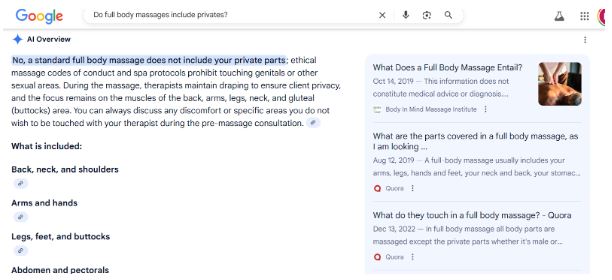
In the AI era, users realize they can use longer queries to get more contextually and conversationally relevant answers. This is why you need to analyze the intent further. The AI era has also provided a unique opportunity for longer and more specific queries. The majority of brands focus on SEO keywords, thereby ignoring opportunities presented by long-tail keywords.
If you optimize for a specific question, your chances are higher that the AI systems will show your page. Therefore, ensure you optimize for long-tail queries directly related to the expertiser and product. You can change the challenge by deciding which longtail keywords to optimize. There are several ways to divide that:
- Listen to the actual customer queries. You can get these queries by paying attention to your sales calls, user feedback, and support tickets. You will answer the questions for most people since these are the same questions asked of the AI tools.
- Community platforms. Platforms such as Reddit, Quora, and other industry forums can help you get answers to the queries people are looking for.
Use Generative AI Content Structure
AI systems process information differently from humans, as they analyze chunks of information before analyzing the relationships between different pieces. It's a more granular form of featured snippet that delivers better results for direct questions. That means how you structure your content will impact AI systems' ability to understand and even cite more effectively.
So, how do you structure your content to align with generative AI's structure? Here are tips:
Have One Idea in Each Paragraph
Ensure you write in short paragraphs, all focusing on one main idea. Combining multiple concepts into a single paragraph makes it harder for the AI system to extract the exact information it needs.
Make sure the key information isn't buried in long paragraphs or sentences. Instead, place your key points at the start of each section to make them easier to extract and find. This will make it easier for humans to read and understand your articles.
Include Clear Statements and Quotes
AI systems love quotes and clear statements. According to a study, pages with statistics or quotes have a 30% to 40% higher chance of appearing in the AI answers. Therefore, instead of saying that "eating your last meal before 7 p.m. is an effective weight-loss program", you can say something like, "People who take their last meal before 7 a.m. lose 30% more belly fat than those who don't."
Clear Headlines and Subheadlines
Headings and subheadings help you organize your content more logically. This is because they act as signposts that help LLMs and humans find the information. Therefore, use headlines to summarize the info under them. SEO specialists use a proven method to appear in the featured snippet: an H2 tag for the query, followed by content that answers the query.
This is a good strategy for traditional SEO. Regarding GEO, you should have a similar plan for all content. However, don't put all your H2s in the form of queries, as the piece will look over-optimized. You must ensure all your articles have logical headlines clearly linked to the headings.
When explaining a several-step or complex process, numbers and clear transitions between parts are clear. Doing that will make it easier for the AI systems to capture the individual steps and the clear transitions between the different parts. When you do that, AI tools can cite the outlined steps when someone asks for the process. This will also offer a better reading experience.
When writing about complex topics, use clear, concise summaries. This is important because AI systems use this digestible information when conveying information to users.
Leverage Schema Markup
Just as humans love well-organized content, machines also do. One way to organize your content is through schema markup, code that helps machines understand the information you are presenting. For instance, the FAQ schema can help the algorithm address common questions. Even if you aren't a developer, many CMS systems, such as WordPress, can enable you to add them automatically.
Format Your Content Better
Better formatting, such as bolding, can help highlight important information and conclusions, making it easier for readers to skim. This can enable AI systems and human readers to find the key information. The main goal is to ensure that your content is accessible to both machines and humans.
If your content is well-structured, it will perform better for different search queries. Additionally, well-structured content can increase the chances of converting visitors to your site.
Final Thoughts
While traditional SEO still works, a new kid on the block is GEO. Generative Engine optimization reflects the changes in how wary people search for information and ensures that your pages appear in AI search results. By following the steps outlined in this guide, you can have your site cited, mentioned, and trusted by AI specialists.
