#1 Social Media Marketplace
Accelerate Your Social Media Growth with SocialWick. Quickly gain real followers, viewers, likes & more with our blend of marketing tactics. SocialWick is known for its fast delivery, premium quality, and low prices. With over a million satisfied customers since 2017, trust SocialWick to take your social media game to the next level.
1.4 M
Customers
13 M
Orders
362 M
Followers sold
1.8 B
Likes sold
How Often Should a New Social Media Account Post
Published on 18.08.2026 by Tracey Chizoba Fletcher
The question of posting frequency plagues many aspiring content creators. When you are growing a new social media account, deciding how often you should post to gain traction can be quite tricky. The answer to that pervasive question is that it depends. What works for one account may not work for another, and posting frequencies may not even translate across different platforms.
There is no universal answer on how often you should post on a new social media account. Generally, posting frequency for a new account will depend on the type of content you make, the platform you will post it on, and your content creation pace. Posting too often may cause content quality to fall, while a slow posting schedule could hamper your efforts to gain algorithmic momentum.
This guide will cover some of the factors you should consider when you plan out a content calendar and cadence. Ultimately, you want a posting cadence that gives you enough room to create high-quality content without losing any momentum made from previous posts.
Why There's No Universal Posting Frequency
There is no standard posting frequency because social media platforms, creators, and users aren’t monolithic. Each platform has a unique ecosystem and best practices that determine how people and algorithms interact with content. Algorithms on different platforms will weigh and reward posting frequency differently, meaning new content creators have to take the platform into account when making posting frequency decisions.
Users will also have different expectations based on the platform and niche. For instance, Instagram users may expect new content more often than users on YouTube due to the inherent nature of these two platforms. Instagram deals in pictures and short-form videos, which can be created on a more frequent basis compared to the longer videos on YouTube. Additionally, posting frequency expectations will also vary by niche, with certain niches lending themselves to a faster schedule and others working best with a slower posting frequency.
Creator capacity also determines how often any given creator posts content. Take two creators working in the same niche and on the same platform; the first one may be able to create and post three pieces of content per week while the other is limited to just one. Factors such as additional responsibilities or the effort required to create content can determine a creator’s capacity to make content. No two creators are identical, and their differences will drive how frequently they post content on new accounts.
Recommended Posting Frequency by Platform
The first factor that will determine how often you post will be your choice of platform. This section will cover practical benchmarks for the most prominent social media platforms. These aren’t exact numbers on how new accounts should post content; rather, treat them as a general range where most creators on the platform typically operate.
TikTok and Instagram Reels
TikTok and Instagram Reels typically reward higher posting frequencies compared to other platforms. Their algorithms will favor profiles that post around 1-3 times daily because it rewards accounts that consistently feed its discovery feed. Unlike long-form videos, short reel-style videos have an extremely short lifespan; sometimes, just days.
They provide limited data signals to train recommendation algorithms before losing relevance. This means short-form platforms like Instagram Reels and TikTok reward frequent posting as it constantly provides fresh material for discovery feeds. A higher posting frequency on these platforms encourages continuous engagement and maximizes the amount of time viewers spend on the platform.
Instagram Feed and Carousels
Instagram, on the other hand, favors a lighter posting cadence of around 3-5 posts per week, which provides a sweet spot between overposting and not posting too often. Since Instagram feeds tend to be more curated, you don’t want to fatigue your followers by appearing too often on their feeds.
On the other hand, if you don’t post often enough, followers may have a hard time remembering you and your content, particularly when you’re just starting. Sometimes, Instagram will show users accounts they don’t follow on their feeds, so it’s quite easy to be lost in the noise and fade from users’ memory if you maintain a posting cadence that doesn’t keep you in users’ minds between posts.
YouTube
YouTube is an incredibly flexible platform. Some users post once a week, some post a few times a week, bimonthly, or even every few months. It all depends on the type of content you make, how long it takes you to create high-quality content, and the community you have built on the platform.
For new channels, posting once or twice a week will be enough to attract your first viewers and start building momentum. The average YouTube video will take you longer to script, record, edit, and post compared to an image or a short-form video, so this platform will require an even slower posting frequency.
Your priority should be to create high-quality videos for your channel, not posting as fast or as much as you can. Speed often comes with quality concessions, and YouTube users can be quite unforgiving of poorly-made videos. Prioritize quality and make sure your content calendar gives you the time you need to create high-quality content.
Frequency vs. Quality: Why More Isn't Always Better
You will inevitably run into the question of whether you should prioritize quantity over quality at this stage. Seeing competitors in your niche with content-packed profiles won’t make it easier. Do not fall for the temptation to churn out more content in a misguided attempt to drive traffic to your account and encourage engagement. You may be making a strategic mistake that will compound over time and stunt your new account’s growth.
Making high frequency your priority will ultimately lower the quality of your content, slowing user retention and limiting the growth of your new account. The irony is that making more content at the expense of quality almost always backfires, as users are much more likely to resonate with high-quality content.
You should prioritize a posting cadence that affords you enough breathing room to consistently produce high-quality content. For new accounts, maintaining your quality bar will always be more important than pushing out more content. High-quality content establishes your authority and expertise in your chosen niche, encourages audience engagement, and keeps them coming for more.
Prioritizing quality over quantity will also help you rank high on search engines, as they tend to reward high-quality content. If you can maintain a consistent schedule of high-quality content, you will attract both organic growth and algorithmic momentum.
How to Build a Sustainable Posting Cadence
So how can you build a posting cadence that’s sustainable and encourages growth? You don’t want a cadence that doesn’t allow you enough downtime and robs you of the enjoyment inherent to content creation. Similarly, a cadence that gives you plenty of breathing room but doesn’t allow you to build on the momentum of previous posts will stunt your account’s growth.
Start With Your Actual Capacity
The first thing to consider is your actual capacity. This refers to the time, resources, and physical and mental energy available to you. A realistic assessment of these factors will help you build a posting cadence you can sustain over the long term.
An unsustainable posting cadence would require more resources, time, and energy than you can reasonably provide. If your schedule has you posting three times a week when you have other time-consuming commitments that put you under significant pressure, or require more time or money than you can provide, your posting cadence is unsustainable. This kind of cadence will ultimately collapse in a short while and leave you burned out.
Batch Content Creation
Creating content in batches is a productivity technique many established content creators use to scale their content pipelines. It specifically allows for content creation at a higher frequency by grouping similar tasks together and doing them in one sitting instead of spreading them out.
Content batching is pretty good at helping content creators maintain consistent publishing schedules, reduce burnout, and prevent context switching. Context switching refers to abrupt changes or shifts in tone, target audience, or topic that can occur in a single piece of media when it isn’t created in one sitting.
You could design carousel graphics and images for a piece of content in a single sitting or film several short-form videos back-to-back. Batching allows you to boost your productivity and create more content without sacrificing quality.
Adjust Based on Performance Data
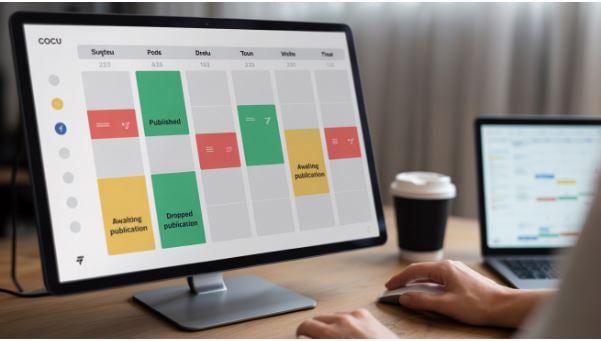
The most effective posting cadence is one that is flexible and evolves. Once you’ve created your posting calendar and started posting content, you should keep an eye on how your posts perform to help adjust your strategy. Additionally, consider spending several weeks or even months studying trends in your niche and among the top creators.
Does content posted on specific days seem to have higher rates of engagement? Do creators who post at a specific cadence perform better than creators working at a different cadence? Figuring out the days and frequencies that drive the best engagement will help you adjust your cadence as needed to keep your engagement rates high.
Signs You're Posting Too Often (or Not Often Enough)
The best posting cadence lies at the sweet spot between posting too often and not posting enough. Here are some signs that you still haven’t figured out the best posting frequency for you:
- Your engagement rates are falling even though your posting cadence has increased. (You are posting too often).
- Your followers tend to disengage from your profile between posts. (You aren’t posting often enough).
- You are struggling to maintain consistency or quality at your current posting frequency. (You are posting too often).
- You aren’t gaining any algorithmic momentum despite posting consistently (You aren’t posting often enough).
- You feel rushed, stressed, or burned out. (You are posting too often).
- You are falling behind on potential leads and missing trends and real-time conversations (You aren’t posting often enough).
Finding Your Ideal Posting Cadence
There is no universal, set number on how often you should post on social media. Each account works differently, so your posting frequency should be influenced by the platform you are posting on, the type of content you create, and the pace you can sustain without making any quality sacrifices.
Ultimately, creating a pace that you can comfortably follow while maintaining content quality is the best thing any new content creator can do. A sustainable pace will outperform a high-frequency cadence that breaks down after a couple of weeks, any day of the week.

Sign up for SocialWick
Login
InstagramYouTubeTikTokFacebookTwitchSpotifyTwitter (X)SoundCloudIGTVLinkedInThreadsWebsitePinterestVKApple MusicSEO
Checkout
OK

Information
Order processing usually starts within a few minutes, but some services may take a few hours or even a few days. We offer free refills for up to 90 days if needed. Our services are 100% secure and discreet, with a focus on gradual and safe delivery for your peace of mind.
Order processing usually starts within a few minutes, but some services may take a few hours or even a few days. We offer free refills for up to 90 days if needed. Our services are 100% secure and discreet, with a focus on gradual and safe delivery for your peace of mind.
Where should we send your order confirmation?
No account needed! We send your confirmation and tracking link here.
Secure checkout. We never share your email.
Have an account?•
Log in
Use your account to pay faster with your saved details.
Create account
Create an account to track all your orders in one place.
Service
+0,00
Voucher
-0.00
Total
+0.00
OK
Affiliate & Reseller Program
Customer Support
How may we help you?
General Support
Order Support
Frequently Asked Questions
1) What services do you offer?
We are a social media marketing company, and we offer a wide variety of services across several platforms that our clients can choose from. Once selected, we create a plan that fits your needs. We offer several types of services, such as followers, subscribers, likes, views, song plays, etc.
2) Is your service safe?
Yes, as we only sell real followers, likes, views, etc., and we hold every service to strict authenticity and quality standards. In order to protect your account, we deliver every order carefully and gradually. We closely monitor all our services. For more information, we strongly recommend reading our Terms of Service before you order.
3) Will I need to give you the passwords for my accounts?
No, you can keep your passwords to yourself because our services don’t need a password to influence your accounts. And if an email ever shows up claiming to be from us and asking for a password, it’s definitely not us, so please let us know right away.
4) Are the likes, followers, and subscribers real, or are they bots?
Unlike many other services, all our likes, followers, and views come from real accounts operated by real people. You won’t find bots, fake profiles, or hijacked accounts anywhere in what we deliver. Every order has to pass our strict authenticity standards, and we keep checking our quality to make sure it stays that way.
5) How fast can you deliver my order?
We will show you the estimated delivery time when choosing the service. However, this is only a rough estimate. In most cases, the services are delivered much faster. In some cases, it may take longer. We always aim for a natural and safe delivery!
6) What are your best-selling social media marketing services?
Although we have many services across most social media companies, our services for Instagram, TikTok, and YouTube are our best-selling options.
7) How do I know my account will not be flagged or banned?
We take safety very seriously. We never ask for your password, all followers, likes, and views come from real accounts, and orders are usually delivered gradually and naturally. What we can promise is careful delivery and strict quality standards. Plus a support team that’s there whenever you need us. We are not aware of a single case since 2017 where a customer got his profile banned.
8) What is the best method to communicate with you?
Do you have a question or run into a problem? Our customer support is available 24/7 for you. Just click Contact and you’ll land right on the support form. When you buy one of our services, we will email you to see if there were any problems. Your satisfaction is our main priority.
9) Are there discounts for large orders?
Yes! If you would like to request a large order that isn’t on our ordering layout, we will have no problems accommodating you. Just reach out through the support form and we’ll put together a buying plan that fits what you need.
10) What methods of payment do you accept?
We accept all forms of credit and debit cards, as well as Klarna, eps, PayPal, and Crypto.
11) If I am unsatisfied with your services, am I able to receive a refund?
Yes! Every purchase comes with a 30 day money-back guarantee. Not satisfied? Just contact our support within 30 days of your purchase and send us your order details and a short note on what went wrong, and we’ll take a look at your case. The full conditions are in our Refund Policy.
12) I haven’t received my order
Please make sure the following criteria are met before placing an order to make sure we can deliver it successfully.
- Your account is set to public
- You have typed in the correct username or link
- You have not changed your username before the order’s completion
- The post or account still exists and has not been deleted
- The post or account has not been restricted or removed in some countries
- Allow the estimated delivery time for completion of your order
For further assistance, please message our support team through the contact form.
13) How can I request a refill?
Just send us a refill request through the contact form. Please note that we can only provide you with a free refill within the first 90 days of your purchase.
Learn More
What is SocialWick?
We are the leading marketplace for social media promotion. You can buy followers, likes, views, subscribers, and a lot more for almost all social media networks. We offer affordable prices without making any compromises in terms of the service quality. We have a strict policy to only sell social media signals from real people. Part of our engagement, for example, comes from ad-based promotion where real users discover the content through ads. Bots, fake profiles, and hijacked accounts have no place in our services. Every delivery has to meet our authenticity standards, and we run regular quality checks, and anything that does not meet them is removed from our catalog. Our services are available for personal use, whether you want more Instagram likes, TikTok followers, YouTube views, or something else for your own profile.
With over a million satisfied customers, SocialWick is the go-to platform for all your social media needs. Our services are discreet and secure, with gradual and careful delivery to keep your social media accounts safe.
About SocialWick — The Market Leader since 2017
With more than 10 million orders, SocialWick is one of the world’s biggest social media stores. You can find everything on our website to improve your presence on major social media platforms like Instagram, TikTok, YouTube, Twitter (X), Facebook, etc. We offer different types of services for several social media platforms. Your wish is our command, and whatever your goal might be, SocialWick will help you achieve it. Whether you need more likes on your Instagram photos or want to make your LinkedIn profile more popular by getting additional followers, SocialWick is there to turn your goal into reality.
Thanks to our effective services and our customer-oriented work, SocialWick has become a top player. You will not find a better service anywhere else, especially not at such affordable prices. SocialWick is operating since 2017.
365 Days Per Year Customer Service
Your satisfaction is our motivation! We’re not here just for the money; we do our work to help people find their road to social media success. And that’s why our team will do all to make sure everything goes according to plan. If there’s something wrong with your social media campaign, or worry that there might be some problems with your account, or want to learn more about how our services work, feel free to reach out. Our service staff is there for you seven days a week, ready to answer any of your questions. You can get in touch with us using the contact form on our website.
Buying Followers and Likes is Essential
Unless you’re Kylie Jenner, you definitely need some help with social media. The more followers you have on Instagram, TikTok, Twitter (X), or YouTube, the more people will automatically notice you. Having all those eyes on your content isn’t just impressive, it’s genuinely fun. The bad news is that everyone wants to be famous these days, but only a few can succeed. The good news is that you can be the chosen one who will get social media fame and everything that comes with it. But, for that, you need a little help from your friends at SocialWick.
With our help, you will increase the number of followers on social media, which can have a domino effect and bring you even more new followers. Once people see that you got a big followership, they will decide to give you a follow. "If a profile has so many followers, it means that it’s interesting" – you can be sure this is going to be their reasoning. Furthermore, more followers mean more visibility for everything you post. Finally, a large number of followers also do great for your credibility. Our social media services will help you to create a better overall picture of your profile.
Let’s be honest; a profile with 30,000 followers looks much better than one with 74 followers. And that’s exactly what new visitors will pay attention to. A weak social media profile can be a real deal-breaker. At the same time, a fantastic social media profile can do wonders for you. And SocialWick can make your social media profile amazing!