Social media can be a very powerful marketing tool when used right, but many businesses often make content-level mistakes that render their marketing strategies for social media ineffective. For entrepreneurs with little content creation knowledge or experience, choosing content that will have the best return on investment can be quite a challenge. Basing your marketing strategy for social media on content pillars can help you streamline your content creation process and extract as much marketing value.
The right content pillars will give your business account structure, enabling you to plan your content calendar at a much faster rate and ensuring all your content is aligned with your core message and brand goals. Content pillars are an absolute must-have for your business account, especially if the account is tied to specific goals you have for the business. Without them, your content will feel reactive and scattered to social media users, significantly reducing its effectiveness as a marketing or brand awareness tool.
In this guide, we will cover content pillars, how you can determine the right pillars for your business, how to build a content strategy around your chosen pillars, and tactics you can use to keep your content feeling fresh and current.
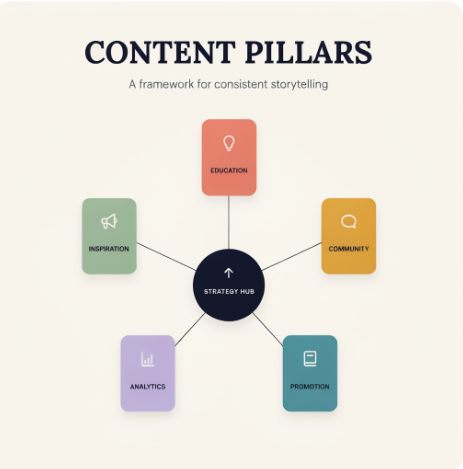
Content Pillars (and Why They Matter)
Your content pillars will be the 3 to 5 core topics you use as the basis for your content strategy. A content creator who isn't tied to a business can usually pick content pillars based on their passions, skills, and what performs best on their chosen platforms. Businesses, on the other hand, are a bit more constrained in their content pillar choices. More often than not, the nature of your business will largely determine the most effective content pillars for your business account. If your ultimate goal is to market your business on social media, matching your content pillars is the way to go.
For instance, a dentist with social media marketing aspirations can build their content around dental care. Insightful, educational, and relatable content that's firmly within the dental niche would help them establish visibility among their desired audience, build trust, and encourage viewers to convert to followers. After that, it's just one more step to transform them into paying customers. Content pillars allow you to put yourself in front of potential customers in a way that doesn't feel too promotional.
They make it possible for business accounts to showcase their expertise and establish value to audiences primed to resonate with their content. The right content pillar will keep all your content aligned with your goals, enable easier brainstorming, and help you gain algorithmic momentum by ensuring you consistently post highly engaging content.
How to Identify the Right Content Pillars for Your Business
We keep saying the "right" content pillars, but what exactly do we mean by that? How do you determine if a specific content pillar is more appropriate for your business than another? At their simplest, your pillars should serve both audiences and your business; addressing the audience's needs and pain points, while giving you the visibility and discoverability you need to make your content creation efforts worthwhile.
Align Pillars With Business Goals
To begin, your content pillars must always align with stated business goals. This will ensure that your content is designed to push your business closer to achieving its goals, be they customer retention, lead generation, or brand awareness. So, what are your online marketing objectives? What do you want to gain by creating content and posting on your business account? The answers you choose will determine the right pillars for your content strategy.
If brand awareness is your goal, your pillars should cover highly shareable and discoverable content that will boost visibility. Customer retention goals would call for content that encourages viewer engagement and saves, while lead generation goals would require content that establishes real value and converts curious social media users to loyal followers and customers.
Research What Your Audience Actually Wants
The next step is to research what kind of content your target audience or demographic actually wants. While your business automatically gives you a niche to work in, most niches are so broad that you will want to narrow down and select themes within your chosen niche. These will be the topics that your target audience will genuinely engage with, and they will ensure all your content is targeted to an audience of already engaged people.
You can figure out what your target audience wants and needs by studying competitor content and going over comments, customer questions, and consumer surveys. Forums like Quora and Reddit can also help you identify pain points right from the customers' mouths, allowing you to tailor-make your content with audiences in mind.
Balance Brand Topics With Broader Industry Topics
To make your social media marketing strategy as effective as possible, the goal should be to cast an extremely wide net. The services and products you offer, as well as any behind-the-scenes activity you are willing to share, will form the foundation of your content strategy. Build out this strategy using broader industry topics, while remaining within your niche, to broaden your reach beyond your existing customers. Hyperfocusing on promotional content will make your work seem monotonous and repetitive and make your channel too promotional, which tends to put social media users off.
Let's say you run a plumbing company and recently launched some kind of social media presence. Your niche affords you an extremely wide range of topics to work with, making it easier for you to reach a much wider audience. Covering a broader range of industry topics is critical for any business intent on maximizing the value they gain from social media marketing.
Common Types of Content Pillars for Business Accounts
The content pillars available to aspiring content creators are quite diverse and wide-ranging. Each pillar serves a different function and performs in specific ways on social media platforms. Once you have your social media goals in mind, you will want to select pillars that complement them.
Let's cover some of the common types of content pillars for business accounts:
- Educational content - This refers to any type of content designed to teach or impart knowledge to the viewer. Educational content tends to perform well on search engines as viewers typically seek this type of content. Guides, industry insights, guides, and tips fall within this category, and they typically attract high share and engagement rates. You can use educational content to catch social media users in the wild and bring them to your profile.
- Industry news and trends - Trend-based content that covers popular topics of the day or day-to-day news in the industry. Industry news can transform you into a reliable information resource in your niche, which will do wonders for your discoverability and lead generation rates. Trending news can cause spikes in new viewers; it's up to you to grab hold of them.
- Inspirational content - This is content that uses personal lessons, real stories, and meaningful quotes to connect with viewers. It involves lots of honesty and speaking from the heart to build a personal brand that social media users can connect to and resonate with
- Customer stories and testimonials - This is where you will publish stories and testimonials from customers to showcase your expertise and build trust among your followers
- Company culture and behind-the-scenes content - If you want to give followers a look behind the hood, this is the kind of content that will help you show the real humans behind the brand
- Product or service-based content - This content involves demos, use cases, features, and the like. It is where you showcase your products or services and show social media users what value your business has to offer.
Turning Pillars Into a Content Plan
You need a strategy that turns your pillars from a framework into actionable content that can convert curious viewers into paying customers. The following is a brief breakdown of how you can convert your pillars into an effective content plan:
Break Pillars Into Specific Content Themes (~160 words)
Start by narrowing each of your pillars down into smaller and more specific subtopics or themes. Most pillars are too broad and can be a hassle to work with when brainstorming, but more specific subtopics make it easier to come up with individual post ideas. You can break most content pillars down into several actionable topics, giving you a wider range of subjects to cover while remaining on-brand.
Map Pillars to a Content Calendar
Map out a content calendar that will allow you to spread your pillars across your content schedule. This will ensure one pillar doesn't dominate your content mix and make it too repetitive and monotonous. Combine your content calendar with a sustainable cadence to create a posting schedule that allows you to post on-brand, top-quality content on a consistent and predictable basis.
Keeping Your Pillars Relevant Over Time
The internet is a beast that changes and evolves. Likewise, your business objectives will not remain static. This means a rigid, inflexible content pillar strategy that doesn't evolve with platform algorithms and adapt to your business's growth will not be effective.
Here's how you can keep your pillars relevant over time:
Reviewing Pillar Performance
Review your pillars' performance by tracking audience data and conducting regular audits. Reviewing performance will show you which types of content get the most engagement, trending search habits, and fading trends. Engaging with your community by running polls and reading comments and direct messages will help you spot pain points and adapt your content mix over time.
When to Add, Remove, or Refine a Pillar
There are certain circumstances where removing, adding, or refining a pillar is the best move for your marketing strategy on social media. Adding a new content pillar can be effective when launching new services or products, shifting your firm's mission, or targeting new audiences. On the other hand, you may have to remove a content pillar if it consistently underperforms, is related to discounted products/offerings, requires too many resources to produce, or isn't relevant to your audience.
Build A Framework To Help Grow Your Business
Creating content pillars gives you a framework that turns social media marketing into a repeatable, goal-driven system. You need to build your business account around clear content pillars that tie back to your business goals. Content pillars will help you streamline your content creation pipeline and maintain your quality bar while consistently posting on-goal content.
The right pillars evolve with business and audience, prioritizing flexibility and adaptability over rigidity. Consistently reviewing your pillars' performance and refining them over time will keep your content strategy working for your business.
