One of the best ways to create content that ranks better is through keyword clustering. This involves grouping similar, relevant, and well-ranking keywords to maximize the content's visibility in search engines. This is a good strategy for understanding search intent to boost your SEO ranking, especially when combined with long-tail keywords. In this article, we look at how to cluster keywords to align with the search intent strategy.
What is Keyword Clustering?
Keyword clustering involves grouping related keywords to improve the optimization of specific pages. Keywords with the same search intent or meaning are grouped to target the same page, thereby enhancing its visibility and relevance in the SERPs.
When grouped, these keywords provide a comprehensive content framework to address the different aspects of a topic on one page.
Benefits of Keyword Clustering
Keyword clustering can significantly improve the significance of your SEO strategy in several ways, such as:
- Reaching a broader audience. When the keyword clusters are placed at the same age, your content is more relevant to a larger audience in search queries, improving your chances of ranking highly in search engines. It is, therefore, an essential tool for enhancing your SEO share of voice.
- Meeting various search intents. Keyword clustering helps you create comprehensive content that addresses the multiple facets of search intent. This results in high engagement and customer satisfaction on the site.
- Fewer but more optimized pages. Rather than creating several pages with different keywords, you can optimize a few pages more effectively, with each of them covering a wide range of terms. This helps save time and effort, ensuring a more streamlined website structure.
- Eradicate keyword clustering. When your keywords are organized into clusters, you can ensure that similar pages aren't competing for the same keyword, therefore impacting your SEO.
Steps in Creating Keyword Clusters
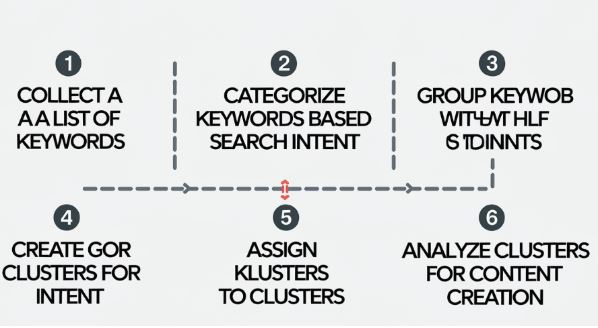
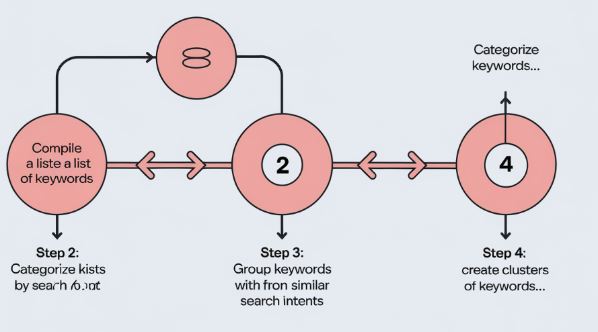
When creating keyword clusters, follow these steps:
Create a List of Keywords
The first step should be to build a list of keywords. Begin with a thorough keyword research to find the relevant search queries that will help you to create your keyword list. The good news is that AI has revolutionized keyword research.
You can do that by identifying the seed keywords consisting of broad and short-tail keywords that describe the business or industry at a higher level. These seed keywords are what you will use to expand into more specific, detailed queries. If your brand sells orthopedic shoes, you can begin by entering the phrase into Google to use as the seed keyword. The auto-complete feature will suggest other related topics and keywords, such as:
- Orthopedic shoes for men.
- Orthopedic shoes for women.
- Orthopedic shoes with ankle support.
- Orthopedic shoes for flat shoes.
You can also get the keywords by looking at the Google Search Console to analyze the results of your website and your competitor's site. These keywords can serve as your seed keywords. Finally, you can analyse the keywords the competitors are ranking for. This will provide insights into what competitors are searching for and the sources of their traffic.
Cluster the Keywords
After creating your list of target keywords, you can focus on organizing them into clusters. This can be an essential step in improving your SEO strategy, as it helps you group words with similar SERP characteristics and search intent. You can use several methods of clustering your keywords, such as:
Clustering as Per the Search Intent
This is the method we focus on in this article, as search intent is an important SEO strategy. Start by categorizing the keywords according to the searcher's intent. You can learn more about optimizing your articles for the different search intents. Generally, the intents can be categorized into information, navigational, commercial, and transactional.
When clustering your keywords, you need to avoid mixing these different intents in the same clusters, or else you will be confusing the search engines and impact your site's ability to rank. If keywords yield similar results in the SERPs, group them. Because they are identical, the search engines will consider the keywords related. It helps to group them in different ways, such as:
Automated vs. Manual Clustering
Manual clustering is a hands-on approach that aims to sort keywords based on their relatedness and relevance. While this may be time-consuming, having keyword clusters can enable precise, tailored grouping that caters to audience needs and the content strategy. This will offer better insights into the relationship of the keywords, ensuring a nuanced and effective content strategy.
You can cluster keywords automatically, using an AI keyword research tool to revolutionize your keyword research. This is an effective strategy for creating an accurate, efficient dataset that can help you save time and minimize human error.
A good keyword strategy involves more than just identifying the potential keywords. Instead, it requires a more comprehensive approach that includes a range of tools to help you understand and leverage various SEO strategies.
Content Creation and Optimization
To enhance your SEO strategy, you need to create and optimize content for your keyword clusters. That means you will need to strategically add the keywords to your webpage clusters or SEO page to improve user engagement and visibility. There are several ways of doing that:
Choose the Right Keywords
Start by identifying the main keywords in each of your clusters, along with their associated keywords. Those associated keywords should also focus on the main keywords to enhance the topic's relevance. This can improve your SERP rankings and enhance organic traffic.
Placement and Intent
It is also essential to analyze each keyword's search results to understand its search intent and what users are searching for. After understanding the purpose, create content that directly satisfies the user's need, adding unique insights to deliver better-quality content.
Make sure your keyword is strategically placed in your copy, particularly in the headings. Doing so can enhance the content's visibility without disrupting its natural flow.
Content Structuring
Ensure your content has a clear structure by assigning specific places for each keyword in the cluster. Ensure the target keywords are added in H1, H2, descriptions, meta titles, and throughout the content. The keywords mentioned in your heading should also be included in the body.
Don't Stuff Keywords
While adding several keywords can be beneficial, you should avoid keyword stuffing. Instead, ensure that each keyword is added correctly in the content. When you find several keywords serving the same purpose, work with the most relevant one to ensure readability and better quality content.
Implement Your Topic Clusters
Adding topic clusters can be a good way to cluster keywords. This model consists of a cornerstone content or pillar page that provides broad links or topics to more detailed subpages that cover specific aspects. This can enable keywords to understand how different content pieces relate to one another, improving site navigation, user experience, and SEO performance.
Track the Performance of Keywords
To determine whether your optimization is working, make sure you are tracking keyword rankings, as this will help you monitor your optimization efforts in terms of revenue, traffic, and conversions. To effectively track the ranking of keywords, you can use different strategies, such as:
Determine Which Keywords You Should Track
Consider the keywords you consider critical for your business and categorize them as either branded or unbranded. Branded keywords can attract significant traffic and are worth tracking. You can then use SEO tools to track the performance of keywords. With the move to mobile-first indexing, it is advisable to track the performance of both desktop and mobile rankings.
In Conclusion
Keyword clustering involves grouping similar keywords to create a single, more comprehensive piece. This is key to preventing keyword cannibalization and improving SEO, as it enables a website to rank for several related searches. If you are wondering how to do keyword clustering, follow the above steps. We recommend you also read our guide on how Google AI overview is impacting SEO.
