If you want your video to rank highly on YouTube, you need an idea that people are searching for content on, but there aren't enough videos covering the topic. However, if you are trying to create a high-retention YouTube video, a key challenge you are likely to face is finding an idea that isn't fully covered by existing videos.
If you keep making the same video that other people are making, you are likely to fail. Fortunately, with content gap evaluations on YouTube, you can find new angles for creating YouTube videos that people aren't covering, enabling you to get organic visibility. In this article, we guide you on conducting content gap evaluations.
What are Content Gaps on YouTube?
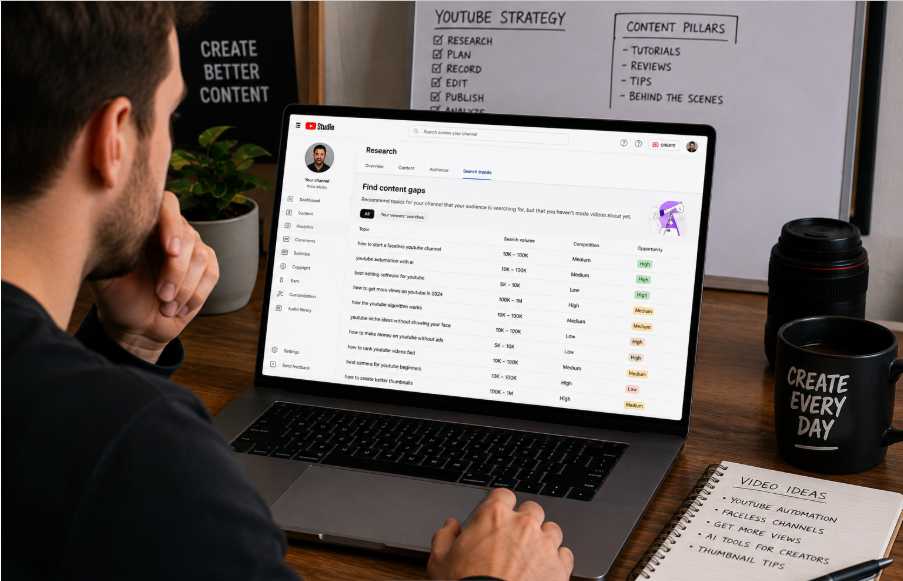
Content gaps refer to a video idea, format, question, topic, or angle that your target audience needs but isn't covered by existing videos on YouTube, or the existing videos haven't covered it well.
That means, at times, the videos may exist, but with loopholes such as:
- Answering the wrong question.
- Having outdated information.
- Being too shallow.
- Focusing on one audience while missing another. For instance, it is suited for experienced users and not beginners.
- Don't explain it well with good visuals, or aren't specific enough.
- Too general, shallow, or boring.
- Too old or poorly packaged.
- Don't have proof or examples.
- Have no comparison.
- Don't have a certain angle.
- Don't tell the audience what they should do next.
All these points point to content gaps that you can exploit. According to YouTube, a content gap exists when viewers are unable to find a result, a matching phrase, or a relevant video because the existing videos are low-quality or poor. Therefore, your goal should be to see where your target audience is seeking answers, struggling, clicking, and asking before creating content that better meets the search intent. You can then optimize the video with the relevant keywords.
However, when conducting a content gap evaluation on YouTube, your goal shouldn't be to copy the competitors but to learn from their videos and create better videos. By spotting these gaps, you can create a video with high demand, better packaging, and a strong unique selling point (USP).
Why Content Gaps Evaluations are Important
When you conduct content gaps analysis, you can have several benefits, such as:
- Eliminate the guesswork. If you are only creating a video without an idea of whether it will work, you are likely to fail. On the other hand, content gaps analysis lets you focus on the content your audience needs but can't find, so you can create content in an already proven area.
- Make it hard to be discovered. If your videos fill a particular content gap, they face less competition. That means they have a significantly higher opportunity of ranking on the SERPs, appearing in the suggested videos. The video gets chosen by the YouTube algorithm for audiences interested in the underserved topic.
- Enhance your topic authority. Content gap evaluation will enable you to create a video that consistently shows you as a reliable resource and expert in your field.
- Ability to dominate your niche. When you address an unmet need in your field, you can get an engaged audience that results in a loyal following and positions your channel as an authority.
Why Content Gaps Work Better Than Random Video Ideas
If you are creating a video on a random idea, it means you are the source of the idea. On the other hand, videos based on content gaps are driven by market demand, and that makes all the difference. That means when you create a video based on content gaps, you are addressing:
- A certain pain point.
- A particular viewer.
- A better video format.
- A reason for the current weak content.
All these provide the reader with a natural reason to watch. In other words, content gaps analysis shows you which videos have a better buyer intent. It is also worth noting that content gaps and a topic are two different things. Content gaps show what your current audience needs that isn't being satisfied by the current videos.
Steps in Content Gap Evaluation on YouTube
To conduct your content gap evaluation on YouTube, follow these steps:
Study Your Competitors' Videos
The easiest and most effective way of conducting a competitor gap analysis is by reviewing your competitor channels. Begin by finding around 10 to 15 competitor channels, which should consist of:
- Your direct competitors.
- Related competitors.
- Indirect competitors: Channels aiming at the same audience but from a different direction.
- Tiny channels with videos performing extremely well.
- Medium-sized channels using a repeatable format.
- Medium-sized channels that are strongly packaged.
Avoid analyzing the big channels in your field, as these may be getting views as a result of their personality, audience trust, distribution, and brand power. That's unlike small and medium-sized channels that may be easier to beat.
Understand the Competitor Data to Track
In the previous step, we found around 10 competitors whom you will be analyzing. Now, for each competitor, pay attention to:
- The name of the channel.
- Typical performance range.
- Videos performing above average.
- Strong topics that seem to continuously work.
- Their underperforming topics.
- What their viewers are requesting in the comment section.
- An angle they didn't cover.
- Areas of improvement.
Check Videos that Nearly Met the Intent
You can visit the channels and arrange the videos by popularity. This will show you which of their video topics were best performing, the topics, and the style. Check if you can detect a pattern across different competitors, such as:
- Video topics that seem to appear consistently.
- Video formats that consistently repeat, such as challenges, reviews, explainers, and tutorials.
Check if there are any videos that have received many views but could have some improvement. Some of the signals to show you this include:
- Unanswered questions in the comments section.
- An old video still ranking.
- A strong thumbnail but with a weak explanation.
- Video targeting beginners only.
- The topic is covered broadly by the video.
- No examples, tools, or templates were added to the video.
- Doesn't show a real use case.
- Low clarity despite the high number of views.
These videos can be categorized as almost good and may be suitable for growing your social media following from zero.
Leverage YouTube Search
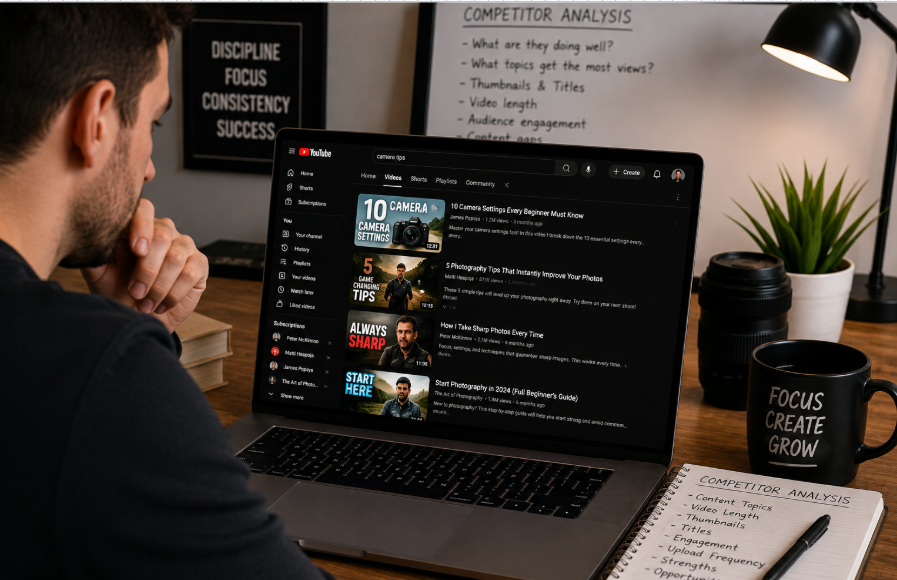
The YouTube search bar can provide insight into the kind of videos that people are looking for answers to. You can search for your main topic while paying attention to:
- Old videos that are already ranking.
- Secondary keyword search.
- Autocomplete suggestions.
- Videos that are getting many views despite their weak thumbnails.
- Poorly made videos that are already ranking.
- Videos whose content is weak but have strong packaging.
- Comments requiring missing details.
- Lacking a version that is niche-specific.
Remember that each keyword idea is a video opportunity, but you should avoid stopping there. Instead, ask yourself what you think the searcher was trying to find out. For instance, when someone searches for the best AI image generator, they are not only searching for a tool to generate images but are also looking for quick ways of making thumbnails. This can be termed buyer intent.
Trends on YouTube Studio for Content Gap Evaluation
Another great resource to spot content that your target audience and other YouTube users are searching for is YouTube Studio. You can use YouTube Trends to see the popular videos that viewers are watching, depending on the topics that are saved and the audience. It will also show you content gaps where viewers on the platform may be searching for high-quality and more relevant Shorts.
Since this data comes directly from YouTube, it can be quite powerful. You can therefore use the data to find:
- Gaps for YouTube Shorts.
- Topics with weak results.
- Ideas requiring deeper competitor research.
- Searches for what your audience cares about.
- Searches matching your channel.
However, don't assume that just because an idea comes from YouTube, content gaps exist. Instead, make sure content gaps are:
- Suitable for your audience.
- Have a high potential for retention.
- Have better packaging potential.
- Is suitable for monetization.
- Is production-fit.
- Can offer better quality.
If you can't find a way to fill the gap better, then it's not the right one.
Check Competitor Outlier Videos
The outlier video refers to the well-performing videos that exceed the channel's average view count, particularly for channels with an irregular posting schedule. It can, therefore, be a good indicator of an approach or topic that met the needs of the audience, indicating a demand that a YouTuber may be unable to meet.
An outlier video works because it can signal interest. However, demand doesn't mean that the audience is fully satisfied with how the topic is covered. Therefore, you may need to combine the outlier video with the comment section to capture the audience's interest. Now you can use proven demand to create an original topic.
Some of the ideas for spotting competitor outline videos include:
- Checking unusual video performance. Check if a video has a view count that is considerably higher compared to the recent average of the channel or even its number of subscribers. You can leverage a third-party tool that can show you the outlier video.
- Analyze the reason for the performance. Analyze the outlier videos, writing down details such as the topic, title, and thumbnail.
- Hook or structure. Consider what made the video perform better than the others. Such an analysis can be an indicator of high interest by your audience.
Audience Feedback
You need to also listen to what your competitors' audiences are saying. Here are the top areas to discover this information:
Comment Section
Go through your video's comments and those of the competitor, particularly the most popular videos. Find out the questions the viewers are asking that cannot be fully answered by the videos. What related topics are they interested in? What pain point are they showing in the videos? All these can be an indicator of an unsatisfied demand.
Check for comments, such as:
- Is it possible to make a guide for beginners? In this case, the content gap requires the creation of a beginner guide.
- Do you have a faceless channel? This indicates demand for a niche-specific channel.
- What tools did you create this with? The content gap is for tool reviews, comparisons, or templates.
- Does this work in 2026? Shows an opportunity for an updated version.
- Is there a template? Shows the demand for a guide with templates.
- How can I achieve this? A reflection of a guide to execute the process.
- Can you juxtapose A and B? This shows content gaps in a comparison review.
While the competitor may have won that first click, it's possible to outrank them with the arising gap. Other areas to get audience insights are:
- Analyze social media and community posts. The topics being discussed and the questions being asked in forums, community tabs, and the social media group for your niche.
- Use a direct poll. Go to the community tab and ask a question in your video, and fill out a survey to understand the content they are requesting and the challenges they are searching for solutions to.
When you leverage your audience's feedback, you can identify certain gaps that may have been previously harder to identify.
Check Competitor Title & Thumbnail
At times, you might find content gaps in the title and in how the video is packaged. If a video has a weak title and thumbnail, this could cause the video to underperform. According to YouTube, the first elements that viewers see are the title and thumbnail, and these are the key elements that help your audience determine if they would like to watch.
Some of the questions to ask yourself when analyzing the competitor videos are:
- The video is on an interesting topic but with a very vague title.
- How cluttered is their thumbnail?
- Does this element provide a clear result?
- Do they offer a weak emotional promise?
- Do they leverage a curiosity gap?
- Do the title and thumbnail sound too generic?
- Is the transformation clearly shown in the thumbnails?
- Is the packaging targeting the right viewer?
For instance, if the video title says "How to spot content gaps on YouTube, that is a weak title." Instead, a title that says, "This is how to see videos missed by your competitor" is a better idea. The second title will work better because of its ability to connect the concept with the outcome desired by the viewers.
YouTube Video Competitor Analysis
After identifying a certain content gap, you can now dig deeper into a particular competitor covering the topic either irregularly or superficially through the YouTube competitor analysis. To do that, you will need to:
- Determine their approach. Check the video of the competitor to see if there are any potential gaps. Consider details such as the topics they are covering in the video, the content structure, information quality, and the style.
- Consider weaknesses. Consider where the competitors are falling short and whether they are providing clear explanations, skipping important details, having low-quality production, or providing outdated information. All these details can offer better video creation opportunities that better fill the gap.
- Check for unique angles. Consider if there is an angle not being offered by the competitor. Is there a way to cover that topic more deeply and in a different content format? For instance, can you create an in-depth tutorial from a listicle or tailor it to an audience subsegment?
Understand Browse Gap vs. Search Gap
Content gaps can be categorized as either search-driven or browse-driven. Before you choose your video format, title, and thumbnail, you should understand the difference between the two. In the search gap, viewers are already searching for a particular answer. This content gap is best served with formats such as tutorials, comparisons, and templates.
In the browse gap, viewers are attracted to click on the video because of the idea. In this type of content gap, you can answer using experiments, stories, teardowns, or a unique angle.
How to Create an Outstanding Video from Content Gap Evaluation
Note that after identifying a content gap, it doesn't mean your work is done. You still need to turn those insights into some highly compelling videos.
You can do that in different ways, such as:
- Refine the video topic. From the analysis you conducted and the content gap you identified, focus on a particular topical problem or question in the content gap you need to address. Ensure that it is completely focused.
- Find a unique angle. You will need to determine what will make your video better than those of the competition. A good idea would be to leverage Style Transfer, where you take a unique idea and use it in your current unique format, personality, or detail level. If your competitors are creating some short videos that only provide an overview, perhaps you need to create a detailed tutorial. If they are using a very formal tone, you can consider using a humorous and more approachable way.
- Add an interesting title and hook. We noted earlier that the title and thumbnail are key parts of content gap evaluation, and you don't want a situation where your title becomes the next piece of content. Therefore, make sure your title and thumbnails clearly illustrate the unique value proposition. Focus on audiences already interested in the gap.
- Structure to show value. Make sure your videos are structured in a way that addresses the content gap throughout while providing the reader with value. You can use the competitor analysis report you created earlier to ensure you cover the point missed or offer a clearer explanation.
Leveraging tools for Content Gap Evaluation
While it's possible to conduct a manual content gap evaluation, you can use different tools to improve the content gap evaluation. The right tools should provide insights into:
- Which competitor channels are there?
- What are their best-performing videos?
- What are their outlier videos?
- Check and compare competitors' topics.
- Find outdated and weak content.
- Analyze the thumbnails and titles.
- Identify the demand in search.
- Find questions from the audience.
- Create videos out of gaps.
- Save the content opportunity.
There are already some tools to overcome this challenge. One of these is the Opportunity Finder feature of TubeBuddy that helps creators find content opportunities that YouTube users search for and find content gaps that competitors probably missed. Similarly, Semrush also has a feature known as the "YouTube Gap Analyzer" that focuses on finding the gap in the leading videos on YouTube and leveraging the gaps to perform better than the competitor.
Another tool for competitor research is Apify. The tool is aimed at discovering the content gap already with high demand and low completion, therefore proving the intent.
In Conclusion
Content gap evaluation on YouTube can help you discover new content topics, angles, or formats that other creators are not using. With few videos covering these gaps, it can mean faster ranking on the YouTube Home and search results. Therefore, by following the steps outlined in our guide, you can use content gap evaluation on YouTube to find opportunities that will bring views and grow your channel.
