#1 Social Media Marketplace
Accelerate Your Social Media Growth with SocialWick. Quickly gain real followers, viewers, likes & more with our blend of marketing tactics. SocialWick is known for its fast delivery, premium quality, and low prices. With over a million satisfied customers since 2017, trust SocialWick to take your social media game to the next level.
1.4 M
Customers
13 M
Orders
362 M
Followers sold
1.8 B
Likes sold
How to Track and Increase YouTube Watch Hours
Published on 18.08.2026 by Tracey Chizoba Fletcher
When creators want to monetize their YouTube channels through the YouTube Partner Program, they realize they need to reach 4,000 hours and gain 1,000 subscribers. While they can still earn through methods such as gifts, the only way to earn through ad revenue is to hit this milestone.
This often makes them question how to interpret YouTube analytics to increase their YouTube watch time. In this article, we provide you with a detailed guide on tracking watch time when leveraging YouTube analytics to grow your channel. We also provide actionable steps on how to grow your channel.
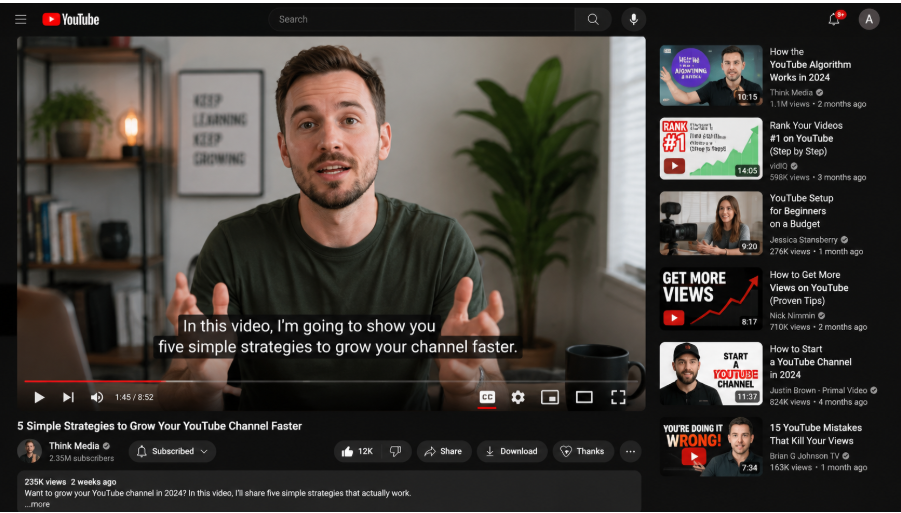
What is YouTube Watch Time?
Watch time refers to the number of hours a YouTube user spends watching videos on the platform. YouTube has acknowledged that watch time is an important factor in its discovery and search algorithms. This metric is a good measure of the engagement level of a video. The longer people watch your YouTube video, the more it is seen as a sign that it adds value to your audience.
YouTube interprets a higher watch time as a sign that the video should be promoted in the suggestions and feed areas. This can offer opportunities for revenue generation, such as brand partnerships and sponsorships. With YouTube channels having a retention rate of 50-60%, the higher your rate, the better it is for your channel. Watch time is calculated in both minutes and as a percentage of your total video length. This makes it an important metric for growing a channel and reaching a bigger audience.
The watch time includes public long-form videos, premieres, and public live streams. It doesn't count views for Shorts, private, deleted, or unlisted videos. Additionally, for the livestream to work, it should be public. If you haven't added a default visibility, you will lose the hours in the stream. When you create a video and delete it, the hours watched are removed as well.
How to Access YouTube Watch Time Data
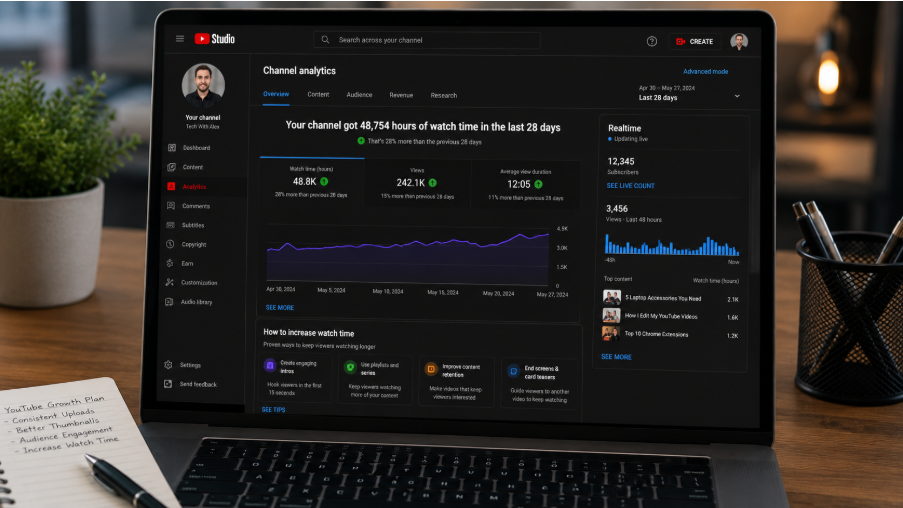
To see YouTube watch time metrics, you should follow these steps:
- Get into YouTube Studio.
- From the left-hand column, check Analytics.
- Select the Advanced Mode option.
- In the dashboard, you will find your various data options.
- Choose the preferred date range, from daily to lifetime.
You can view the main chart showing the channel's highest watch time.
How Long Does it Take to Reach 400 Watch Hours?
Many creators earn 4000 watch hours within 6 to 12 months if they are already uploading consistently. Most of the channels that reach that milestone faster combine evergreen long-form video with regular live streams. If a channel depends on a single type of content or uploads sporadically, it might even take longer.
Why Are Long-Form Videos Reducing in Watch Time?
It can be discouraging to see videos that had a considerable watch time start to decline. When that happens, a good idea is to start by reviewing the audience retention data. To do that, you can visit YouTube Studio, open your videos, and tap Analytics, followed by the Engagement tab. By looking at the retention curve, you can get these insights:
- If viewers leave within the first 30 seconds, it shows your introductions are weak.
- If views are consistently dropping at a certain point in the video, you have a pacing problem.
- If there is a sharp drop near the end, your outro will need to be redone.
Remember that watch hours are also important, as are the distribution of suggested videos and those appearing in search results. If your video features a strong retention curve, it can be shown to bigger audiences in the Home Feed and as recommendations. If a video has a weak retention curve, it can be hard to recommend it. When you improve your retention, you increase the chances that your videos will be recommended.
How to Increase YouTube Watch Time
Now that we understand why watch time matters, let us look at the steps to increase your watch time using the top YouTube video retention hacks.
Use Strong Introductions
The first 30 seconds are what most viewers use to decide whether a video is worth watching. That means the introduction is the most important part affecting watch time. A common mistake creators make is to start their videos with context rather than offering value. That's why you see many videos that start by welcoming viewers to the channel and describing the topic they will be discussing. This strategy doesn't work because the viewer has already seen the title and thumbnail and understands the topic.
A good strategy would be to use a payoff. For instance, if you are creating a video on improving thumbnails, show a before-and-after image. This will hook the viewers and make them feel like there is something important they will miss if they don't watch the video.
Add Pattern Interrupts Every 30 Seconds
One reason for lower watch hours is that viewers' minds wander. You can change what the viewer is looking at or hearing using a pattern interrupt. This can include a zoom, a reaction video, a sound-effect B-roll cut, text overlays, and a jump cut.
The rule should be that every 60 seconds, an interrupt should occur if nothing is changing on the screen. Pay attention to the before-and-after images of the retention curve; you will see the difference in the data.
Create High-Quality Videos Consistently
This is a no-brainer: poorly created content will harm your watch time. Therefore, when creating a video, provide the viewer with a reason to keep watching for the next minute. Use the top tool and edit the video flawlessly. When you make the videos enjoyable, you can reduce the likelihood of viewers dropping off in the middle. Use eye-catching visuals to capture the viewers' attention.
Also post consistently, as the YouTube algorithm recommends content from channels that publish regularly. If you are consistent for six months, you can outperform another channel that creates with intensity for six weeks. However, consistency doesn't mean daily posting. The most important thing is to have a cadence to ensure sustainability without burnout.
Add Video Captions
Many YouTube viewers scroll the platform with their sound off. If you add an audio hook, it may not work for most people. Captions can be a great tool for reaching viewers who are watching with the sound off. In addition to retention, captions offer other benefits.
For one, YouTube tends to index captions for search. Therefore, if your captions are accurate, it becomes easier to cover a topic. Additionally, YouTube uses the captions to generate subtitles, enabling viewers who are watching in other languages to understand. You can use the built-in editor to add the caption, so that the automatic transcript is generated from the video.
Ensure the Video Length Matches the Retention
If you have 30-minute videos and the watch time is 10 minutes, that's 30%. A 15-minute video viewed for 10 minutes gives you a 75% retention rate, which is far better. Therefore, longer videos may not be better if people are not watching them for longer. The watch time isn't calculated solely by YouTube, but rather in combination with retention data from other similar videos.
That means when creating videos, it is important to match the length of other high-performing videos in your niche. Some content formats, such as how-to content and educational videos, support longer videos as viewers try to learn new skills. Content with shorter attention spans includes commentary and entertaining topics. Check your YouTube Analytics data for videos with average view durations, and create more of such videos.
Add Auto-Playing Playlists
When you organize your videos on a playlist, your viewers can continue watching the next video when the current one ends. That means even when they have a plan to watch one video, they can end up watching two or three without having to click another. Since YouTube tracks session duration rather than individual viewing time, you can increase the likelihood that the platform will recommend the video.
Therefore, go ahead and organize your videos in playlists consisting of 5 to 10 videos. Put them in an order so that one video leads to the next one. Otherwise, without a playlist, viewers will need to decide for themselves what they want to watch. But when you organize your videos into a playlist, the platform decides for them.
Use Livestreams to Increase Watch Hours
Livestreams are the best format for increasing your watch hours. If you have a livestream running for 2 hours with 50 concurrent viewers, it can add up to 100 watch hours. It is more important to maintain a steady stream of content in a variety of formats, such as behind-the-scenes content, Q&As, live tutorials, and more. No matter the format you choose, make sure to stream consistently.
Remember to make the recording private so others can still view it after the livestream ends. Keep checking your YouTube Studio. If a livestream detail is unlimited, you can easily lose the hour gained.
In Conclusion
Watch time is one of the most important metrics you need to pay attention to, as it determines whether your channel is monetized and even the actual amount you earn. Therefore, you should follow the steps outlined in this guide to track and increase your watch time.

Sign up for SocialWick
Login
InstagramYouTubeTikTokFacebookTwitchSpotifyTwitter (X)SoundCloudIGTVLinkedInThreadsWebsitePinterestVKApple MusicSEO
Checkout
OK

Information
Order processing usually starts within a few minutes, but some services may take a few hours or even a few days. We offer free refills for up to 90 days if needed. Our services are 100% secure and discreet, with a focus on gradual and safe delivery for your peace of mind.
Order processing usually starts within a few minutes, but some services may take a few hours or even a few days. We offer free refills for up to 90 days if needed. Our services are 100% secure and discreet, with a focus on gradual and safe delivery for your peace of mind.
Where should we send your order confirmation?
No account needed! We send your confirmation and tracking link here.
Secure checkout. We never share your email.
Have an account?•
Log in
Use your account to pay faster with your saved details.
Create account
Create an account to track all your orders in one place.
Service
+0,00
Voucher
-0.00
Total
+0.00
OK
Affiliate & Reseller Program
Customer Support
How may we help you?
General Support
Order Support
Frequently Asked Questions
1) What services do you offer?
We are a social media marketing company, and we offer a wide variety of services across several platforms that our clients can choose from. Once selected, we create a plan that fits your needs. We offer several types of services, such as followers, subscribers, likes, views, song plays, etc.
2) Is your service safe?
Yes, as we only sell real followers, likes, views, etc., and we hold every service to strict authenticity and quality standards. In order to protect your account, we deliver every order carefully and gradually. We closely monitor all our services. For more information, we strongly recommend reading our Terms of Service before you order.
3) Will I need to give you the passwords for my accounts?
No, you can keep your passwords to yourself because our services don’t need a password to influence your accounts. And if an email ever shows up claiming to be from us and asking for a password, it’s definitely not us, so please let us know right away.
4) Are the likes, followers, and subscribers real, or are they bots?
Unlike many other services, all our likes, followers, and views come from real accounts operated by real people. You won’t find bots, fake profiles, or hijacked accounts anywhere in what we deliver. Every order has to pass our strict authenticity standards, and we keep checking our quality to make sure it stays that way.
5) How fast can you deliver my order?
We will show you the estimated delivery time when choosing the service. However, this is only a rough estimate. In most cases, the services are delivered much faster. In some cases, it may take longer. We always aim for a natural and safe delivery!
6) What are your best-selling social media marketing services?
Although we have many services across most social media companies, our services for Instagram, TikTok, and YouTube are our best-selling options.
7) How do I know my account will not be flagged or banned?
We take safety very seriously. We never ask for your password, all followers, likes, and views come from real accounts, and orders are usually delivered gradually and naturally. What we can promise is careful delivery and strict quality standards. Plus a support team that’s there whenever you need us. We are not aware of a single case since 2017 where a customer got his profile banned.
8) What is the best method to communicate with you?
Do you have a question or run into a problem? Our customer support is available 24/7 for you. Just click Contact and you’ll land right on the support form. When you buy one of our services, we will email you to see if there were any problems. Your satisfaction is our main priority.
9) Are there discounts for large orders?
Yes! If you would like to request a large order that isn’t on our ordering layout, we will have no problems accommodating you. Just reach out through the support form and we’ll put together a buying plan that fits what you need.
10) What methods of payment do you accept?
We accept all forms of credit and debit cards, as well as Klarna, eps, PayPal, and Crypto.
11) If I am unsatisfied with your services, am I able to receive a refund?
Yes! Every purchase comes with a 30 day money-back guarantee. Not satisfied? Just contact our support within 30 days of your purchase and send us your order details and a short note on what went wrong, and we’ll take a look at your case. The full conditions are in our Refund Policy.
12) I haven’t received my order
Please make sure the following criteria are met before placing an order to make sure we can deliver it successfully.
- Your account is set to public
- You have typed in the correct username or link
- You have not changed your username before the order’s completion
- The post or account still exists and has not been deleted
- The post or account has not been restricted or removed in some countries
- Allow the estimated delivery time for completion of your order
For further assistance, please message our support team through the contact form.
13) How can I request a refill?
Just send us a refill request through the contact form. Please note that we can only provide you with a free refill within the first 90 days of your purchase.
Learn More
What is SocialWick?
We are the leading marketplace for social media promotion. You can buy followers, likes, views, subscribers, and a lot more for almost all social media networks. We offer affordable prices without making any compromises in terms of the service quality. We have a strict policy to only sell social media signals from real people. Part of our engagement, for example, comes from ad-based promotion where real users discover the content through ads. Bots, fake profiles, and hijacked accounts have no place in our services. Every delivery has to meet our authenticity standards, and we run regular quality checks, and anything that does not meet them is removed from our catalog. Our services are available for personal use, whether you want more Instagram likes, TikTok followers, YouTube views, or something else for your own profile.
With over a million satisfied customers, SocialWick is the go-to platform for all your social media needs. Our services are discreet and secure, with gradual and careful delivery to keep your social media accounts safe.
About SocialWick — The Market Leader since 2017
With more than 10 million orders, SocialWick is one of the world’s biggest social media stores. You can find everything on our website to improve your presence on major social media platforms like Instagram, TikTok, YouTube, Twitter (X), Facebook, etc. We offer different types of services for several social media platforms. Your wish is our command, and whatever your goal might be, SocialWick will help you achieve it. Whether you need more likes on your Instagram photos or want to make your LinkedIn profile more popular by getting additional followers, SocialWick is there to turn your goal into reality.
Thanks to our effective services and our customer-oriented work, SocialWick has become a top player. You will not find a better service anywhere else, especially not at such affordable prices. SocialWick is operating since 2017.
365 Days Per Year Customer Service
Your satisfaction is our motivation! We’re not here just for the money; we do our work to help people find their road to social media success. And that’s why our team will do all to make sure everything goes according to plan. If there’s something wrong with your social media campaign, or worry that there might be some problems with your account, or want to learn more about how our services work, feel free to reach out. Our service staff is there for you seven days a week, ready to answer any of your questions. You can get in touch with us using the contact form on our website.
Buying Followers and Likes is Essential
Unless you’re Kylie Jenner, you definitely need some help with social media. The more followers you have on Instagram, TikTok, Twitter (X), or YouTube, the more people will automatically notice you. Having all those eyes on your content isn’t just impressive, it’s genuinely fun. The bad news is that everyone wants to be famous these days, but only a few can succeed. The good news is that you can be the chosen one who will get social media fame and everything that comes with it. But, for that, you need a little help from your friends at SocialWick.
With our help, you will increase the number of followers on social media, which can have a domino effect and bring you even more new followers. Once people see that you got a big followership, they will decide to give you a follow. "If a profile has so many followers, it means that it’s interesting" – you can be sure this is going to be their reasoning. Furthermore, more followers mean more visibility for everything you post. Finally, a large number of followers also do great for your credibility. Our social media services will help you to create a better overall picture of your profile.
Let’s be honest; a profile with 30,000 followers looks much better than one with 74 followers. And that’s exactly what new visitors will pay attention to. A weak social media profile can be a real deal-breaker. At the same time, a fantastic social media profile can do wonders for you. And SocialWick can make your social media profile amazing!