In the recent past, there has been a resurgence of long-form videos in the short-form video era. This is attributed to a number of factors, such as audiences suffering from short-form video fatigue and an audience's desire for deeper storytelling. However, unlike short-form videos, longer videos often require creators to capture viewer attention.
Without a good audience retention strategy, you will struggle to keep audiences engaged in your video. In this guide, we share top tips to hold your audience's attention in long-form YouTube videos.
What is Audience Retention?
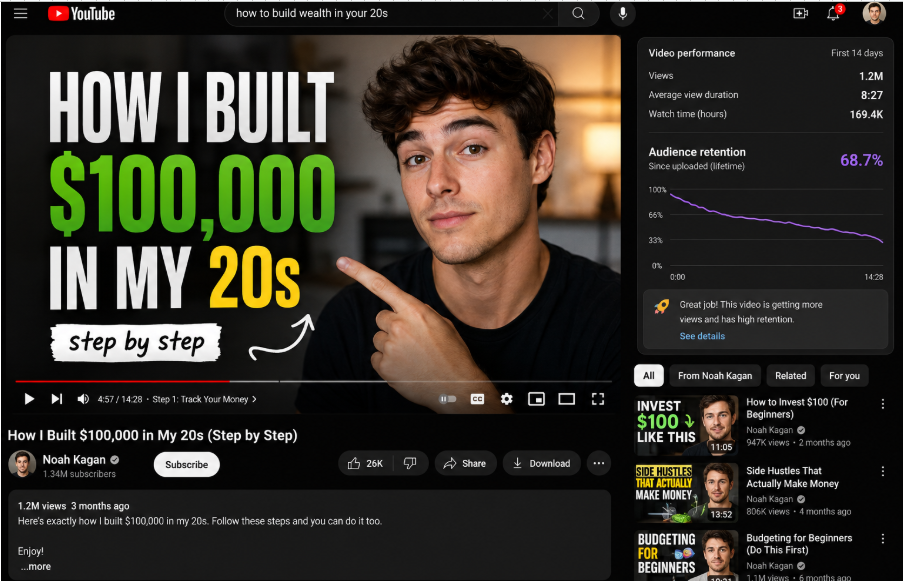
Audience retention refers to the percentage of viewers who watch. It is a good metric for tracking the audience that remains throughout the video content, from beginning to end. If your YouTube video is maintaining strong retention, YouTube interprets that as a signal that you are creating valuable videos that will continue driving the viewer's interest.
When the YouTube algorithm notices that your videos hold people's attention, it will rank them highly. While YouTube audience retention signals which videos people watch, another important metric to track is the "average view duration", a metric that indicates the amount of time people spend watching a video. These two numbers are interlinked. However, audience retention is what provides a better picture of the ability of your video content to hold people's attention throughout the video.
For instance, if you create an 8-minute video and viewers are, on average, watching the video for 4 minutes, it has a 50% audience retention. However, instead of focusing on the raw data, you can pay attention to the area where people are leaving by checking the "retention graph".
Can Audience Retention Data Fuel Growth?
Audience retention data plays an important role as YouTube interprets it as a sign of the viewers' satisfaction level. If your content is getting high retention, it can get more impressions, more recommendations, and more views.
A high audience retention can, therefore, offer various benefits, such as:
- Higher level of discoverability. When your video has high retention, YouTube is likely to showcase it on the homepage, in the suggested feed, and in search results because it shows viewers why they are there.
- A higher level of loyalty. When people finish your videos, they can easily subscribe, comment, share, or even come back for more of the same content.
- Better content strategy. YouTube retention strategy can be a good sign of whether your YouTube strategy is working or not. If a video maintains high retention, it will be an indicator of the type of content that people are interested in.
- More monetization opportunities. When you have a more engaged audience, advertisers tend to pay more. Better retention can increase watch time, which can improve your earnings and make your content more attractive to sponsors.
All the growth metrics are usually linked to audience retention, whether you are creating educational content, vlogs, or even product review videos.
Understanding the Right Audience Retention Data
According to a 2025 study reviewing various videos, the average YouTube retention is 23.7%. Only around 16% of videos had a retention of more than 50%. That means if your videos are achieving a retention of more than 50%, you are already performing better than the majority of channels.
Some of the other audience retention data you need to watch include:
- Best-performing videos. The top-performing videos are those between 5 and 10 minutes and have an average retention of 31.5%. Shorter videos don't mean they are better, while mid-length content is best for holding viewers when the video offers viewers the runtime.
- Retention also differs depending on the type of content. The educational videos in the how-to niche are among the best-performing, with an average retention of 42.1%. On the other hand, vlogs are usually at the lower end, with a retention of 21.5%.
- No matter the video's length, 55% of viewers will leave in the first 60 seconds. Its first minute isn't only an introduction but is usually the top moment of the whole video.
In videos where more than 65% of viewers go beyond its first minute, this results in higher retention compared to other videos.
How to Interpret YouTube Retention Data
You can check the YouTube retention data by going to Analytics and clicking on a video. This will provide you with important insights, such as:
- Early drop-off. If people are dropping off within 30 seconds, it's an indication that your hook is not performing well, or that you had a thumbnail or title that overpromised.
- A dip in mid-video. When you notice viewers leaving at a particular timestamp, it indicates the content has lost relevance or the video has slowed down. Consider what was in that location, such as B-roll, a tangent, or a transition that felt like it was abrupt.
- Spike. When you see that there was a spike in the number of views at a certain location, it shows something landed well, people were surprised by a visual, or there was an information piece that hit well at a particular time. You want to ensure that you are creating more of such moments.
- A flat line. When the graph is flat, it means your video is performing well, with consistent pacing and driving interest in a sustainable way throughout.
Filter your data on audience retention by the type of audience. You can analyze the retention data by:
- New vs. returning viewers. In most cases, the returning viewer has a higher retention.
- Desktop vs. mobile. In most cases, the attention span of the mobile viewer is lower, resulting in a higher drop-off point.
You can leverage this data after each upload. With time, you will see patterns that are specific to your audience and channel.
Top Tips for Increasing Audience Retention in Long-Form Videos
There are several tips for increasing YouTube retention. These are:
Use the First Thirty Seconds as a Hook
If you are starting your content with a common phrase like "Welcome back to our channel" or some intro music, or even a long setup process, you will lose. A good idea would be to delve into the topic as fast as possible. Use the first thirty seconds to tell the viewers why they should watch the rest of the video.
You can do that by using:
- A preview hook. Start by showing the result or clip from a later video. You can use words such as "By the time you come to the end of my video, you will have a working system".
- A question hook. You need to ask a question about something that the user is considering. For instance, why are my videos losing audiences in the middle?
- A bold claim. Use a counterintuitive or surprising statement to lead the viewers.
Use the Right Video Pace or Script
An easy way of killing retention is by rambling on-camera. If the video delivery is wandering, the attention of the viewer will also wander. The best way of dealing with this challenge is by creating a video script. This will help remove dead air and ensure your video content is delivered at the right speed. Otherwise, if you have many long pauses in your video, it will negatively impact video retention.
Add Chapters & Signposting in Your Video
There are two key purposes of video chapters. For one, they enable viewers to navigate around your video. They also let viewers know from YouTube that you have intentional and organized content. If your content is more than 5 minutes, be sure to include timestamps. When starting a long video, be sure you briefly inform the viewer what the video is about.
Ensure the video is also divided into a number of segments ranging from three to five minutes. Such a smaller unit will provide the viewer with a mental checkpoint and prevent any form of dropping off before the video ends.
Use Pattern Interrupt
If your content consists of unbroken talking heads or static visuals, it can cause the drifting of the viewer's attention. This is why you need to alter an element on the screen after every sixty to ninety seconds.
Some of the tips for using pattern interrupts are:
- A close-up image or another camera angle.
- Including animated graphics or text overlay to emphasize a particular point.
- Adding B-roll footage.
- Using an on-screen poll or question.
Every visual shift will act like a bit of a reset to signal the viewer's brain that there is something new already happening, helping you get some more focused attention.
Edit Ruthlessly
Go through the video and remove the repeated points, long silences, and tangents that feel like an improvization, as these are what make viewers leave. Make the surveyor video consist of clean transcriptions rather than the flashy ones. If your transitions are overproduced, they will cause your attention to wander away. You can leverage the best tools for short video editing to have the right video pace.
Strategically Add CTAs
By adding an in-video call to action, you can increase engagement, but this may also impact the experience of the viewer. Add the CTA during those natural pause moments, such as comment, subscribe, and follow, in the video's middle rather than at the video closing, where most viewers have already dropped off. However, don't add so many CTAs at the same point.
Final Thoughts
If you want your long-form video content to drive engagement, a good idea would be to focus on improving your retention. When YouTube sees that your videos are retaining viewers, it can recommend them more, leading to more views. Therefore, use our detailed guide to drive your YouTube retention.
