In today's digital marketing, social media isn't only about posting content, it's also about measuring the results of your social media strategy. With social media reporting, you can transform scattered data points into actionable insights that inform your strategy and demonstrate real value. This is especially important in the age of the dark social, the invisible sharing economy.
However, many creators and brands are often bombarded with shiny metrics that appear to be a sign of success. In reality, these metrics may not be accurate or may be misleading you. This article examines why your social metrics may be deceiving you and offers suggestions on how to address the issue.

Why You Shouldn't Be Obsessed with Vanity Metrics
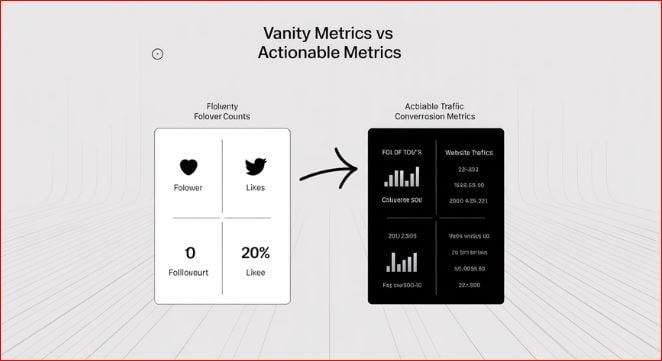
A social media metric refers to a numerical measure that indicates the impact of an action related to your social media account. Vanity metrics often appear impressive at first, but they don't accurately reflect a company's level of success in achieving its goals.
While a metric is measurable, it doesn't reflect a real return on investment. Some of the top vanity metrics include the number of likes, comments, or followers. There is no doubt that people love vanity metrics such as reach, impressions, and views. However, these metrics don't tell the true story.
For instance, when you see that your post received 10 million impressions, you assume that your brand's visibility has increased. The truth of the matter is that an impression simply means that the post appeared on someone's feed. It doesn't matter if they stopped to look, read, or care about the post. It's similar to someone passing your storefront without caring to look inside.
Similarly, the number of followers doesn't necessarily translate to more sales; a like isn't necessarily an indication of intent, while a share isn't a sign of loyalty. A view doesn't always lead to a lead even though most marketers and creators spend a lot of time tracking these KPIs. It results in inflated confidence and poor performance.
That means instead of getting obsessed with total reach, you are better off focusing on the CTR. Instead of focusing on saves, concentrate more on pipeline acceleration. Ultimately, it's not the prettiest metric that wins, but rather those that bring in the most sales. Therefore, if a metric doesn't accurately reflect how people move, stay, buy, or convert, it is more of a vanity metric.
What Are Vanity Metrics?
Vanity metrics are superficial numbers that often appear impressive but do not accurately reflect a business's performance. Several characteristics can help you identify vanity metrics. These are:
- Usually misleading.
- Lacking enough substance.
- Generally not contextual.
- Overly simplistic to measure and track.
- Doesn't offer any meaningful improvement to your product or service.
What Are Actionable Metrics?
Actionable metrics measure the specific actions that bring measurable results to your business. This ensures that you have a marketing strategy that brings actionable results. The metrics help marketers align their team around key metrics that align with their business goals.
These metrics can help businesses understand whether their products meet customer needs and identify areas for improvement where necessary. According to a Forrester Research study, when a business properly aligns with actionable metrics, it helps increase its revenue by 32%. You can read our guide on key TikTok metrics to track.
Actionable metrics, as you would expect, represent the key metrics that help you track, analyze, and refine your strategy. Unlike vanity metrics, these actionable metrics drive specific business action that leads to higher business growth.
There are no hard rules on metrics that can be considered actionable, as this will depend on your individual goal. However, metrics such as engagement rate can provide your team with more insights. Similarly, the number of shares may be a better indicator of whether your content resonates well with your audience than likes.
Understanding the Actionable Metrics That Matter
To achieve results in your digital marketing strategy, you must track the metrics that truly matter. These include:
Click-through Rate
Unlike impressions that only put your content in the eyes of your audience, click-through rate (CTR) will show you how many of those who saw the content and thought it was worth a click. A high CTR indicates that your content marketing strategy, timing, and placement are all working well. If it's low, it means people hardly care about your content despite seeing it.
In other words, this is one of the most honest metrics that indicate human interest versus intent. If you receive a high engagement rate but a low CTR, it suggests that you are creating great content, but people aren't interested in making a purchase.
Conversion Rate
This is the metric that shows the real results. After you speak, it shows that people listened and took action. This is the most effective actionable metric that shows the ROI of your campaigns. If you are getting high impressions with a low conversion rate, it means the whole campaign is ineffective.
Engagement Rate Per Impression
If you are only looking at raw engagement numbers, you may be staring at vanity metrics. To gain a clearer understanding of your campaign's performance, consider the engagement rate per impression. This is a better metric to track because it shows the percentage of viewers who took the time to engage and demonstrates the effectiveness of your campaign in attracting the right target audience.
This is, therefore, a tremendous social media KPI that will separate the noise from action. For instance, if you receive 100,000 impressions but only 30 people react, it indicates that your digital marketing strategy isn't working.
Customer Acquisition Cost (CAC)
One of the numbers that marketers like to keep small is the Customer Acquisition Cost (CAC), as it accurately reflects the actual cost of your campaign. No matter how well the social media campaign was received, if its cost ballooned out of your budget, it may not be well-received. This is a vital metric that enables you to reconcile what you earned with the campaign's cost.
Customer Lifetime Value (CLV)
CLV is an essential actionable metric that shows you how long a customer remains with you and how much they ultimately spend. This can be a good actionable metric to track as you don't want to attract people who buy once before they disappear. You want to ensure that you have a content strategy that retains buyers beyond a single campaign, which can be shown through a high CLV.
If you aren't tracking CLV, you may spend a lot of time tracking people who may not spend a significant amount of time with you. You might have good-looking reports, but with poor margins.
Final Thoughts
While social media metrics, such as the number of followers and likes, may make you feel good, they may not add significant value to your business. This is why it may be essential to understand the difference between vanity and actionable insights to know what you need to pay more attention to. Actionable insights are the ones that matter because they provide insights into the real results of your campaign.
