#1 Social Media Marketplace
Accelerate Your Social Media Growth with SocialWick. Quickly gain real followers, viewers, likes & more with our blend of marketing tactics. SocialWick is known for its fast delivery, premium quality, and low prices. With over a million satisfied customers since 2017, trust SocialWick to take your social media game to the next level.
1.4 M
Customers
13 M
Orders
362 M
Followers sold
1.8 B
Likes sold
Why is My YouTube Watch Time Not Increasing Even With More Views
Published on 02.05.2026 by Tracey Chizoba Fletcher / Last Update: 03.08.2026
More views should mean more watch time. That’s the assumption most creators make. You upload a video, and the views climb. Analytics looks promising at first glance. But then you check watch time, and something feels off.
It barely moved. Or worse, it moved far less than the view count suggests it should have. It is among the most baffling aspects in the life of a creator. It seems like there is nothing to add. And here’s the interesting part…
Views and watch time are not the same type of signal inside YouTube’s system. They measure two very different things.
Once you understand how those signals work together, the mystery behind “more views but not more watch time” starts to make sense.
The First Thing to Understand: A View is a Very Weak Signal
A YouTube view sounds meaningful. Technically, however, it is one of the weakest engagement indicators that the platform tracks. YouTube records a view when one gains access to a brief segment of the video. This particular threshold is not publicized yet; it may be as little as a few seconds, depending on the situation.
That means someone could click your video… Watch for 10 seconds. Leave. And the platform may still count it as a view, but watch time tells a completely different story.
Watch time measures how long people stay. Not whether they clicked. This difference matters more than most creators realize.
Metric What It Measures Why It Matters
Views Number of clicks on the video Indicates reach
Watch Time Total minutes watched Indicates engagement
Average View Duration How long viewers stay Indicates content quality
One click. Ten seconds. One view recorded. But almost no watch time was generated. Multiply that behavior across thousands of viewers, and suddenly the numbers begin to make sense.
The Real Metric YouTube Cares About
Many creators focus on views, but YouTube’s recommendation system cares far more about viewer satisfaction signals. Watch time sits at the center of those signals.
Why?
Because the platform’s main goal is simple: Keep people watching. The more time the viewers spend watching YouTube, the more advertisements they watch, and the more the site expands. YouTube’s scale is enormous. The company says viewers globally now watch more than 1 billion hours of YouTube content on TV screens every day. At that scale, the platform has to constantly evaluate which content keeps people engaged.
So if viewers click your video but leave quickly, YouTube interprets that as a weak signal. Not a failure. Just a sign that the video didn’t hold attention, and this is where things get interesting.
The “Curiosity Click” Problem
Sometimes, videos get many views because of the title or thumbnail. But those clicks are driven by curiosity rather than commitment. Someone sees a compelling title. They click and watch for a few seconds, then they realize the video is not what they expected. They leave. Fast.
This creates a pattern called curiosity clicks. High click-through rate. Low retention. In analytics, this often shows up like this:
Metric Example
Views 50,000
Average View Duration 28 seconds
Video Length 8 minutes
Total Watch Time Much lower than expected
The video attracted attention, but it didn’t hold it. And that difference is everything because watch time grows when viewers stay. Not when they arrive.
Audience Retention is the Hidden Engine of Watch Time
If watch time feels confusing, the answer usually lives in one chart: Audience retention. This graph shows exactly where viewers leave your video, and the patterns can be revealing.
Common drop-off moments include:
• Long intros
• Slow opening explanations
• Irrelevant first 30 seconds
• Clickbait titles that mislead viewers
• Poor pacing
The first 30 seconds matter more than most creators realize. When creators analyze their retention graphs inside YouTube Studio, a common pattern appears. The steepest drop often happens within the first 30 seconds.
This early moment determines whether viewers stay or leave, which means if the video doesn’t quickly confirm the viewer’s expectation, they leave.
And when they leave early… Watch time barely moves.
Short Videos Can Generate Many Views but Low Watch Time
Another factor is video length. Short videos can accumulate views very quickly, but they generate less watch time per view.
Let’s compare.
Video Type Length Average Watch Time per View
Short tutorial 1 minute 30 seconds
Documentary style video 12 minutes 6 minutes
Podcast clip 30 minutes 10 minutes
A 1-minute video may have less watch time than two thousand views of a 12-minute video. This implies that the relationship between the views and watch time is not linear.
It depends on viewer duration, and this is where things get interesting. Sometimes, the algorithm pushes a video widely, but the average viewing time remains short, so the watch time graph grows slowly.
Traffic Source Can Change Everything
Where the views come from also affects watch time, as not all views behave the same way.
Here’s a simplified comparison.
Traffic Source Typical Viewer Behavior
YouTube Search Longer viewing sessions
Suggested Videos Medium engagement
External websites Shorter watch times
Social media shares Often very short views
Someone searching for an answer on YouTube is usually committed to watching. A user who clicks a random link on social media is not guaranteed to remain there for as long as a few seconds. According to YouTube marketing research discussed by HubSpot, search-driven traffic tends to produce stronger retention and engagement signals.
The second one means that two videos with the same number of views may have entirely different results in terms of watch time based on the source of those views. Same number of clicks. Different viewing behavior.
The Algorithm Rewards Session Watch Time
Here’s a detail that many creators miss. YouTube doesn’t only track watch time for a single video. It also measures session watch time.
This refers to how long someone stays on the platform after watching your video.
Imagine two scenarios.
Scenario A:
Someone watches your video for two minutes, then leaves YouTube.
Scenario B:
Someone watches your video for two minutes, then watches five more videos afterward.
From YouTube’s perspective, the second scenario is more valuable because your video helped extend the viewer’s session. This means your video contributed to keeping the viewer on the platform longer, which the algorithm loves. But that’s only part of the story.
The Retention Curve Tells the Truth
Inside YouTube Studio, there is one graph that explains almost everything. The audience retention curve. It shows exactly how viewers move through your video.
Typical patterns look like this:
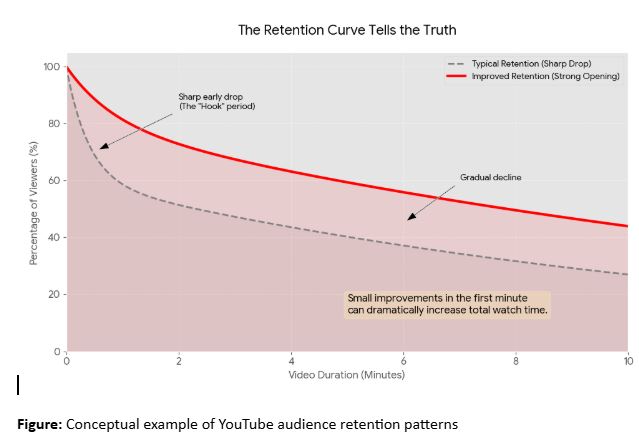
Figure: Conceptual example of YouTube audience retention patterns
Sharp early drop. Gradual decline afterward. This is normal.
But if the first drop is extremely steep, watch time struggles to grow because viewers leave too early. Small improvements in the first minute can dramatically increase total watch time. Even a 10 percent retention improvement early in the video can multiply total watch minutes, which is why strong openings matter so much.
The “Expectation Gap” Problem
Sometimes, the problem is not the content. It is the mismatch between promise and delivery. Your thumbnail promises one thing. The video starts somewhere else. That gap breaks trust instantly.
Viewers click expecting one experience and receive another, so they leave. This is often called the expectation gap. Closing that gap can significantly improve watch time.
Simple techniques include:
- Confirm the promise in the first 10 seconds
- Preview the value viewers will receive
- Remove long intros
- Start with the most interesting point
When the viewer feels they clicked the right video, they stay. And when they stay, watch time grows.
Watch Time is a Story About Attention
At first glance, analytics feels like numbers. Views. Minutes watched. Retention percentages. But underneath those numbers lies something simpler.
Human attention. Viewers decide within seconds whether something deserves their time. Every title creates an expectation.
Every opening either confirms it or breaks it. Every minute of the video either builds curiosity or loses it. And that’s the deeper pattern behind the watch time mystery. More views do not automatically create more watch time. Attention does.
Conclusion
At first, it feels confusing. More views appear in your analytics, but watch time barely moves. The numbers seem disconnected. Yet once you look deeper, the pattern becomes clear.
Views measure curiosity. Watch time measures commitment. And YouTube’s algorithm cares far more about commitment.
If viewers leave early, watch time remains low regardless of how many people clicked. But when videos hold attention, something powerful happens.
Watch time grows. Recommendations increase.
The algorithm begins to trust the content. Therefore, when you have no increase in watch time even with increased views, then the solution is often in three areas:
Retention.
Expectation.
Attention.
Fix those, and the numbers start telling a very different story.

Sign up for SocialWick
Login
InstagramYouTubeTikTokFacebookTwitchSpotifyTwitter (X)SoundCloudIGTVLinkedInThreadsWebsitePinterestVKApple MusicSEO
Checkout
OK

Information
Order processing usually starts within a few minutes, but some services may take a few hours or even a few days. We offer free refills for up to 90 days if needed. Our services are 100% secure and discreet, with a focus on gradual and safe delivery for your peace of mind.
Order processing usually starts within a few minutes, but some services may take a few hours or even a few days. We offer free refills for up to 90 days if needed. Our services are 100% secure and discreet, with a focus on gradual and safe delivery for your peace of mind.
Where should we send your order confirmation?
No account needed! We send your confirmation and tracking link here.
Secure checkout. We never share your email.
Have an account?•
Log in
Use your account to pay faster with your saved details.
Create account
Create an account to track all your orders in one place.
Service
+0,00
Voucher
-0.00
Total
+0.00
OK
Affiliate & Reseller Program
Customer Support
How may we help you?
General Support
Order Support
Frequently Asked Questions
1) What services do you offer?
We are a social media marketing company, and we offer a wide variety of services across several platforms that our clients can choose from. Once selected, we create a plan that fits your needs. We offer several types of services, such as followers, subscribers, likes, views, song plays, etc.
2) Is your service safe?
Yes, as we only sell real followers, likes, views, etc., and we hold every service to strict authenticity and quality standards. In order to protect your account, we deliver every order carefully and gradually. We closely monitor all our services. For more information, we strongly recommend reading our Terms of Service before you order.
3) Will I need to give you the passwords for my accounts?
No, you can keep your passwords to yourself because our services don’t need a password to influence your accounts. And if an email ever shows up claiming to be from us and asking for a password, it’s definitely not us, so please let us know right away.
4) Are the likes, followers, and subscribers real, or are they bots?
Unlike many other services, all our likes, followers, and views come from real accounts operated by real people. You won’t find bots, fake profiles, or hijacked accounts anywhere in what we deliver. Every order has to pass our strict authenticity standards, and we keep checking our quality to make sure it stays that way.
5) How fast can you deliver my order?
We will show you the estimated delivery time when choosing the service. However, this is only a rough estimate. In most cases, the services are delivered much faster. In some cases, it may take longer. We always aim for a natural and safe delivery!
6) What are your best-selling social media marketing services?
Although we have many services across most social media companies, our services for Instagram, TikTok, and YouTube are our best-selling options.
7) How do I know my account will not be flagged or banned?
We take safety very seriously. We never ask for your password, all followers, likes, and views come from real accounts, and orders are usually delivered gradually and naturally. What we can promise is careful delivery and strict quality standards. Plus a support team that’s there whenever you need us. We are not aware of a single case since 2017 where a customer got his profile banned.
8) What is the best method to communicate with you?
Do you have a question or run into a problem? Our customer support is available 24/7 for you. Just click Contact and you’ll land right on the support form. When you buy one of our services, we will email you to see if there were any problems. Your satisfaction is our main priority.
9) Are there discounts for large orders?
Yes! If you would like to request a large order that isn’t on our ordering layout, we will have no problems accommodating you. Just reach out through the support form and we’ll put together a buying plan that fits what you need.
10) What methods of payment do you accept?
We accept all forms of credit and debit cards, as well as Klarna, eps, PayPal, and Crypto.
11) If I am unsatisfied with your services, am I able to receive a refund?
Yes! Every purchase comes with a 30 day money-back guarantee. Not satisfied? Just contact our support within 30 days of your purchase and send us your order details and a short note on what went wrong, and we’ll take a look at your case. The full conditions are in our Refund Policy.
12) I haven’t received my order
Please make sure the following criteria are met before placing an order to make sure we can deliver it successfully.
- Your account is set to public
- You have typed in the correct username or link
- You have not changed your username before the order’s completion
- The post or account still exists and has not been deleted
- The post or account has not been restricted or removed in some countries
- Allow the estimated delivery time for completion of your order
For further assistance, please message our support team through the contact form.
13) How can I request a refill?
Just send us a refill request through the contact form. Please note that we can only provide you with a free refill within the first 90 days of your purchase.
Learn More
What is SocialWick?
We are the leading marketplace for social media promotion. You can buy followers, likes, views, subscribers, and a lot more for almost all social media networks. We offer affordable prices without making any compromises in terms of the service quality. We have a strict policy to only sell social media signals from real people. Part of our engagement, for example, comes from ad-based promotion where real users discover the content through ads. Bots, fake profiles, and hijacked accounts have no place in our services. Every delivery has to meet our authenticity standards, and we run regular quality checks, and anything that does not meet them is removed from our catalog. Our services are available for personal use, whether you want more Instagram likes, TikTok followers, YouTube views, or something else for your own profile.
With over a million satisfied customers, SocialWick is the go-to platform for all your social media needs. Our services are discreet and secure, with gradual and careful delivery to keep your social media accounts safe.
About SocialWick — The Market Leader since 2017
With more than 10 million orders, SocialWick is one of the world’s biggest social media stores. You can find everything on our website to improve your presence on major social media platforms like Instagram, TikTok, YouTube, Twitter (X), Facebook, etc. We offer different types of services for several social media platforms. Your wish is our command, and whatever your goal might be, SocialWick will help you achieve it. Whether you need more likes on your Instagram photos or want to make your LinkedIn profile more popular by getting additional followers, SocialWick is there to turn your goal into reality.
Thanks to our effective services and our customer-oriented work, SocialWick has become a top player. You will not find a better service anywhere else, especially not at such affordable prices. SocialWick is operating since 2017.
365 Days Per Year Customer Service
Your satisfaction is our motivation! We’re not here just for the money; we do our work to help people find their road to social media success. And that’s why our team will do all to make sure everything goes according to plan. If there’s something wrong with your social media campaign, or worry that there might be some problems with your account, or want to learn more about how our services work, feel free to reach out. Our service staff is there for you seven days a week, ready to answer any of your questions. You can get in touch with us using the contact form on our website.
Buying Followers and Likes is Essential
Unless you’re Kylie Jenner, you definitely need some help with social media. The more followers you have on Instagram, TikTok, Twitter (X), or YouTube, the more people will automatically notice you. Having all those eyes on your content isn’t just impressive, it’s genuinely fun. The bad news is that everyone wants to be famous these days, but only a few can succeed. The good news is that you can be the chosen one who will get social media fame and everything that comes with it. But, for that, you need a little help from your friends at SocialWick.
With our help, you will increase the number of followers on social media, which can have a domino effect and bring you even more new followers. Once people see that you got a big followership, they will decide to give you a follow. "If a profile has so many followers, it means that it’s interesting" – you can be sure this is going to be their reasoning. Furthermore, more followers mean more visibility for everything you post. Finally, a large number of followers also do great for your credibility. Our social media services will help you to create a better overall picture of your profile.
Let’s be honest; a profile with 30,000 followers looks much better than one with 74 followers. And that’s exactly what new visitors will pay attention to. A weak social media profile can be a real deal-breaker. At the same time, a fantastic social media profile can do wonders for you. And SocialWick can make your social media profile amazing!