#1 Social Media Marketplace
Accelerate Your Social Media Growth with SocialWick. Quickly gain real followers, viewers, likes & more with our blend of marketing tactics. SocialWick is known for its fast delivery, premium quality, and low prices. With over a million satisfied customers since 2017, trust SocialWick to take your social media game to the next level.
1.4 M
Customers
13 M
Orders
362 M
Followers sold
1.8 B
Likes sold
YouTube Renames Its Repetitious Content Policy
Published on 11.05.2026 by Tracey Chizoba Fletcher
At some point, almost every creator on YouTube has wondered the same thing: What exactly counts as “repetitive content”? But most importantly, why are there some channels that get punished over it, and yet others appear to prosper off doing what others do similarly?
The answer was long-term and unclear.
Repetitive content was one of the policies stated by YouTube, yet the meaning was general. Open to interpretation. Hard to apply in practice. That created confusion.
Since repetition is not necessarily evil, as a matter of fact, a lot of successful channels depend on consistency—similar formats, familiar structures, recognizable styles. So where is the line?
Here’s the interesting part. YouTube did not just clarify the policy. It renamed it, and that slight transition tells something more.
This is not all about wording. It is concerning the way YouTube would like creators to think of value, originality, and contribution. What most people don’t realize is that platforms rarely change language unless the underlying system has already shifted. And this is where things get interesting.
The renaming of “repetitious content” is less about policing creators and more about redefining what counts as meaningful content in an algorithm-driven ecosystem.
This article walks through that shift. What changed? Why did it change? And what does it mean for creators moving forward?
Why the Original “Repetitious Content” Policy Was Confusing
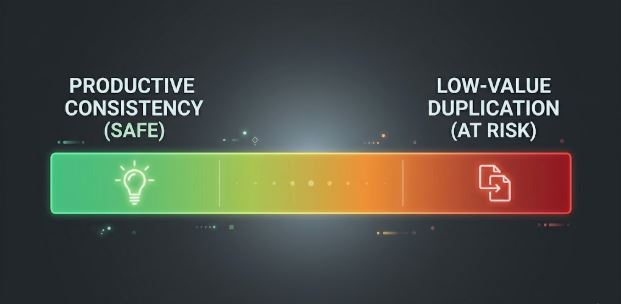
On the surface, the term “repetitious content” sounds clear. Content that repeats itself. But in practice, it created a lot of gray areas because repetition exists in almost every successful content strategy.
Think about it. Educational channels repeat formats. Reaction channels follow similar structures. Even storytelling channels often use the same narrative patterns. So if repetition is everywhere, why penalize it?
The problem was not repetition itself. It was how it was interpreted. YouTube’s original wording did not clearly distinguish between “productive repetition” and “low-value duplication,” and that made the creators guess.
Here is where things got tricky.
Some creators would produce slightly modified versions of the same video. Same script. Same visuals. Minimal changes. Others would follow a consistent format but deliver new insights each time.
To the system, both could look similar at first glance, but they were essentially different.
Let us break that down:
Type of Repetition Characteristics Value
Structural repetition Same format, new content High
Content duplication Same content, minor changes Low
Aggregated clips Compiled, reused material Low
Thematic consistency Same topic, new perspective High
The policy struggled to separate these clearly, and that created uncertainty. Creators did not know whether they were building consistency or risking penalties.
What the Renaming Actually Signals
Renaming a policy might seem minor, but it is not because language shapes interpretation, and interpretation shapes behavior. Here’s the interesting part.
When YouTube moved away from the term “repetitious content,” it was not just simplifying language. It was shifting focus from repetition to value.
The new framing emphasizes whether the content adds something new and not whether it looks similar. It is a little but significant difference.
The question changed. Instead of asking, “Is this repetitive?” The system now asks, “Does this add value?”
Let us break this into layers.
First Layer, Simple Explanation.
Creators can use similar formats as long as each piece of content contributes something new.
Second Layer, Deeper Mechanism.
On YouTube, such signals are analyzed through watch time, retention, and engagement, and can determine whether a piece of content is new or repeat. According to YouTube, recommendations are largely driven by what viewers watch and how they respond, including factors like watch time, clicks, and satisfaction signals.
Third Layer, Real-World Implication.
Creators who rely on copying or recycling content without adding insight are more likely to struggle. Those who build structured formats with new ideas can thrive.
This encourages a different kind of consistency. Not repetition for efficiency. But repetition with variation.
How the Algorithm Detects “Low-Value Repetition”
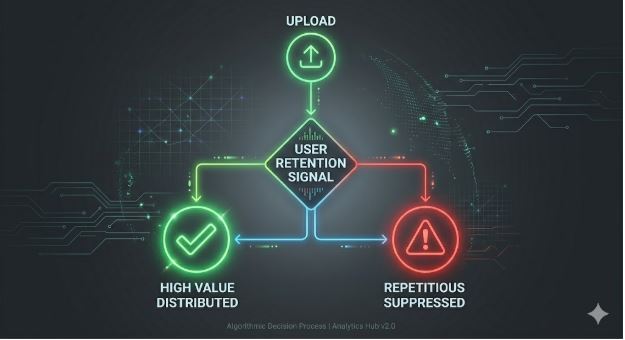
YouTube does not manually review most content. The system relies heavily on data signals, which means “repetitious” is not judged by humans alone. It is inferred through behavior.
If viewers treat your content as repetitive, the algorithm picks up on that.
Here are some key signals:
• High drop-off rates
• Low engagement
• Repeated patterns of abandonment
These signals indicate that viewers are not finding enough new value.
Behavior reveals perception. Now compare that to high-performing content.
Even if the format is similar, strong retention and engagement signal that viewers see each video as unique.
Here is a comparison:
Signal Low-Value Content High-Value Content
Watch Time Drops early Sustained
Retention Sharp decline Gradual
Engagement Minimal Active
Return viewers Low High
The algorithm is not just analyzing content. It is analyzing the response. And that is what determines whether something feels repetitive.
The Fine Line Between Consistency and Redundancy
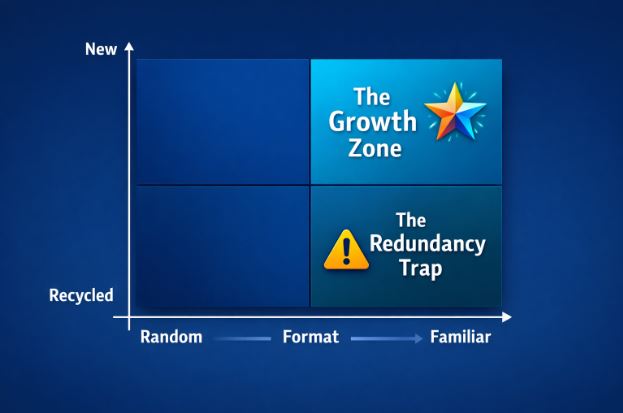
This is where most creators struggle. Consistency is necessary, and redundancy is dangerous, but the difference is not always obvious.
Consistency refers to the provision of content in a similar format. Redundancy is providing the same value in a repetitive manner. Format can repeat. Insight cannot.
Let’s look at an example.
A productivity channel might post weekly videos with the same structure:
Hook → Problem → Solution → Example
That is consistent. However, when all of the videos present something new, a new idea, or a new use, it is worthwhile.
Compare that to a channel that takes the same advice with a few changes in wording. That becomes redundant, the surface looks similar, and the depth is different.
Here is a quick breakdown:
Aspect Consistency Redundancy
Format Repeated Repeated
Ideas New Recycled
Value Expanding Stagnant
Audience response Engaged Disengaged
Growth lives in the difference. Creators who understand this line can scale without risking penalties.
What This Means for Different Types of Creators
Not all creators are affected equally. The impact of this policy shift varies depending on content type.
Let’s break it down.
Educational Creators
These creators are in a strong position because their content naturally evolves. Each video can explore a new concept, even within a consistent format. As long as the information is fresh, repetition is not an issue.
Reaction Channels
This is more nuanced. Reactions can feel repetitive if they add little commentary, but when creators provide unique insights, humor, or analysis, the content becomes transformative.
The reaction matters more than the content.
Compilation Channels
These are at a higher risk because they often rely on reused material. Without significant transformation, this content can be flagged as low-value.
Short-Form Content Creators
Short videos often follow trends. This increases the risk of repetition, but creators who add a unique twist can stand out. It is not about avoiding trends. It is about adding perspective.
The Bigger Shift: From Content Volume to Content Value
For years, many creators focused on volume. More videos. More uploads. More output. That worked for a while, but platforms evolve, and so do their priorities.
YouTube is shifting toward value and not just how much you post, but what each piece contributes. More is no longer enough.
Here is what this shift looks like:
Old Approach New Approach Redundancy
High volume High value Repeated
Repetition for scale Variation for engagement Recycled
Algorithm chasing Audience focus Stagnant
Quantity metrics Quality signals Disengaged
This does not mean posting less. It means posting with intention. Each video should have a reason to exist. A clear contribution. A unique angle.
Conclusion
At first glance, renaming a policy might not seem like a big deal. But in this case, it reflects a deeper shift, one that moves from repetition to value, from rigid structure to meaningful substance, and from chasing volume to focusing on impact.
YouTube is not pushing creators away from consistency; it is pushing them away from stagnation, and that distinction matters.
The creators who perform best already understand this. They work within familiar formats, but continuously introduce new ideas, fresh perspectives, and sharper insights.
That is what keeps audiences engaged over time, and that is what the platform is now rewarding more clearly. In the end, the takeaway is straightforward: do not just repeat, evolve.

Sign up for SocialWick
Login
InstagramYouTubeTikTokFacebookTwitchSpotifyTwitter (X)SoundCloudIGTVLinkedInThreadsWebsitePinterestVKApple MusicSEO
Checkout
OK

Information
Order processing usually starts within a few minutes, but some services may take a few hours or even a few days. We offer free refills for up to 90 days if needed. Our services are 100% secure and discreet, with a focus on gradual and safe delivery for your peace of mind.
Order processing usually starts within a few minutes, but some services may take a few hours or even a few days. We offer free refills for up to 90 days if needed. Our services are 100% secure and discreet, with a focus on gradual and safe delivery for your peace of mind.
Where should we send your order confirmation?
No account needed! We send your confirmation and tracking link here.
Secure checkout. We never share your email.
Have an account?•
Log in
Use your account to pay faster with your saved details.
Create account
Create an account to track all your orders in one place.
Service
+0,00
Voucher
-0.00
Total
+0.00
OK
Affiliate & Reseller Program
Customer Support
How may we help you?
General Support
Order Support
Frequently Asked Questions
1) What services do you offer?
We are a social media marketing company, and we offer a wide variety of services across several platforms that our clients can choose from. Once selected, we create a plan that fits your needs. We offer several types of services, such as followers, subscribers, likes, views, song plays, etc.
2) Is your service safe?
Yes, as we only sell real followers, likes, views, etc., and we hold every service to strict authenticity and quality standards. In order to protect your account, we deliver every order carefully and gradually. We closely monitor all our services. For more information, we strongly recommend reading our Terms of Service before you order.
3) Will I need to give you the passwords for my accounts?
No, you can keep your passwords to yourself because our services don’t need a password to influence your accounts. And if an email ever shows up claiming to be from us and asking for a password, it’s definitely not us, so please let us know right away.
4) Are the likes, followers, and subscribers real, or are they bots?
Unlike many other services, all our likes, followers, and views come from real accounts operated by real people. You won’t find bots, fake profiles, or hijacked accounts anywhere in what we deliver. Every order has to pass our strict authenticity standards, and we keep checking our quality to make sure it stays that way.
5) How fast can you deliver my order?
We will show you the estimated delivery time when choosing the service. However, this is only a rough estimate. In most cases, the services are delivered much faster. In some cases, it may take longer. We always aim for a natural and safe delivery!
6) What are your best-selling social media marketing services?
Although we have many services across most social media companies, our services for Instagram, TikTok, and YouTube are our best-selling options.
7) How do I know my account will not be flagged or banned?
We take safety very seriously. We never ask for your password, all followers, likes, and views come from real accounts, and orders are usually delivered gradually and naturally. What we can promise is careful delivery and strict quality standards. Plus a support team that’s there whenever you need us. We are not aware of a single case since 2017 where a customer got his profile banned.
8) What is the best method to communicate with you?
Do you have a question or run into a problem? Our customer support is available 24/7 for you. Just click Contact and you’ll land right on the support form. When you buy one of our services, we will email you to see if there were any problems. Your satisfaction is our main priority.
9) Are there discounts for large orders?
Yes! If you would like to request a large order that isn’t on our ordering layout, we will have no problems accommodating you. Just reach out through the support form and we’ll put together a buying plan that fits what you need.
10) What methods of payment do you accept?
We accept all forms of credit and debit cards, as well as Klarna, eps, PayPal, and Crypto.
11) If I am unsatisfied with your services, am I able to receive a refund?
Yes! Every purchase comes with a 30 day money-back guarantee. Not satisfied? Just contact our support within 30 days of your purchase and send us your order details and a short note on what went wrong, and we’ll take a look at your case. The full conditions are in our Refund Policy.
12) I haven’t received my order
Please make sure the following criteria are met before placing an order to make sure we can deliver it successfully.
- Your account is set to public
- You have typed in the correct username or link
- You have not changed your username before the order’s completion
- The post or account still exists and has not been deleted
- The post or account has not been restricted or removed in some countries
- Allow the estimated delivery time for completion of your order
For further assistance, please message our support team through the contact form.
13) How can I request a refill?
Just send us a refill request through the contact form. Please note that we can only provide you with a free refill within the first 90 days of your purchase.
Learn More
What is SocialWick?
We are the leading marketplace for social media promotion. You can buy followers, likes, views, subscribers, and a lot more for almost all social media networks. We offer affordable prices without making any compromises in terms of the service quality. We have a strict policy to only sell social media signals from real people. Part of our engagement, for example, comes from ad-based promotion where real users discover the content through ads. Bots, fake profiles, and hijacked accounts have no place in our services. Every delivery has to meet our authenticity standards, and we run regular quality checks, and anything that does not meet them is removed from our catalog. Our services are available for personal use, whether you want more Instagram likes, TikTok followers, YouTube views, or something else for your own profile.
With over a million satisfied customers, SocialWick is the go-to platform for all your social media needs. Our services are discreet and secure, with gradual and careful delivery to keep your social media accounts safe.
About SocialWick — The Market Leader since 2017
With more than 10 million orders, SocialWick is one of the world’s biggest social media stores. You can find everything on our website to improve your presence on major social media platforms like Instagram, TikTok, YouTube, Twitter (X), Facebook, etc. We offer different types of services for several social media platforms. Your wish is our command, and whatever your goal might be, SocialWick will help you achieve it. Whether you need more likes on your Instagram photos or want to make your LinkedIn profile more popular by getting additional followers, SocialWick is there to turn your goal into reality.
Thanks to our effective services and our customer-oriented work, SocialWick has become a top player. You will not find a better service anywhere else, especially not at such affordable prices. SocialWick is operating since 2017.
365 Days Per Year Customer Service
Your satisfaction is our motivation! We’re not here just for the money; we do our work to help people find their road to social media success. And that’s why our team will do all to make sure everything goes according to plan. If there’s something wrong with your social media campaign, or worry that there might be some problems with your account, or want to learn more about how our services work, feel free to reach out. Our service staff is there for you seven days a week, ready to answer any of your questions. You can get in touch with us using the contact form on our website.
Buying Followers and Likes is Essential
Unless you’re Kylie Jenner, you definitely need some help with social media. The more followers you have on Instagram, TikTok, Twitter (X), or YouTube, the more people will automatically notice you. Having all those eyes on your content isn’t just impressive, it’s genuinely fun. The bad news is that everyone wants to be famous these days, but only a few can succeed. The good news is that you can be the chosen one who will get social media fame and everything that comes with it. But, for that, you need a little help from your friends at SocialWick.
With our help, you will increase the number of followers on social media, which can have a domino effect and bring you even more new followers. Once people see that you got a big followership, they will decide to give you a follow. "If a profile has so many followers, it means that it’s interesting" – you can be sure this is going to be their reasoning. Furthermore, more followers mean more visibility for everything you post. Finally, a large number of followers also do great for your credibility. Our social media services will help you to create a better overall picture of your profile.
Let’s be honest; a profile with 30,000 followers looks much better than one with 74 followers. And that’s exactly what new visitors will pay attention to. A weak social media profile can be a real deal-breaker. At the same time, a fantastic social media profile can do wonders for you. And SocialWick can make your social media profile amazing!