While social media offers many benefits, it also has one downside. It can take a lot of time, effort, and resources to grow your following. From brainstorming social media content ideas to creating content and engaging with followers, there is a lot to do. If you don't have a dedicated social media management team, these tasks can overwhelm you.
The good news is that AI has revolutionized how social media content is created. From caption-generating tools to image and video generators, there are many AI tools that can make social media content creation easier. In this article, we guide you on AI content creation tools for social media.
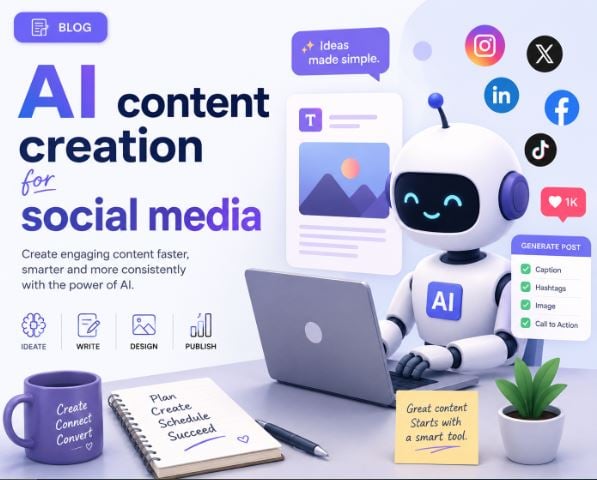
What is AI Content Creation for Social Media?
AI content creation for social media involves using generative AI tools such as Canva, Midjourney, and ChatGPT to automate, scale, and optimize your content, thereby reducing the time you would have spent on it.
It involves developing personalized, targeted, and visually appealing content that meets your social media audience's needs. It can also involve setting up an automated content calendar and using AI tools to analyze your audience's behavior and drive better engagement.
Benefits of AI Social Media Content Creation
Using AI for your social media content creation comes with a lot of benefits, such as:
Saving Time and Resources
AI content creation tools allow users to create content, such as copy and calendars, in a few minutes. This means they can be huge time-savers for teams, allowing them to focus more on the strategic post. Tasks that previously took hours or days can now be completed in minutes.
Brainstorming Content Ideas
If you are facing writer's block, AI social media content creation tools can help you brainstorm ideas for your posts. They can also come in handy when you want to create large content volumes within a short time. AI social listening tools can help you analyze trends and identify content that resonates with your target audience.
Content Calendar Optimization
Nowadays, AI platforms such as Metricool offer automation features, including optimal posting-time recommendations, copy performance analysis, and tone adaptation for social media. AI can analyze thousands of posts and track their performance across different accounts. It can help you identify anomalies, trends, and opportunities that would otherwise have taken longer to find.
Automation and Efficiency
AI tools can handle many tasks, from scheduling posts to responding to comments to generating content variations. This means the best AI tools for social media scheduling can free up your time so you can focus on higher-level strategic planning.
Better Targeting and Personalization
AI tools can enable you to deliver content to your most relevant audience segment. You can use it to analyze user preferences and data, so you can focus on creating content and captions that drive higher engagement and reach.
Content Performance Analysis
You can use AI tools to analyze your content's performance, thereby gaining insights into what works for your target audience. When you discover that a particular content format isn't working, you can adjust the strategy to optimize content creation and achieve better results.
AI Community Tools
ChatGPT has become a major tool for community managers because of its ability to write copy, replies, messages, and scripts. Alternatively, tools such as Jasper.AI or Copy.ai offer optimized templates for social media platforms like Instagram, TikTok, and LinkedIn. When it comes to graphic design, a tool like Canva offers Magic Write, which can generate text posts and visuals based on your prompt.
A Comprehensive Tool
AI tools also enable creators to automatically generate content, analyze their data, and schedule posts, all from a single location. This makes them suitable for saving time and ensuring a consistent digital presence.
How to Develop an AI Social Media Content Strategy
Here are the steps to follow when setting up an AI content creation strategy:
Determine Your Goals
Before you choose AI tools, determine what you are trying to achieve with them. Do you want to create more content more efficiently, or do you need faster SEO results? Remember, you need a smarter goal than simply using AI to create social media content.
Here are some ideas to help you determine your goal:
- Increase the volume of the content you create. It could be that your team is already stretched thin or that you are struggling to maintain a consistent posting schedule across different platforms. AI can help you create content faster without burning out.
- Minimize the content creation time. Are you spending hours creating, editing, and formatting content for different channels? This is also a good reason to choose AI social media tools.
- Scale your content creation. When you have a presence across different social media platforms, creating content can be harder. You can, therefore, aim to create and adapt content to improve the channel's efficiency.
- Higher engagement rate. Remember that using AI would magically drive your content engagement. However, it can help you identify the pattern that may be working, so you can use the insights consistently.
Choose one or more goals to get started. You can always add to the goals later. Otherwise, if you try to do everything at once, nothing will get done.
Audit Your Current Content Performance
You should start by determining how much time your team spends creating content and assessing the different social media channels. Also, consider the time required to review the content's performance. Therefore, track the time spent generating content ideas, creating, editing, monitoring, scheduling, and analyzing content performance.
Honestly, auditing your content's performance can help you identify the areas where AI can have the biggest impact. Review the content process for your social media and identify the most common bottlenecks. You should also understand content performance and which types drive the highest engagement. You want to ensure you have a baseline against which to measure the content strategy.
Consider Social Media Tasks to Automate
The fact that there are various AI social media tools doesn't mean you need to automate all your tasks. Remember that you are automating to free up your time and mental energy, so you can focus more on tasks that require your judgment and creativity.
When considering the task to automate, you will have different options, such as:
- Content ideation. You can use AI tools to generate content ideas for your social media posts, such as topic generation, competitor analysis, and discovering trends. With its ability to scan large volumes of data, AI can provide insights into what is already gaining traction in the industry.
- Content creation. AI tools can help generate visual concepts, scripts, hashtags, and captions. However, take note that the goal isn't to completely replace human creators but to generate your first draft or improve your existing draft.
- Content optimization. AI can provide insights into the best posting time, A/B test your captions, and test different copies for different audiences.
- Content distribution. You can leverage the social media tools to handle your post scheduling and adapt content to the needs of the different platforms, or even create social snippets from long-form posts.
- Content performance analysis. You can use AI social media tools to track metrics and benchmark against competitors. You can also collect data on areas where your social media managers and marketers spend a lot of time to automate them.
After you have combined performance data from different channels, you will find it easier to view all the data in a single dashboard. You can also see your consolidated metrics from one place, such as the total number of posts, engagement, video views, follower growth, and more.

Choose the Right AI Content Creation Tool
After determining which tasks need automation, you will now need to choose the right tool to handle them. This can be daunting, as there are hundreds of AI content creation tools and new ones are launched every day. So, how do you choose the right one? There are several factors you need to consider, such as:
- Integration ease. You should ensure that your tool integrates well with your current social media platforms.
- Ease of use. You want to select a user-friendly tool that doesn't require a steep learning curve. You should be able to start using the tool immediately.
- Insights and analytics. Select tools that offer deep insights, not just random engagement numbers. The tool should provide insights into content performance, audience demographics, and sentiment.
- Content creation and scaling up. Make sure that the tools you choose enable you to create, schedule, or repurpose large volumes of social media posts.
- Data security. Ensure that the tool you select complies with the data privacy laws so your business isn't accused of data breaches.
- Branding consistency. Can the tool help you maintain a consistent brand voice across different platforms? Is it possible to track and analyze your brand mentions in real time?
Start Planning and Strategizing
Now that you have defined your goals and chosen the right tool, you can move on to the next step: the actual content planning. This moves you to the actual content creation. However, when doing this, ensure every decision is backed by historical data rather than guesswork or short-term trends.
Again, when strategizing, AI can help you identify the content pillars that will resonate with your target audience and warrant more focus. Take time to determine the content themes that are already working for you and your competitors on different platforms, and pay more attention to the content theme that appeals to you. This will ensure that instead of starting from scratch, you can build a content theme around pillars that have already proven to drive engagement.
Create AI Content
After determining the strongest content pillars, you will need to map them across content types, identify where they perform best, and allocate content more effectively. You will then use the data insights to determine the volume of each content type to create, the platforms to use, and how to balance educational and promotional content.
However, even as you use AI to create your first structure based on data, you need more room to adapt and create what works. When creating an AI content creation strategy, you need to iterate, plan, publish, and refine it.
When using AI for content creation, you should:
Batch Create Your Content
One area that will help you in content creation is by creating several variations of the same content at scale. Rather than spending hours writing and editing your caption, AI will enable you to instantly create several variations of the caption at once. This can be particularly helpful, as creating large volumes of content is one of the challenges marketers often face. Remember that the approach you use depends on the platform you are creating content for. For instance:
- Instagram. You can use AI tools to create reels and identify trends. AI tools can also provide insights into the kinds of content that are growing in popularity before they reach their peaks. Through the AI social media prompts, you can have some creative prompts fast.
- Facebook. You can use AI to create some community-focused content. Specifically, you can use AI to generate conversation starters, drive engagement in groups, and create content that's easy to share.
- TikTok. You can use AI to create scripts for your videos in a trending format. Remember that TikTok is a fast-moving platform, and AI tools can help create scripts that align with trends while maintaining your brand voice.
- LinkedIn. You can use AI tools to articulate difficult ideas clearly and consistently. There are AI tools to enhance your LinkedIn content creation, helping you generate post ideas, draft posts and even add commentary on a given topic.
- X (formerly Twitter). X is another fast-moving platform that can make it hard for you to manually maintain a consistent posting schedule. The good news is that you can use AI tools to respond to the relevant trends.
Remember that while AI can hasten content creation and help scale everything, you will still need human oversight, or else you might end up posting irrelevant or meaningless content.
Repurpose Your Top Content
It is not realistic to always create new content from scratch for every social media platform. This is why it would help you identify your best-performing content and repurpose it for different platforms. The good news is that there are tools that can help to make the whole repurposing process easier.
These tools can help you turn long-form LinkedIn articles into different Instagram carousel posts, TikTok scripts, or X Threads. If you had a top-performing reel, you could adapt it into a top YouTube Short, complete with the hooks and captions. The idea is to use content that is working. Pay attention to your top post and consider what resonates with your target audience. You can then translate these elements into different formats.
Compare AI vs. Non-AI Formats
Another important step to consider when creating AI content is whether it performs as well as content your team creates manually. While AI can help speed up the content creation process, you need to determine whether that efficiency comes at a cost to engagement.
When tracking the performance of your AI content, you are likely to face one challenge: many social media analytics tools do not differentiate between manually created and AI-generated content. Instead, they will provide you with aggregated numbers. However, some third-party tools, such as Social Insider, solve this problem through the post tagging option, which allows you to add custom labels, such as AI-generated. You can then use the tag to analyze the post's performance.
This can provide you with insights into the performance of your AI-generated content compared to the manually written content. As you continue collecting data, you will have enough to show whether AI posts are performing better than manually written ones. This kind of AI social media analysis is important, as it will help you refine your resource management and strategy. When you discover that the AI social media analysis is performing better, you can allow the AI tools to handle most of the work.
Tips For Using AI Tools For Content Creation
To ensure the best results in your AI social media content creation, consider using these tips:
Use Specific Prompts
One of the most important factors when using AI tools for content generation is to be as specific as possible. This is important because the more specific you become with your prompt, the better the results you will get. If you use a vague prompt such as "write a tweet on the best accounting software", you will only get dull, unclear, and generic responses. However, when you provide the tool with sufficient direction, context, and constraints, you will get results closer to what you are searching for.
There are certain details you should add to your prompt, such as:
- Your target length of post.
- Content's intention.
- Target audience.
- Angles and specific details to be covered in the response.
- Tone to be used.
Specify the Role the Tool Will Play
Defining the role you want the tool to play can help you improve your results. This is because it provides a buyer persona and helps the tool understand the task's context and deliver the desired output. For instance, if you want to create a LinkedIn post to promote a recent blog post, you can use this promotion idea: "Assume you are Mark, a founder of a tech start-up with 15 years of experience in a top Saas company…" This can provide the tool with better insight into the results you are looking for.
Provide References
When a generative tool has a reference, it can produce outstanding content as compared to when you explicitly tell it what to do. Therefore, be sure to include some instructions on the style to make the content informative, exciting, and succinct. You can also review the prompts you used in your previous great content and learn what you did right.
You can take it to another level by creating a library of reference pieces, such as the high-quality content you've used in the past that delivered outstanding results. Once you provide your tool with inspiration, it can better match your brand's tone of voice and deliver outstanding quality.
Check and Edit
The fact that an AI tool has produced content doesn't mean you should post it exactly as it is. While AI has come a long way in the last few years, it's not a perfect tool to replace humans. No matter how good your tools are or how great the prompts you use are, AI tools can sometimes get the content's purpose and tone wrong. It can label false information as facts. It will also use specific phrases to help readers and viewers recognize that the content is AI-generated.
You may want to run an AI detector test to eliminate robotic phrasing as you enhance your workflow, which would serve as a tune-up before the final review. Otherwise, if you simply copy and paste AI responses into your content calendar, you will put yourself at risk.
Many social media platforms now feature sophisticated algorithms that can easily detect generative AI content. Some platforms may mark such content as spam, hurting its organic reach. Additionally, if you use a non-universal or specific prompt, you may end up with generic content that makes it hard for users to detect your brand voice in the feeds, reducing content engagement.
In Conclusion
AI can be an effective tool for speeding up your content creation efforts. It can help you handle the heavy tasks and various content variations while maintaining judgment at the centre of your strategic and creative decisions. By following the steps outlined in this guide, tracking what is working and refining your strategy, you can have an AI content creation strategy that works for your brand.
