Around 83% of marketers suggest that YouTube has helped them with video generation. By creating outstanding, high-retention YouTube videos, you can reach your target audience and demonstrate to them that your products or services are the best solution for their needs.
However, many creators and brands fail in their YouTube strategy because of a lack of strategy. Today, they are posting a dance trend video; tomorrow, a product review video; and the other day, a tutorial. Their channel doesn't feel like an authority but feels random, ending up confusing the algorithm. If you would like to avoid this challenge and show your expertise in your industry, focus on building topic clusters. In this guide, we help you understand how to build topic clusters on YouTube.
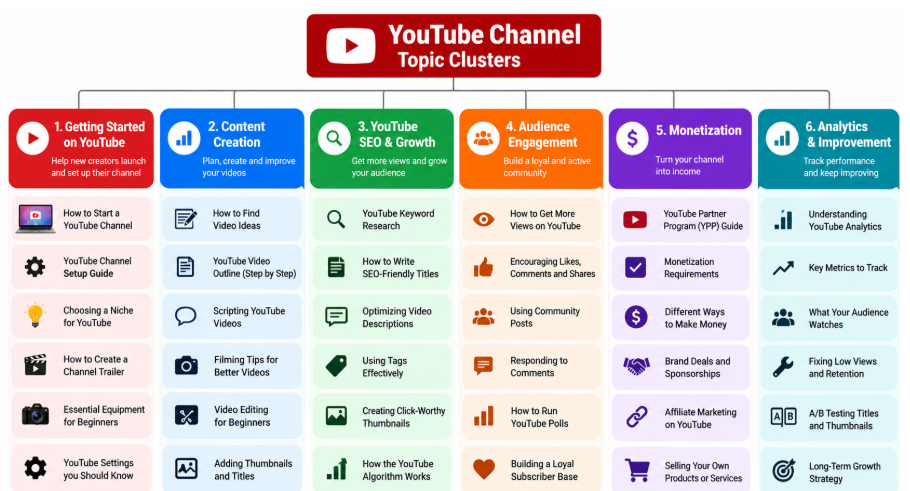
What are Topic Clusters on YouTube?
A topic cluster refers to a batch of interconnected videos built around a certain problem, format, demand pattern, or viewer's desire. Instead of creating videos that stand on their own, the topic cluster can enable you to create videos around a particular topic that reinforce one another. That means while they are interrelated, they serve audiences from various angles.
For instance, if the pillar video topic is on creating YouTube thumbnails, the cluster topics can be:
- Why are people ignoring your great thumbnail?
- This is what I found out after analyzing 100 thumbnails.
- This is the one thumbnail mistake small channels are making.
- Redesigning my most terrible thumbnail using this pattern brought 100K views in 1 week.
But is it similar to adding a YouTube playlist or a YouTube calendar for a playlist? The answer is no. The topic cluster shows you that there is demand in a subject worth building content on. As you can see, all the topics are interrelated and are about designing thumbnails. However, they serve similar viewers, meaning they are in one cluster. It isn't about a grouping of similar topics: it's about creating several videos serving the same purpose.
Why You Need Topic Clusters on YouTube
When you have a cluster in the place of individual videos, you can begin to see things hidden by individual videos, such as:
- Whether multiple creators are focusing on the same subject.
- Whether the interest continues to repeat across different content formats.
- Whether your videos are gaining more attention over time.
- Whether the topic can last beyond that breakout moment.
Therefore, this will provide insights into whether you are reviewing some real opportunities or some isolated cases of success.
How Cluster Helps Spot Patterns
If you make one video that goes viral, it will be more visible, leaving a strong impression. On the contrary, it can be harder to find a YT topic cluster that is strengthening. However, this doesn't mean the video is less valuable.
While analyzing videos individually, everything may look chaotic. A video may spike, while another goes viral. But when you analyze videos in clusters, you can easily spot the patterns. Instead of asking yourself "Why did this video go viral?" a cluster will show you:
- If a certain topic idea appears more regularly.
- If you have several creators gaining traction.
- Is your topic becoming stronger or just louder?
These questions are key to providing you with a long-term content strategy.
Why is this Key for Timing?
Before a breakout video receives the attention of the majority of people, the opportunity in the video is gone. To gain an advantage from a video that is performing well, spot it early. By looking at the performance of a cluster, you can see a pattern before it becomes obvious to others.
By looking at the surrounding cluster of different creators and smaller videos, it means the signal will already be there before it breaks out. It is only that the majority of people were looking at the wrong layer.
Why Clusters Have More Value Than Keywords
Keywords often refer to the language people use or how people phrase a question. On the contrary, clusters describe behavior. A keyword will tell you how people are phrasing a question. On the contrary, a cluster indicates behavior and whether people are converging around a similar topic. That means clusters can reveal more than keywords in early discovery.
This matters for brands and creators because clusters aren't only a concept of research. It changes how people make decisions.
Creators can better answer different questions like:
- How relatable is this topic?
- Is this trending up or fading?
- Is this video a growing area or a one-off success?
- Is my entry early enough to bring good results?
Instead of just copying what previously worked, these can be great questions.
Creating an Outstanding Content Cluster Plan
When creating a YT content cluster plan on YouTube, use the following steps:
Determine Your Viewers' Needs and Desires
A common mistake that many creators make when building clusters is to begin with keywords. A better idea would be to start with what your viewers want. For instance, they may need to earn more money on YouTube, increase clicks, grow their Facebook channel, improve their retention, and more. This is what will become the cluster's centerpiece.
Turn the Need into Problems
No matter the desire, you can always turn a need into a problem. For instance, if the viewer's desire is to gain more clicks, this can be broken down into several problems, such as:
- A confusing title.
- A boring thumbnail.
- Lack of a curiosity gap.
- Wrong choice of a topic.
- A mismatch between the title and the thumbnail.
- Targeting the wrong audience.
You can create a subcluster for each of these problems.
Competitor Video Analysis
You should look at the competitor video while paying attention to the different elements such as the title, thumbnail, URL, name of the channel, date of upload, viewer desire, and the outlier score. However, avoid copying their videos and topics and instead check the demand patterns. Your goal should be to detect a repeated signal.
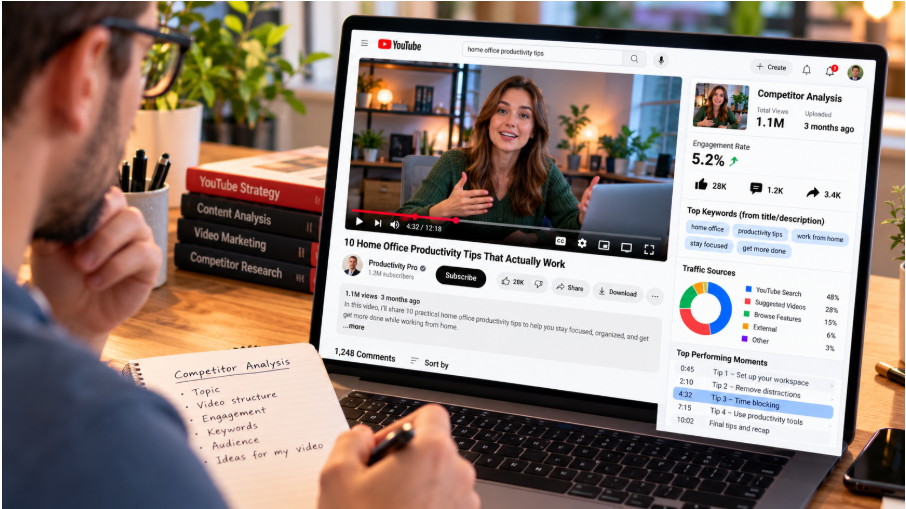
For instance, if you note that only one YouTube competitor made a video on the topic, that is a sign of a weaker signal. However, if you find that there were five competitors who made a video on the topic, with four of them outperforming their usual baseline, that can be a stronger signal. You can read our detailed guide on using competitor channels to generate video ideas.
Cluster Videos According to Viewer Intent and Main Keywords
You have probably already seen topic clusters working for written content. You can follow a similar model for YouTube videos, following a similar framework. You can begin by determining the content pillar, which would be the broader topic clusters from which your smaller topics will arise.
For instance, a financial institution can begin by creating content pillars on financial health. You can then have topic clusters like budgeting and retirement savings, etc. Make sure you create an outline for your topic clusters as you do with blog posts. You will use the outline as the roadmap for YouTube marketing.
A good method would be to cluster the videos according to the pillar topic. For instance:
- Mistakes in thumbnails.
- Increasing CTR.
- Testing thumbnails.
- Redesign of thumbnails.
- Thumbnails are getting ignored.
However, you should avoid stopping at the keyword and also go ahead and group according to the intent. For instance, "Why captivating thumbnails may not work" and the top thumbnail mistakes that hinder small channels' growth. They are serving one intent even though their wording is different. They explain to the viewer why people fail to click on videos, which is therefore the main cluster.
Separate the Tangle Clusters from the Topic Cluster
As compared to the topic cluster, a tangle cluster is more emotional, sharper, and better packaged. For instance, if the topic keyword is "YouTube thumbnail," a tangle cluster can be on "These YouTubers' thumbnails look good but fail". Make sure your topic cluster is broad enough for creating outstanding titles.
Number of Videos to Add to a Cluster
A good cluster should consist of at least five videos, while a stronger cluster should consist of ten to twenty videos. Having over 50 videos in a cluster in the long run can be termed a major cluster. To experiment with a cluster, you can have three videos. Anything below that cannot be termed a cluster. To fully experiment with your topic clustering, you need at least five videos.
If you can get at least 10 videos, that will provide real names for your content. With over 20 videos, you will have popular content for your channels. However, make sure that all the topics are strong and avoid adding weak topics just to match the numbers.
In Conclusion
Building a YouTube channel around a certain cluster can be a good way of establishing yourself as an expert in your industry. This can also help your audience better understand your channel's theme. Therefore, go ahead and use our guide to make a great topic cluster on YouTube.
