#1 Social Media Marketplace
Accelerate Your Social Media Growth with SocialWick. Quickly gain real followers, viewers, likes & more with our blend of marketing tactics. SocialWick is known for its fast delivery, premium quality, and low prices. With over a million satisfied customers since 2017, trust SocialWick to take your social media game to the next level.
1.4 M
Customers
13 M
Orders
362 M
Followers sold
1.8 B
Likes sold
Hosting a LinkedIn Audio Event with a Step by Step Guide From Our Experts
Published on 11.10.2025 by Tracey Chizoba Fletcher
The online universe of the business world expands at warp speed, and LinkedIn has been leading the way. Most familiar as a networking site, thought leadership site, and resume site, LinkedIn has worked tirelessly to develop technology to bring conversations to life in real-time.
Of its many offerings, the most thrilling is LinkedIn Audio Events—a product that virtually brings professionals together to present industry insights and participate in live, real-time audio conversations within communities.
Audio events find a perfect equilibrium between intimacy and accessibility. They’re not as stiff as video webinars and don’t have quite as much formality to them, but are a group discussion where all voices are equal.
Since they are on LinkedIn, they are grounded in professional learning and networking and are, therefore, perfect for thought leaders, founders, and creatives who need to establish credibility. You can’t just flip on the microphone and sit back and wait for things to unfold. It requires structure, preplanning, and proper technique to keep people attentive in the optimal manner for bringing people in—and keeping them there.
That is what this guidebook addresses. From creating your ideas to maintaining the conversation, experts have divided the procedure into step-by-step approaches.
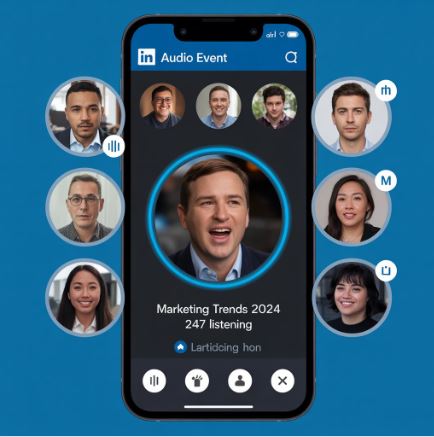
Step 1: Specify Your Goal Before Going Live
Even before making it as far as posting on LinkedIn solely so that you have a mechanism to organize your event, you ought to be thinking about one huge question: why the event? If you don’t have anything to concentrate on, you risk leaping into circular dialogue that provides nothing at all to your visitors.
Your mission might be to be industry cutting-edge, plan networking with professionals, or generate brand/company exposure for yourself or your company/brand. Even hosts utilize audio events as a forum to test out ideas for courses, podcasts, or product lines. Bringing your mission under consideration at inception makes structuring your event to your advantage, as well as that of your listeners, much easier.
Just to provide you with a tiny little illustration here, if you’re considering brand awareness, perhaps you might think about highlighting a wide industry trend to attempt to engage as many members of your crowd as humanly possible.
If you’re networking, perhaps you might be sure to leave attendees time to move around and introduce themselves, and discuss what they think. By getting that purpose out of the way, you are not only focused but you indicate to prospective guests why they should give you a minute or two of their time.
Step 2: Choosing the Right Topic and Format
That will be followed by step two of selecting an intriguing topic to discuss with your members. On LinkedIn, there is an interesting but professional discussion; therefore, think about topics that generate curiosity, arguments, or positive real-world knowledge.
If your company consists of a marketing department, you can construct an event around “The Future of AI in Content Creation.” If you are within the health industry, you can construct an event around “How Digital Health Tools Are Transforming Patient Care.”
No less important, though, is the type of event you organize. Do you organize a panel of a small number of speakers, a Q&A with the audience, or a one-talk where you give your talk and leave yourself open to questions?
All have drawbacks and advantages. Panels provide richness of perspective, Q&As allow for interaction, and one-talks are said to build authority.
Consider timing as well. Thirty minutes is ideal for speed of insight, but an hour session provides more to talk about. The trade-off is between the depth of content and your folks’ attention span. Do what you prefer, though: absolute clarity is required—if people are absolutely clear on exactly what they’re going to receive from appearing to you, they’re much more likely to engage.
Step 3: Schedule and Promote Strategically
If you’ve chosen your category and topic, you are ready to put your event on LinkedIn. It is easy to schedule, but to get people to come, you need to promote it.
Your LinkedIn Audio Events title needs to be concise and attention-grabbing to capture the subject and value of the experience. Similar to your headline—it needs to be thought-provoking and provide value. Don’t put on generic tags such as “Business Talk” and do something tangible like “5 Hiring Trends That Will Define 2025.”
By itself, scheduling does not commit to promotion. Put your event on the LinkedIn stream, invite contacts separately, and have your host speakers do the same. Weeks ahead of time, early reminder posting puts it in the limelight, and brief teaser bulletins create expectation.
For example, you can post statistics on your subject and invite viewers to respond beforehand. Don’t forget other locations as well. Promotion on e-mail newsletters, directory listings, or even on Twitter can bring more varied attendees.
The sooner you promote and the more you promote, the larger and more populated an event you are going to have.
Step 4: Get Your Tech and Environment Ready
One of the biggest errors that hosts make is to undervalue the role of technical planning. Although LinkedIn Audio Events are not difficult to host, there are still some details that are involved in case you need to sound professional.
Start out by purchasing yourself a good microphone or headset. Your “sound” has to be good; there’s nothing to get viewers to leave faster than background noise or fuzzy sound.
Pre-test your audio, checking volume as you would your internet connection. A wired setup crashes less during live sessions than one that uses Wi-Fi.
Your recording space matters as well. Select a quiet location where you will not be interrupted and eliminate background noise such as fans, phones, or traffic. Although you don’t have video, the professionalism of your audio space says a lot about your company.
Lastly, get yourself organized. A set of talking points, host partner queries, and a plan of action for how you’re going to cut to another segment prevents awkward moments of silence and guarantees smooth chat.
It’s your event’s behind-the-scenes invisible framework—guests might not even know about it, but they’ll definitely notice the difference.
Step 5: Write a Captivating Introduction
Your first few minutes on the LinkedIn Audio Event set the tone for the remainder of the event. A positive opening enables you to become the authority, sets the guests at ease, and keeps them wanting to stay until the end of the event.
Begin with a short introduction of yourself and, if applicable, speakers or hosts. You want to be personal but professional—share knowledge but infuse a little bit of humanity, perhaps why you’re doing the talk. It makes you credible but within reach.
Lastly, give a preview of what those attending will experience later on at the event. Giving a roadmap sets everyone on the right track and on notice that there will be an official discussion. You can tell them something like this: “We will start the event with a 20-minute roundtable discussion, after which we shall open up for questions from the audience.”
It is also great to use opening involvement. Let others direct you to what they are hearing or why they decided to listen to the chat. These small touches generate immediate involvement and engage the observers in what they are saying, and not just listeners. It is a strong, authoritative beginning that makes you draw the observers in and hold their attention till the end.
Step 6: Keep the Conversation Flowing
Once you’re rolling with an event, momentum is what you need. Dead spots or rambling chatter will induce wandering thoughts immediately. Do that at all costs by getting ahead of speaker switches and talking points.
One good approach is to prepare a series of questions beforehand to steer the conversation. They can be used as a marker to reel back in control in case the conversation wanders too far off track.
If you’re on a panel discussion, for instance, you can ask each speaker essentially the same question and then collate what each of them contributes cumulatively. The conversation remains focused, and everyone has an equal chance of being heard.
Energy is also essential. Host pacing is in your hands. Infuse the passion, mix up the rhythm, and intentionally express gratitude to speakers and floor comments. Even minimal positives, such as “That’s a great point” or “I love that twist,” can maintain energy and moods.
Place yourself in the role of narrator and conductor, both of you at the same time—managing rhythm but crafting insight into narrative. Good flow control isn’t just engaging individuals but makes the whole proceedings all the more professional.
Step 7: Invite Audience Participation
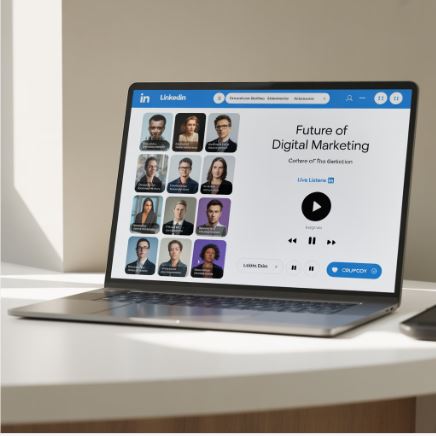
What sets LinkedIn Audio Events apart from classic webinars is that they become interactive. People want to be at the core of the conversation, and not be the quiet listener. Therefore, channel implementation, which makes interaction possible for the viewers, takes priority.
Start by asking the participants to use the “raise hand” option to pose questions or give ideas. Leave space for such contributions, but deal with them carefully so as not to disrupt the event schedule. For example, you can allocate the last 15 minutes for floor questions so that the event remains uninterrupted during the central discussion.
Other ways you can engage include posting questions or polls before and during the event. Ask individuals to respond to a comment on your LinkedIn post with the answer, and then incorporate some of the comments during the live Q&A. Not only does this encourage interaction within the event, but receives additional exposure on LinkedIn itself.
Interacting with the audience enriches and diversifies the discussion. It strengthens the connections—if one feels listened to, then he or she’s more likely to be a loyal follower or potential partner.
By turning your event into more discussion and less lecture, you turn passive listeners into active members of your community.
Step 8: Answer Q&A Confidently
A Q&A can be the crowning achievement of a LinkedIn Audio Event, but only if well-moderated. Listeners enjoy having the opportunity to pose questions one-on-one, but if not done in an orderly way, Q&As become off-base tangents or go on too long.
It’s just a matter of establishing expectations. At the beginning of the event, be sure you let others know when and how you’ll be doing Q&A. Will individuals be unmuted to ask questions live, or should they be asked in comments? A heads-up prevents confusion and enhances interaction.
Answer first those questions that lie within the topic of your event and that would be of most value to the largest groups of listeners. The conscientious host is always respectful of questions, even when he/she is unable to answer completely. Briefer statements like, “That is a great question, though perhaps during a later session, we can answer that,” are respectful but keep the event on track.
Confidence does matter. Keep questions brief and to the point, but don’t hesitate to say you don’t know. It creates trust, and you can then follow up as a way of getting back to them later and delivering resources. A good Q&A makes attendees feel listened to and closer to you as a thought leader.
Step 9: Conclude with Impact
Your event’s closing is just as critical as the event opening. A strong close ensures that the attendee departs having received value and a motive to remain in touch with you after the event.
Start by succinctly summarizing the major points that emerged from the session. That not only solidifies learning but also allows individuals to leave home with some takeaways. Refer to one or two memorable statements speakers or attendees made to put some personality in the wrap-up.
Finally, thank your participants graciously—your speakers (if you had any), as well as your guests. It goes a long way in making a good lasting impression. Include a simple call to action. Tell people to follow you on LinkedIn, follow your company page, or sign up for future events. Anticipate what’s on the horizon.
If it’s another upcoming audio event, webinar, or new content you’re revealing, keep a little in reserve so that there’s something to anticipate. Signing off with energy and commitment makes your event more than just one connection, but the beginning of a lasting relationship with your viewers.
Step 10: After-the-Event Follow Up
Work doesn’t stop once the audio session ends. That is where a lot of the relationship-building occurs within the follow-up period. It keeps you connected to the listener and helps convert occasional listeners to long-term relations.
Begin by thanking attendees. A quick LinkedIn message thanking everyone who attended—along with naming speakers or key players—keeps the enthusiasm alive. It’s also a promotion to non-attendees, allowing them to see a glimpse of your busy schedule and why they should be following you.
Highlight sharing is another sure-fire strategy. Put together unique one-liners, insights, or interesting questions thrown up during the event and make posts, articles, or mini-videos out of them. With that, you get to enrich the ones you’re following and provide extra shelf life to your event far after its live existence.
Finally, individually contact your highest participatory users. A sincere thank you for participating can forge new collaborations, from joint projects to sponsorships of your new event.
Thoughtful follow-up turns your LinkedIn Audio Event from one conversation into an opening to mutually beneficial professional contacts.
Step 11: Repurpose Content to Widen Your Audience
One of the greatest things you receive from having an audio event is the amount of content that you get. Even if you can’t unlock all of that value after an event has ended, reuse that content in a way that still helps your brand.
As one of the options, if you had taped the session, you could cut and paste together a high-impact, bite-sized video to share on LinkedIn, YouTube, or as a podcast series. The session can be transcribed to provide you with blog posts, LinkedIn articles, or newsletter content. All of these touch points enable you to address those you couldn’t and to extend your expertise to the broader world.
Reuse content also as a means of advanced promotion of future events. Posting a clip of a valuable moment or memorable quote shows future visitors what you are able to do in subsequent videos. It stimulates appetites, creates anticipation, and builds up your following gradually but surely.
Repurposing is not reuse, though, but rather an expansion. By redefining your event as multiple different formats, you gain maximum mileage on the effort you put in and have the ideas keep generating excitement after the live event is over.
Step 12: Monitor and Improve for the Following Interaction
Each event you put on is a learning experience. Taking the time to discuss what went well and how you can do better next time will ensure your next LinkedIn Audio Event is even better.
Start by doing a survey of LinkedIn stats. Search for attendance levels, best listening times, and for how long they listened. These can reveal to you whether or not your subject took off, if you were in cue, and at what point you lost them. Then supplement that with qualitative insights by polling your participants for what they liked best and what they can’t wait to see again.
Self-reflection is helpful as well. Did the introductions go smoothly? Were speakers smoothly transitioning to each other? Did Q&A flow, or did they drag? Open evaluation helps to inform content and hosting.
Always space to improve. The more events you host, the more mature and sophisticated you will get. Put all events on a continuum and not one event, and you’ll place yourself in the long term as someone able to host meaningful, engaging conversations on LinkedIn.
Conclusion
LinkedIn Audio Events has created a whole new avenue for professionals to reach out, exchange ideas, and become industry leaders. In comparison to other typical webinars and podcasts, they provide accessibility and professionalism as a unique duo, and offer you an opportunity to converse in real-time with the individuals who can be of importance to you in your career or business.
By moving forward step-by-step—defining your objectives, selecting the appropriate topic, preparing your technology, captivating your audience, and closing strongly—you put yourself on the right track.
The real magic, though, comes after: follow-up, content repurposing, and monitoring your outcome to enhance it. Events become not isolated conversations but part of the bigger picture of how you build influence and network.
Essentially, inviting others to a LinkedIn Audio Event is all about starting real conversations. With planning, authenticity, and dependability, you are not hosting events, but building communities. And communities, in this age of everything digital, are the keys to sustained professional success!

Sign up for SocialWick
Login
InstagramYouTubeTikTokFacebookTwitchSpotifyTwitter (X)SoundCloudIGTVLinkedInThreadsWebsitePinterestVKApple MusicSEO
Checkout
OK

Information
Order processing usually starts within a few minutes, but some services may take a few hours or even a few days. We offer free refills for up to 90 days if needed. Our services are 100% secure and discreet, with a focus on gradual and safe delivery for your peace of mind.
Order processing usually starts within a few minutes, but some services may take a few hours or even a few days. We offer free refills for up to 90 days if needed. Our services are 100% secure and discreet, with a focus on gradual and safe delivery for your peace of mind.
Where should we send your order confirmation?
No account needed! We send your confirmation and tracking link here.
Secure checkout. We never share your email.
Have an account?•
Log in
Use your account to pay faster with your saved details.
Create account
Create an account to track all your orders in one place.
Service
+0,00
Voucher
-0.00
Total
+0.00
OK
Affiliate & Reseller Program
Customer Support
How may we help you?
General Support
Order Support
Frequently Asked Questions
1) What services do you offer?
We are a social media marketing company, and we offer a wide variety of services across several platforms that our clients can choose from. Once selected, we create a plan that fits your needs. We offer several types of services, such as followers, subscribers, likes, views, song plays, etc.
2) Is your service safe?
Yes, as we only sell real followers, likes, views, etc., and we hold every service to strict authenticity and quality standards. In order to protect your account, we deliver every order carefully and gradually. We closely monitor all our services. For more information, we strongly recommend reading our Terms of Service before you order.
3) Will I need to give you the passwords for my accounts?
No, you can keep your passwords to yourself because our services don’t need a password to influence your accounts. And if an email ever shows up claiming to be from us and asking for a password, it’s definitely not us, so please let us know right away.
4) Are the likes, followers, and subscribers real, or are they bots?
Unlike many other services, all our likes, followers, and views come from real accounts operated by real people. You won’t find bots, fake profiles, or hijacked accounts anywhere in what we deliver. Every order has to pass our strict authenticity standards, and we keep checking our quality to make sure it stays that way.
5) How fast can you deliver my order?
We will show you the estimated delivery time when choosing the service. However, this is only a rough estimate. In most cases, the services are delivered much faster. In some cases, it may take longer. We always aim for a natural and safe delivery!
6) What are your best-selling social media marketing services?
Although we have many services across most social media companies, our services for Instagram, TikTok, and YouTube are our best-selling options.
7) How do I know my account will not be flagged or banned?
We take safety very seriously. We never ask for your password, all followers, likes, and views come from real accounts, and orders are usually delivered gradually and naturally. What we can promise is careful delivery and strict quality standards. Plus a support team that’s there whenever you need us. We are not aware of a single case since 2017 where a customer got his profile banned.
8) What is the best method to communicate with you?
Do you have a question or run into a problem? Our customer support is available 24/7 for you. Just click Contact and you’ll land right on the support form. When you buy one of our services, we will email you to see if there were any problems. Your satisfaction is our main priority.
9) Are there discounts for large orders?
Yes! If you would like to request a large order that isn’t on our ordering layout, we will have no problems accommodating you. Just reach out through the support form and we’ll put together a buying plan that fits what you need.
10) What methods of payment do you accept?
We accept all forms of credit and debit cards, as well as Klarna, eps, PayPal, and Crypto.
11) If I am unsatisfied with your services, am I able to receive a refund?
Yes! Every purchase comes with a 30 day money-back guarantee. Not satisfied? Just contact our support within 30 days of your purchase and send us your order details and a short note on what went wrong, and we’ll take a look at your case. The full conditions are in our Refund Policy.
12) I haven’t received my order
Please make sure the following criteria are met before placing an order to make sure we can deliver it successfully.
- Your account is set to public
- You have typed in the correct username or link
- You have not changed your username before the order’s completion
- The post or account still exists and has not been deleted
- The post or account has not been restricted or removed in some countries
- Allow the estimated delivery time for completion of your order
For further assistance, please message our support team through the contact form.
13) How can I request a refill?
Just send us a refill request through the contact form. Please note that we can only provide you with a free refill within the first 90 days of your purchase.
Learn More
What is SocialWick?
We are the leading marketplace for social media promotion. You can buy followers, likes, views, subscribers, and a lot more for almost all social media networks. We offer affordable prices without making any compromises in terms of the service quality. We have a strict policy to only sell social media signals from real people. Part of our engagement, for example, comes from ad-based promotion where real users discover the content through ads. Bots, fake profiles, and hijacked accounts have no place in our services. Every delivery has to meet our authenticity standards, and we run regular quality checks, and anything that does not meet them is removed from our catalog. Our services are available for personal use, whether you want more Instagram likes, TikTok followers, YouTube views, or something else for your own profile.
With over a million satisfied customers, SocialWick is the go-to platform for all your social media needs. Our services are discreet and secure, with gradual and careful delivery to keep your social media accounts safe.
About SocialWick — The Market Leader since 2017
With more than 10 million orders, SocialWick is one of the world’s biggest social media stores. You can find everything on our website to improve your presence on major social media platforms like Instagram, TikTok, YouTube, Twitter (X), Facebook, etc. We offer different types of services for several social media platforms. Your wish is our command, and whatever your goal might be, SocialWick will help you achieve it. Whether you need more likes on your Instagram photos or want to make your LinkedIn profile more popular by getting additional followers, SocialWick is there to turn your goal into reality.
Thanks to our effective services and our customer-oriented work, SocialWick has become a top player. You will not find a better service anywhere else, especially not at such affordable prices. SocialWick is operating since 2017.
365 Days Per Year Customer Service
Your satisfaction is our motivation! We’re not here just for the money; we do our work to help people find their road to social media success. And that’s why our team will do all to make sure everything goes according to plan. If there’s something wrong with your social media campaign, or worry that there might be some problems with your account, or want to learn more about how our services work, feel free to reach out. Our service staff is there for you seven days a week, ready to answer any of your questions. You can get in touch with us using the contact form on our website.
Buying Followers and Likes is Essential
Unless you’re Kylie Jenner, you definitely need some help with social media. The more followers you have on Instagram, TikTok, Twitter (X), or YouTube, the more people will automatically notice you. Having all those eyes on your content isn’t just impressive, it’s genuinely fun. The bad news is that everyone wants to be famous these days, but only a few can succeed. The good news is that you can be the chosen one who will get social media fame and everything that comes with it. But, for that, you need a little help from your friends at SocialWick.
With our help, you will increase the number of followers on social media, which can have a domino effect and bring you even more new followers. Once people see that you got a big followership, they will decide to give you a follow. "If a profile has so many followers, it means that it’s interesting" – you can be sure this is going to be their reasoning. Furthermore, more followers mean more visibility for everything you post. Finally, a large number of followers also do great for your credibility. Our social media services will help you to create a better overall picture of your profile.
Let’s be honest; a profile with 30,000 followers looks much better than one with 74 followers. And that’s exactly what new visitors will pay attention to. A weak social media profile can be a real deal-breaker. At the same time, a fantastic social media profile can do wonders for you. And SocialWick can make your social media profile amazing!