#1 Social Media Marketplace
Accelerate Your Social Media Growth with SocialWick. Quickly gain real followers, viewers, likes & more with our blend of marketing tactics. SocialWick is known for its fast delivery, premium quality, and low prices. With over a million satisfied customers since 2017, trust SocialWick to take your social media game to the next level.
1.4 M
Customers
13 M
Orders
362 M
Followers sold
1.8 B
Likes sold
How to Build Trust on Social Media Without Spending Money
Published on 29.04.2026 by Tracey Chizoba Fletcher
Most things that work on social media have one thing behind them, and you don’t see it right away. You cannot see it directly, but you can feel its absence instantly.
You scroll past a post, and something feels off. Too polished. Too forced. Too disconnected. And you move on. That decision happens in seconds, but here’s the interesting part. It is not random.
Behind that split-second judgment is a system. A quiet evaluation process that every user runs, consciously or not. Who feels real? Who feels consistent? Who feels worth listening to again?
Most creators try to win attention first, but attention without trust is fragile. It spikes, then disappears.
Trust, on the other hand, builds something slower, but much stronger. It builds gravity. People return and remember. They start to associate your content with a certain feeling, a certain level of clarity, a certain type of value.
And this is where we have some interesting stuff. Once that association forms, growth stops being unpredictable. It becomes directional.
According to Hootsuite’s 2026 Social Media Statistics report, people spend an average of 2 hours and 21 minutes daily on social platforms, not just consuming content, but forming quick micro-judgments about credibility and usefulness. Those judgments determine what gets watched longer, shared further, and remembered later.
So the real game has not been reached. It resonates.
This article goes deeper into that idea. Not just what to do, but why it works. How does trust form? How does it compound? And how can you intentionally build it without spending money?
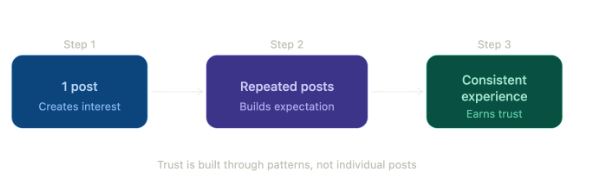
Trust is Built Through Patterns, Not Individual Posts
Most people treat content like isolated events. Post something. Move on. Repeat. But your audience does not see it that way. They experience your content as a pattern, and patterns are what create belief.
Here’s a simple way to understand it. One good post creates interest. Repeated good posts create expectations. Consistent expectation creates trust. That shift is subtle, but powerful because once someone expects value from you, they stop evaluating every post from scratch. They assume it will be worth their time.
That assumption is everything. It reduces friction. And when friction drops, engagement rises naturally.
But that is only the first layer. The deeper layer is cognitive consistency. People naturally look for things that line up. When your tone and ideas stay steady over a few weeks or months, it starts to feel reliable. And stability signals reliability, which signals trust.
On the other hand, inconsistency creates doubt. You can post something solid, but if it’s not clear what you mean or what you stand for, people pause.
Think about creators who constantly switch niches, tone, or messaging. One day educational, next day entertainment, next day personal rant. It confuses the audience, and confusion slows trust. And don't look at separate posts, look at trends.
Question:
- What do people expect of me?
- What emotional tone do I consistently bring?
- What kind of problems do I repeatedly solve?
Those answers shape your pattern. And your pattern shapes trust.
The Hidden Role of Predictability in Building Trust
Predictability sounds super boring, but it is one of the most powerful trust signals on social media. Not in content ideas, but in experience.
Do they know what they are getting when they look at your post? More important than creativity is clarity. Here’s why.
The brain likes to be familiar. Something predictable takes less effort to process. And when something needs less, they tend to participate more.
This is supported by behavioral studies commonly used in marketing studies. Patterns are familiar and, therefore, lessen the cognitive load, leading to better retention and interaction.
This does not imply the duplication of the same material. It means structuring your content in recognizable ways.
For example:
- Clear hooks at the start
- Structured breakdowns
- Consistent tone and pacing
- Familiar formats
Different ideas. Same experience. This is the point where it turns.
Predictability also creates comfort. When people feel comfortable with your content, they stay longer. When they stay longer, algorithms push it further.
So what looks like a creative strategy is actually a psychological one. You are not just making content. You are designing an experience.
Why Small Signals Matter More Than Big Claims
Many creators try to build trust through big statements.
“I helped 100 clients.”
“This strategy works.”
“This is the best method.”
But big claims require belief, and belief takes time. Small signals, on the other hand, bypass resistance. They feel natural. Observable. Real.
For example:
- A detailed breakdown of your process
- A thoughtful reply to a comment
- A simple example that explains a concept clearly
These do not announce credibility. They demonstrate it. And demonstration is more persuasive than declaration.
Here’s a simple comparison:
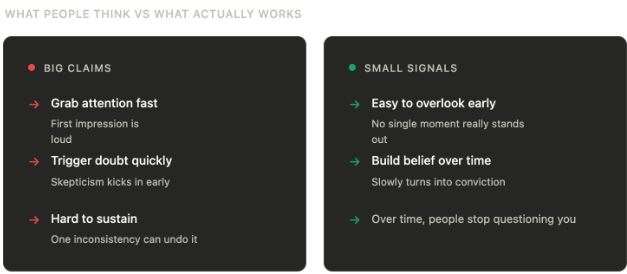
The deeper mechanism is trust calibration. People do not instantly trust you or distrust you. They adjust their level of trust gradually, based on signals.
Every small signal moves that level slightly. Up or down. And over time, those movements accumulate, which means you do not need viral moments to build trust. You need consistent signals.
The Power of Showing Thinking, Not Just Conclusions
Most content focuses on conclusions. Final advice. Clear answers. Finished ideas. But what most people don’t realize is that trust often comes from seeing how someone thinks, not just what they conclude, because conclusions can be copied, but thinking cannot.
When you explain your reasoning, your decision-making, your process, something changes. Your audience starts to understand you. And understanding builds trust faster than authority.
Here’s an example. Instead of saying: “Post consistently to grow.”
Explain:
- Why consistency matters?
- What patterns does it create?
- How does it affect audience behavior?
Now the audience is not just taking your advice. They are learning your framework.
Here’s where it shifts. When people start trusting how you think, they don’t keep picking apart what you say because they can see how you arrived there. This creates deeper trust, not surface-level agreement.
Time-Based Trust: Why Longevity Still Matters
In a world of fast content, time still plays a role. Trust builds faster today than before, but it still requires exposure over time. According to insights, repeated exposure to content from the same source increases recognition and engagement rates significantly. That is not just about visibility. It is about familiarity. And familiarity decreases the perceived risk.
Here is the easy answer: The more a person looks at you, the less insecure you become. The less doubtful you are, the more open you are. The more you open up, the more you trust. This is not merely about frequent posting. It is about staying present over time, even if growth feels slow, because trust often builds invisibly until it suddenly becomes visible.
Through:
- A comment from a silent follower
- A message from someone who has been watching for months
- A post that performs far better than expected
These moments feel sudden, but they are not. They are the products of cumulative exposure.
Micro-Interactions: The Quickest Method to Establish Trust
When you have nothing to start with, just the content is not enough. You need interaction because interaction accelerates trust. Here’s why.
Content is one-way. Interaction is two-way. And two-way communication creates a connection faster. Even small interactions matter.
For example:
- Replying to comments with depth
- Responding to DMs thoughtfully
- Engaging with your audience’s content
These actions signal attention, and attention is rare, which makes it valuable. But the deeper layer is this. Micro-interactions humanize you. They turn your presence from “account” into “person.” And people trust people more than content.
So instead of waiting for a large engagement, focus on small loops. One comment. One reply. One conversation. Repeated consistently.
The Role of Clarity in Reducing Doubt
Confusion kills trust, even if the content is good. If people do not understand what you are saying or what you stand for, they hesitate. And hesitation breaks engagement.
Clarity, on the other hand, reduces doubt. It makes your message easier to process and believe.
This applies to:
- Your niche
- Your messaging
- Your content structure
For example:
Unclear:
“I talk about growth and mindset and business.”
Clear:
“I help service-based businesses attract clients through organic content.”
The second statement builds trust faster because it is specific, and specificity signals expertise. But that is only the surface. The deeper mechanism is decision ease.
When your content is clear, people can quickly decide:
- Is this for me?
- Is this useful?
And quick decisions increase engagement, which reinforces trust.
Creating a Trust Loop Instead of Chasing Growth
Most people think in terms of growth tactics. Post more. Use trends. Optimize timing. But growth is often the result of a loop, not a tactic.
Here is what that loop looks like:
- You provide value
- People engage
- You respond
- They feel seen
- They return
- Engagement increases
- Visibility expands
And the loop continues.
This is not fast, but it is stable. And once it begins to work, it is self-reinforcing. This means that you will not need new strategies all the time. You need a strong loop, and that loop is built on trust.
A More Advanced Framework for Organic Trust Building
Let’s go deeper than the basics. Instead of thinking in layers, think of this as building a reputation engine.
Not something you assemble once. Something that runs, compounds, and strengthens over time.
Each part plays a role. Remove one, and the system weakens.
Step 1: Identity Clarity
Every engine needs direction. If people cannot quickly understand what you stand for, they will not stay long enough to trust you. So define it clearly. Not broad categories. Not vague positioning.
Specific problems. Specific people. Specific outcomes. When your identity is clear, your content becomes easier to trust because it feels intentional.
Step 2: Content Consistency
This is what keeps the engine running. Not occasional bursts, but steady motion. You must not leave your audience guessing what they will get out of you. Your ideas, tone, and delivery should have a familiar rhythm. Different angles are fine.
Randomness is not. Consistency turns scattered content into a pattern, and patterns build belief.
Step 3: Value Depth
Surface-level content creates attention. Depth creates credibility. Anyone can share quick tips, but few take the time to explain the thinking behind them.
That difference matters because when you go deeper, you stop sounding like everyone else. And you start becoming a reference point.
Step 4: Interaction Quality
This is where the engine becomes human. Content attracts. Interaction converts.
How you reply, how you interact, even how you acknowledge someone’s comment, that’s what shapes how people see you. Quick responses help.
Thoughtful replies build connection, and connection builds trust faster than content ever can.
Step 5: Proof Signals
This is what validates everything else. Not big claims. Visible impact.
Even small moments count:
- A comment that shows someone understood
- A message that shows someone applied your idea
- A result that came from your content
These signals show that what you share works, and that is what people trust.
Step 6: Time Presence
This is what compounds everything. Trust does not peak. It accumulates. Show up long enough, and people start recognizing you. After that, they don’t question you as much, and that changes how they engage with your content.
Slow at first. Then suddenly, it's not so slow anymore. Each part feeds the next.
Identity shapes content → Content delivers value → Value attracts interaction → Interaction builds proof → Proof strengthens perception → Time compounds everything.
And once it starts working, it does not feel like effort anymore. It feels like momentum.
Conclusion
Hacks do not create trust. It is constructed by alignment; the unspoken contract between what you say, the way you appear, and the experience people get of you in the long run. When those three things match, something shifts. Your content stops feeling random and starts feeling intentional. People begin to recognize you, not just see you. And recognition is where things start to change.
That alignment creates consistency. When people see you often enough in a similar way, they stop trying to figure you out. They already have a sense of what you’re about. That’s where comfort comes from. And comfort is what lowers resistance and allows trust to form without force.
Trust is not pushed. It is allowed.
What makes this powerful is that none of it depends on money. There is no shortcut you need to buy, no reach you need to rent. Most of this comes down to something simple, but easy to ignore. Paying attention. Not just to how your content looks, but how it lands. Don't look at how many people have responded, but listen to what they are saying. It is not how many people are responding, it is what they are saying.
Not what you are writing today, but the trend you are establishing in weeks and months. That pattern is what people remember, and here, most men fail.
Social media is not the process of forcing content out there. With time, what you put on the posts begins to define you in the eyes of others. All the posts, all the responses, all the silent spaces between them, all that creates such an impression. Slowly. Quietly. Repeatedly.
Through signals. Through patterns. Spend some time with it, and you begin to sense the change. Expansion no longer feels as unnatural, less like something you’re constantly pushing for. It begins to show up on its own because once people trust you, paying attention to you becomes automatic.

Sign up for SocialWick
Login
InstagramYouTubeTikTokFacebookTwitchSpotifyTwitter (X)SoundCloudIGTVLinkedInThreadsWebsitePinterestVKApple MusicSEO
Checkout
OK

Information
Order processing usually starts within a few minutes, but some services may take a few hours or even a few days. We offer free refills for up to 90 days if needed. Our services are 100% secure and discreet, with a focus on gradual and safe delivery for your peace of mind.
Order processing usually starts within a few minutes, but some services may take a few hours or even a few days. We offer free refills for up to 90 days if needed. Our services are 100% secure and discreet, with a focus on gradual and safe delivery for your peace of mind.
Where should we send your order confirmation?
No account needed! We send your confirmation and tracking link here.
Secure checkout. We never share your email.
Have an account?•
Log in
Use your account to pay faster with your saved details.
Create account
Create an account to track all your orders in one place.
Service
+0,00
Voucher
-0.00
Total
+0.00
OK
Affiliate & Reseller Program
Customer Support
How may we help you?
General Support
Order Support
Frequently Asked Questions
1) What services do you offer?
We are a social media marketing company, and we offer a wide variety of services across several platforms that our clients can choose from. Once selected, we create a plan that fits your needs. We offer several types of services, such as followers, subscribers, likes, views, song plays, etc.
2) Is your service safe?
Yes, as we only sell real followers, likes, views, etc., and we hold every service to strict authenticity and quality standards. In order to protect your account, we deliver every order carefully and gradually. We closely monitor all our services. For more information, we strongly recommend reading our Terms of Service before you order.
3) Will I need to give you the passwords for my accounts?
No, you can keep your passwords to yourself because our services don’t need a password to influence your accounts. And if an email ever shows up claiming to be from us and asking for a password, it’s definitely not us, so please let us know right away.
4) Are the likes, followers, and subscribers real, or are they bots?
Unlike many other services, all our likes, followers, and views come from real accounts operated by real people. You won’t find bots, fake profiles, or hijacked accounts anywhere in what we deliver. Every order has to pass our strict authenticity standards, and we keep checking our quality to make sure it stays that way.
5) How fast can you deliver my order?
We will show you the estimated delivery time when choosing the service. However, this is only a rough estimate. In most cases, the services are delivered much faster. In some cases, it may take longer. We always aim for a natural and safe delivery!
6) What are your best-selling social media marketing services?
Although we have many services across most social media companies, our services for Instagram, TikTok, and YouTube are our best-selling options.
7) How do I know my account will not be flagged or banned?
We take safety very seriously. We never ask for your password, all followers, likes, and views come from real accounts, and orders are usually delivered gradually and naturally. What we can promise is careful delivery and strict quality standards. Plus a support team that’s there whenever you need us. We are not aware of a single case since 2017 where a customer got his profile banned.
8) What is the best method to communicate with you?
Do you have a question or run into a problem? Our customer support is available 24/7 for you. Just click Contact and you’ll land right on the support form. When you buy one of our services, we will email you to see if there were any problems. Your satisfaction is our main priority.
9) Are there discounts for large orders?
Yes! If you would like to request a large order that isn’t on our ordering layout, we will have no problems accommodating you. Just reach out through the support form and we’ll put together a buying plan that fits what you need.
10) What methods of payment do you accept?
We accept all forms of credit and debit cards, as well as Klarna, eps, PayPal, and Crypto.
11) If I am unsatisfied with your services, am I able to receive a refund?
Yes! Every purchase comes with a 30 day money-back guarantee. Not satisfied? Just contact our support within 30 days of your purchase and send us your order details and a short note on what went wrong, and we’ll take a look at your case. The full conditions are in our Refund Policy.
12) I haven’t received my order
Please make sure the following criteria are met before placing an order to make sure we can deliver it successfully.
- Your account is set to public
- You have typed in the correct username or link
- You have not changed your username before the order’s completion
- The post or account still exists and has not been deleted
- The post or account has not been restricted or removed in some countries
- Allow the estimated delivery time for completion of your order
For further assistance, please message our support team through the contact form.
13) How can I request a refill?
Just send us a refill request through the contact form. Please note that we can only provide you with a free refill within the first 90 days of your purchase.
Learn More
What is SocialWick?
We are the leading marketplace for social media promotion. You can buy followers, likes, views, subscribers, and a lot more for almost all social media networks. We offer affordable prices without making any compromises in terms of the service quality. We have a strict policy to only sell social media signals from real people. Part of our engagement, for example, comes from ad-based promotion where real users discover the content through ads. Bots, fake profiles, and hijacked accounts have no place in our services. Every delivery has to meet our authenticity standards, and we run regular quality checks, and anything that does not meet them is removed from our catalog. Our services are available for personal use, whether you want more Instagram likes, TikTok followers, YouTube views, or something else for your own profile.
With over a million satisfied customers, SocialWick is the go-to platform for all your social media needs. Our services are discreet and secure, with gradual and careful delivery to keep your social media accounts safe.
About SocialWick — The Market Leader since 2017
With more than 10 million orders, SocialWick is one of the world’s biggest social media stores. You can find everything on our website to improve your presence on major social media platforms like Instagram, TikTok, YouTube, Twitter (X), Facebook, etc. We offer different types of services for several social media platforms. Your wish is our command, and whatever your goal might be, SocialWick will help you achieve it. Whether you need more likes on your Instagram photos or want to make your LinkedIn profile more popular by getting additional followers, SocialWick is there to turn your goal into reality.
Thanks to our effective services and our customer-oriented work, SocialWick has become a top player. You will not find a better service anywhere else, especially not at such affordable prices. SocialWick is operating since 2017.
365 Days Per Year Customer Service
Your satisfaction is our motivation! We’re not here just for the money; we do our work to help people find their road to social media success. And that’s why our team will do all to make sure everything goes according to plan. If there’s something wrong with your social media campaign, or worry that there might be some problems with your account, or want to learn more about how our services work, feel free to reach out. Our service staff is there for you seven days a week, ready to answer any of your questions. You can get in touch with us using the contact form on our website.
Buying Followers and Likes is Essential
Unless you’re Kylie Jenner, you definitely need some help with social media. The more followers you have on Instagram, TikTok, Twitter (X), or YouTube, the more people will automatically notice you. Having all those eyes on your content isn’t just impressive, it’s genuinely fun. The bad news is that everyone wants to be famous these days, but only a few can succeed. The good news is that you can be the chosen one who will get social media fame and everything that comes with it. But, for that, you need a little help from your friends at SocialWick.
With our help, you will increase the number of followers on social media, which can have a domino effect and bring you even more new followers. Once people see that you got a big followership, they will decide to give you a follow. "If a profile has so many followers, it means that it’s interesting" – you can be sure this is going to be their reasoning. Furthermore, more followers mean more visibility for everything you post. Finally, a large number of followers also do great for your credibility. Our social media services will help you to create a better overall picture of your profile.
Let’s be honest; a profile with 30,000 followers looks much better than one with 74 followers. And that’s exactly what new visitors will pay attention to. A weak social media profile can be a real deal-breaker. At the same time, a fantastic social media profile can do wonders for you. And SocialWick can make your social media profile amazing!