#1 Social Media Marketplace
Accelerate Your Social Media Growth with SocialWick. Quickly gain real followers, viewers, likes & more with our blend of marketing tactics. SocialWick is known for its fast delivery, premium quality, and low prices. With over a million satisfied customers since 2017, trust SocialWick to take your social media game to the next level.
1.4 M
Customers
13 M
Orders
362 M
Followers sold
1.8 B
Likes sold
How to Measure YouTube Channel Success Accurately
Published on 17.08.2026 by Tracey Chizoba Fletcher
You have probably come across YouTube channels that experience viral success while others perform poorly. With so many factors affecting a YouTube channel's success, it can be hard to understand what it takes to succeed on the platform. However, one step you can take to increase your chances of success is to utilize YouTube Analytics to grow your channel.
By checking the analytics, you can determine whether your YouTube content strategy is working. In this article, we look at how to leverage YouTube analytics to determine whether your channel is successful.
How to Measure the Success of a YouTube Channel
To determine if your YouTube channel is performing well or poorly, use the following tips:
Measure the Basics: Watch Time and Views
Before you dig deeper into your YouTube channel's performance, start by tracking the basic metrics. These are important for providing you with a clear snapshot of your videos' performance.
The basic metrics to track are:
- Watch time: A good metric for how much time people are spending watching your videos. If your videos are receiving a high watch time, it indicates you have a highly engaged audience. It is one of the most important factors for increasing the reach of your videos. If you have a lower-than-usual watch time, it could be a sign that your content doesn't resonate with the target audience.
- Views. As one of the most basic metrics, you shouldn't track views on their own; they should be considered alongside the other metrics to get a complete picture.
Measure the Click-Through Rate
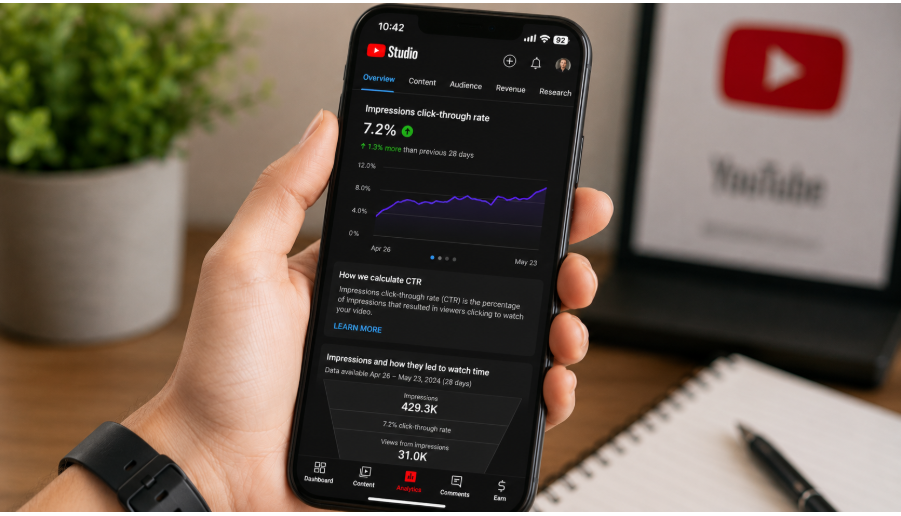
The click-through rate is a good indicator of how many viewers click a video after encountering its title and thumbnail. This can be a good metric for showing how exciting your video is to potential viewers. If your videos have a low CTR, it's a sign that your title and thumbnail aren't interesting enough. You should, therefore, experiment with different titles and thumbnails to see which ones drive the most clicks.
If your videos are achieving a high CTR, it shows that the thumbnails and titles are quite effective and that viewers are interested in learning more. You can leverage A/B testing of titles and thumbnails to get better results.
Average View Duration and Impressions
The average view duration and impressions are also important metrics that can show the performance of your videos and channel. As the name suggests, if your videos are receiving a high average view duration, it shows you have more engaging content that keeps your viewers interested. On the other hand, a shorter average view duration shows your videos are performing better.
Impressions are a metric that shows how often YouTube users come across your videos. If your videos are making a deep impression, it shows they are being discovered by a large number of users. However, if the impression count is high and the CTR is low, it indicates weak titles and thumbnails.
Measure Subscriber Growth
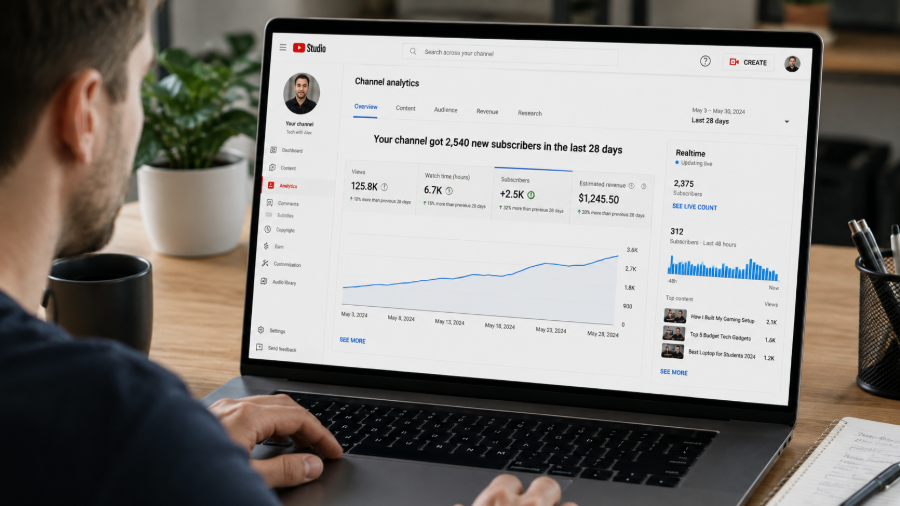
Subscriber growth is a strong indicator of your channel's long-term success. If people are subscribing to your channel, it's an indication that they would like to see more of this type of content. If your subscribers are growing, it shows you are creating videos that resonate with your target audience, making them want to keep coming back.
If you are losing subscribers, you need to investigate the cause and adjust your content accordingly. Therefore, tracking subscriber count can help you measure your channel's growth and adjust accordingly.
Check Audience Engagement
The engagement rate is one of the most important metrics for tracking your YouTube video's performance, as it indicates whether the content resonates with your target audience. You want to pay attention to metrics like comments, likes, and shares to see whether people enjoy and interact with the content.
The engagement rate can be categorized into:
- Likes vs. dislikes. This is a good metric to show how your audience is receiving your videos. If the likes are much higher than the dislikes, it shows you are creating outstanding content.
- Comments. If your posts are receiving a high number of comments, that is an indicator that they are sparking conversation. You can boost the engagement level by responding to the comments.
- Shares. If you have viewers sharing videos, it is a clear indicator that the content is quite valuable and worth sharing.
When you engage with your audience by encouraging them to comment and share the content, it can boost video performance, improving their visibility in the YouTube algorithm.
Track the Source of Traffic
You can see the source of your YouTube traffic directly on YouTube Analytics. The source can include YouTube Search, the Home page, or external sources such as other social media platforms. This data is key, as it helps you determine which channels are driving the most traffic. When you realize that a lot of your traffic is coming from YouTube search, it is an indicator that your tags, video title, and descriptions are well optimized. Pay attention to the keywords that drive the most traffic and add more of them.
If most of your traffic comes from external websites, it may indicate that people are sharing your video link on other platforms. That means you have a good opportunity to expand your social media presence beyond the YouTube algorithm.
Check the Audience Retention Data
The audience retention data is a good metric for tracking your video’s performance, as it shows how long viewers stay in the video. Consider whether they are dropping off early or sticking around. A high video retention rate indicates that your viewers find the content relevant, engaging, and valuable.
If the retention rate is low, it's a sign that your audience is dropping off early, and it could indicate you need to improve the video’s pacing or structure. When you track video retention, you can adjust the video's style to attract more viewers and increase the likelihood of your videos ranking higher in the SERPs.
YouTube Benchmarks for New Channels
Creators with small channels often wonder whether their channels are performing well or poorly. The YouTube creator benchmark can be a good metric to show where your channel stands. These can enable creators to understand their progress and set some realistic goals. Benchmarks compare the performance of new channels with similar ones. They can help answer the question of whether your channel is growing fast enough or if you're getting healthy engagement.
Here are some of the top creator benchmarks:
Beginner Channel (with 0 to 10k Subscribers)
Beginner creators usually expect to see results as soon as possible. However, this doesn't happen, as building an audience takes time. The average growth for beginner channels is usually 15 to 25% monthly. That means you can get as few as 50 views for your first video, while the 10th one might get around 500 views.
As a beginner channel, don't expect to see a high watch time, and it's normal to see watch times of 2 to 5 minutes for most of your videos. The ratio of subscribers to views is also as low as 1:50, where you get 1 subscriber for every 50 views. Engagement is where the small channels beat the bigger ones, reaching between 8 and 12%. To be monetized, it can take 6 to 18 months.
Intermediate Level (10,000 to 1000,00 Subscribers)
Here, you have already passed the survival phase, and your content format is already working, meaning you have a ready audience. The growth at this phase is between 8 and 15% monthly, which is slower than for beginner channels. It requires more effort to grow at this stage than to grow from 50K to 55k.
The video watch time may also increase from five to 15 minutes. The audience is already watching for a longer period because they trust the content format. The ratio of subscribers to views can change from 1:100 as you get more views for each subscriber and your content gets recommended more by the algorithm.
There can also be a drop in the engagement rate by 5 to 8%, which is considered normal, as a bigger audience includes casual viewers who aren't interacting. In addition, there can be a significant increase in revenue from $500 to $5,000 monthly, depending on the niche. At this level, some niches earn more than others. To grow at this level, you will need to collaborate with other creators.
Established Creator
Statistics indicate that less than 1% of channels get to the level of an established creator, meaning that you have already reached the top level. At this stage, the watch time for each video can reach 10-30 minutes, as your core audience now loves your channel. They are now in love with your personality and not just the video.
The ratio of subscribers to views is usually between 1:200 and 1:500. At this point, you can get many views, with a 20-minute video likely getting between 1 and 2 million views. At this stage, the engagement rate can fall to 3-5%, but the absolute number can rise to 2 million.
The revenue potential for established creators can range from $1,000 to over $100K monthly in some niches, such as finance. There is a need for diversification at this level. You can use other earning methods such as affiliate marketing, sponsorship, and digital products to monetize your YouTube channel.
In Conclusion
If you want to rise from a beginner creator to an established one, you need to track how well your YouTube channel is performing. By following the steps outlined in this guide, you should be able to do that. Once you have grown your channel, you can now learn how to optimize your YouTube channel to attract sponsors.

Sign up for SocialWick
Login
InstagramYouTubeTikTokFacebookTwitchSpotifyTwitter (X)SoundCloudIGTVLinkedInThreadsWebsitePinterestVKApple MusicSEO
Checkout
OK

Information
Order processing usually starts within a few minutes, but some services may take a few hours or even a few days. We offer free refills for up to 90 days if needed. Our services are 100% secure and discreet, with a focus on gradual and safe delivery for your peace of mind.
Order processing usually starts within a few minutes, but some services may take a few hours or even a few days. We offer free refills for up to 90 days if needed. Our services are 100% secure and discreet, with a focus on gradual and safe delivery for your peace of mind.
Where should we send your order confirmation?
No account needed! We send your confirmation and tracking link here.
Secure checkout. We never share your email.
Have an account?•
Log in
Use your account to pay faster with your saved details.
Create account
Create an account to track all your orders in one place.
Service
+0,00
Voucher
-0.00
Total
+0.00
OK
Affiliate & Reseller Program
Customer Support
How may we help you?
General Support
Order Support
Frequently Asked Questions
1) What services do you offer?
We are a social media marketing company, and we offer a wide variety of services across several platforms that our clients can choose from. Once selected, we create a plan that fits your needs. We offer several types of services, such as followers, subscribers, likes, views, song plays, etc.
2) Is your service safe?
Yes, as we only sell real followers, likes, views, etc., and we hold every service to strict authenticity and quality standards. In order to protect your account, we deliver every order carefully and gradually. We closely monitor all our services. For more information, we strongly recommend reading our Terms of Service before you order.
3) Will I need to give you the passwords for my accounts?
No, you can keep your passwords to yourself because our services don’t need a password to influence your accounts. And if an email ever shows up claiming to be from us and asking for a password, it’s definitely not us, so please let us know right away.
4) Are the likes, followers, and subscribers real, or are they bots?
Unlike many other services, all our likes, followers, and views come from real accounts operated by real people. You won’t find bots, fake profiles, or hijacked accounts anywhere in what we deliver. Every order has to pass our strict authenticity standards, and we keep checking our quality to make sure it stays that way.
5) How fast can you deliver my order?
We will show you the estimated delivery time when choosing the service. However, this is only a rough estimate. In most cases, the services are delivered much faster. In some cases, it may take longer. We always aim for a natural and safe delivery!
6) What are your best-selling social media marketing services?
Although we have many services across most social media companies, our services for Instagram, TikTok, and YouTube are our best-selling options.
7) How do I know my account will not be flagged or banned?
We take safety very seriously. We never ask for your password, all followers, likes, and views come from real accounts, and orders are usually delivered gradually and naturally. What we can promise is careful delivery and strict quality standards. Plus a support team that’s there whenever you need us. We are not aware of a single case since 2017 where a customer got his profile banned.
8) What is the best method to communicate with you?
Do you have a question or run into a problem? Our customer support is available 24/7 for you. Just click Contact and you’ll land right on the support form. When you buy one of our services, we will email you to see if there were any problems. Your satisfaction is our main priority.
9) Are there discounts for large orders?
Yes! If you would like to request a large order that isn’t on our ordering layout, we will have no problems accommodating you. Just reach out through the support form and we’ll put together a buying plan that fits what you need.
10) What methods of payment do you accept?
We accept all forms of credit and debit cards, as well as Klarna, eps, PayPal, and Crypto.
11) If I am unsatisfied with your services, am I able to receive a refund?
Yes! Every purchase comes with a 30 day money-back guarantee. Not satisfied? Just contact our support within 30 days of your purchase and send us your order details and a short note on what went wrong, and we’ll take a look at your case. The full conditions are in our Refund Policy.
12) I haven’t received my order
Please make sure the following criteria are met before placing an order to make sure we can deliver it successfully.
- Your account is set to public
- You have typed in the correct username or link
- You have not changed your username before the order’s completion
- The post or account still exists and has not been deleted
- The post or account has not been restricted or removed in some countries
- Allow the estimated delivery time for completion of your order
For further assistance, please message our support team through the contact form.
13) How can I request a refill?
Just send us a refill request through the contact form. Please note that we can only provide you with a free refill within the first 90 days of your purchase.
Learn More
What is SocialWick?
We are the leading marketplace for social media promotion. You can buy followers, likes, views, subscribers, and a lot more for almost all social media networks. We offer affordable prices without making any compromises in terms of the service quality. We have a strict policy to only sell social media signals from real people. Part of our engagement, for example, comes from ad-based promotion where real users discover the content through ads. Bots, fake profiles, and hijacked accounts have no place in our services. Every delivery has to meet our authenticity standards, and we run regular quality checks, and anything that does not meet them is removed from our catalog. Our services are available for personal use, whether you want more Instagram likes, TikTok followers, YouTube views, or something else for your own profile.
With over a million satisfied customers, SocialWick is the go-to platform for all your social media needs. Our services are discreet and secure, with gradual and careful delivery to keep your social media accounts safe.
About SocialWick — The Market Leader since 2017
With more than 10 million orders, SocialWick is one of the world’s biggest social media stores. You can find everything on our website to improve your presence on major social media platforms like Instagram, TikTok, YouTube, Twitter (X), Facebook, etc. We offer different types of services for several social media platforms. Your wish is our command, and whatever your goal might be, SocialWick will help you achieve it. Whether you need more likes on your Instagram photos or want to make your LinkedIn profile more popular by getting additional followers, SocialWick is there to turn your goal into reality.
Thanks to our effective services and our customer-oriented work, SocialWick has become a top player. You will not find a better service anywhere else, especially not at such affordable prices. SocialWick is operating since 2017.
365 Days Per Year Customer Service
Your satisfaction is our motivation! We’re not here just for the money; we do our work to help people find their road to social media success. And that’s why our team will do all to make sure everything goes according to plan. If there’s something wrong with your social media campaign, or worry that there might be some problems with your account, or want to learn more about how our services work, feel free to reach out. Our service staff is there for you seven days a week, ready to answer any of your questions. You can get in touch with us using the contact form on our website.
Buying Followers and Likes is Essential
Unless you’re Kylie Jenner, you definitely need some help with social media. The more followers you have on Instagram, TikTok, Twitter (X), or YouTube, the more people will automatically notice you. Having all those eyes on your content isn’t just impressive, it’s genuinely fun. The bad news is that everyone wants to be famous these days, but only a few can succeed. The good news is that you can be the chosen one who will get social media fame and everything that comes with it. But, for that, you need a little help from your friends at SocialWick.
With our help, you will increase the number of followers on social media, which can have a domino effect and bring you even more new followers. Once people see that you got a big followership, they will decide to give you a follow. "If a profile has so many followers, it means that it’s interesting" – you can be sure this is going to be their reasoning. Furthermore, more followers mean more visibility for everything you post. Finally, a large number of followers also do great for your credibility. Our social media services will help you to create a better overall picture of your profile.
Let’s be honest; a profile with 30,000 followers looks much better than one with 74 followers. And that’s exactly what new visitors will pay attention to. A weak social media profile can be a real deal-breaker. At the same time, a fantastic social media profile can do wonders for you. And SocialWick can make your social media profile amazing!