The days when social media was a simple platform for connecting family and friends are long gone. Today, it has become a full-blown platform to help users find, research, and even buy products. On Facebook, Instagram, and TikTok, these platforms now enable users to complete their purchase directly on the platform.
This indicates that social commerce has blurred the line between entertainment and product discovery, shortening the journey from discovery to purchase. This means that brands need to have a social commerce strategy to drive their brand awareness and conversion. In this article, we look at social commerce tips and trends that are working in 2026.
What is Social Commerce?
Social commerce refers to the buying of products or services directly on social media platforms. It is a good way to ensure a more streamlined customer journey, enabling users to discover, research, and buy products directly on the app while scrolling. That means social commerce combines social media with e-commerce to turn those likes, comments, and shares into conversions.
Top social media platforms, such as Facebook, Instagram, TikTok and Pinterest, now feature dedicated social commerce features where people can discover products and buy directly on the platform.
Social Commerce vs. Social Selling vs. e-Commerce
While these terms may sound similar, they have differences, mainly in where the transaction takes place. As noted earlier, social commerce involves using social media platforms for the purchase and discovery of products. That means the whole buying journey happens within the social media platform.
Social selling involves the use of social media platforms for relationship-building and lead generation. It is often used by industries that have a longer sales cycle. Finally, e-commerce involves the buying and selling of products on online platforms, whether dedicated websites, apps, or online marketplaces. That means social media users need to get off the platform to complete their purchase.
Why Social Commerce Has Become Very Popular
Statistics indicate that 40% of social media users now use social media for product discovery. This can be attributed to several reasons, such as:
Shorter Sales Cycle
In e-commerce, the journey involves the user discovering the product on one platform and moving to another to complete the purchase. On the other hand, social commerce has removed this friction, ensuring that consumers can discover products directly on the same social media platform where they discovered the product.
Since the purchase feels like part of their social media scrolling, it can help to reduce cart abandonment and also help to capture spontaneous purchases that may not often happen on your website.
Lower Customer Acquisition Cost (CAC)
Social media offers brands an opportunity to market their products directly to their audience. If the content resonates with their target audience, there is a chance of it reaching a wide audience through tags and shares. Brands don't need to pay anything for their audience to share and even tag others. This makes social commerce cost-effective as brands can reach their target audience free of charge on social media.
Built-in Social Proof
Social proof is a psychological phenomenon where buyers make decisions based on the opinion, experience, and actions of others in the digital marketplace. When customers encounter your brand on social media, they are likely to interact with it, read reviews, and encounter UGC, providing instant validation, driving trust through community engagement and increasing the conversion rate.
More Authentic Brand Connections
Social commerce enables brands to connect with target customers through DMs, comments, and interactive content that is not only authentic and organic but drives relationships that are more than transactional. Brands can answer the questions that customers have in real-time, address any concerns in the shopping journey, and even get instant feedback.
Lower Cart Abandonment
Statistics indicate that e-commerce customers lose over $81 billion annually as a result of cart abandonment. The good news is that social commerce can help minimize this rate of cart abandonment because of its ability to encourage intuitive shopping opportunities, fast payment options, and more personalized recommendations.
Key Elements of Social Commerce
For social commerce to succeed, it should consist of several building blocks. These are:
- Shoppable content. Social commerce features social media content with product tags embedded so that the user can tap to view and buy. The shoppable content can be in different formats such as single images, carousels, and videos. That means every piece of social media content is an opportunity to complete a sale, whether it's an influencer showcasing a brand or a video tutorial with your product.
- In-app storefront. Social commerce requires a virtual shop on a social media platform such as Instagram Shop, TikTok Shop, and Facebook Shop for displaying a product catalog so that users don't need to leave the app. The top social media platforms we mentioned earlier enable users to complete their purchase directly within the app, eradicating cart abandonment that occurs as a result of users getting redirected to buy on external sites.
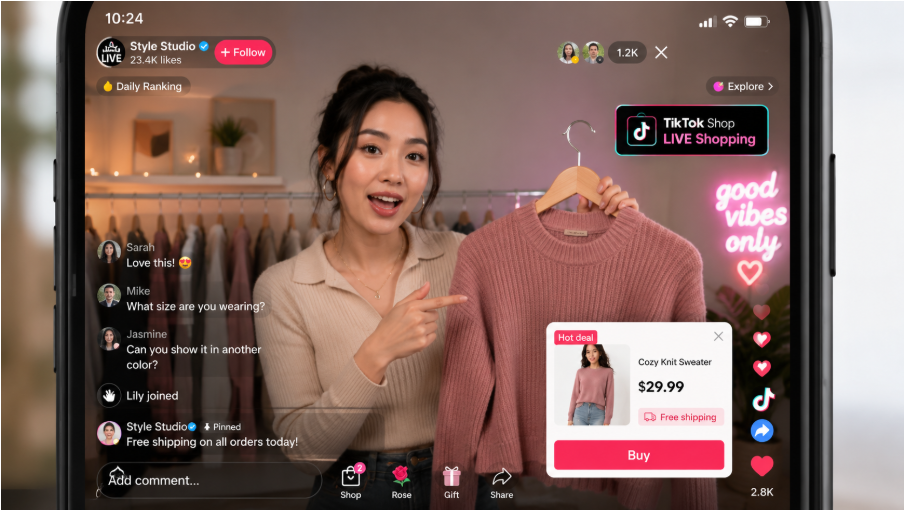
- Live Shopping. With the live shopping feature, brands can add some clickable product links during their live broadcast. This enables users to buy directly as they continue watching the livestream. It's a good strategy for blending a livestream with entertainment and live demonstration, resulting in instant buying.
- Influencer partnership. Brands collaborating with influencers is an effective strategy in social commerce, as it helps them reach their targeted audience using brand recommendations and social commerce sales. This is particularly effective in 2026, when platforms like Instagram and TikTok allow shoppable posts and social media platforms are focusing on authenticity instead of follower count.
- Checkout feature. After customers buy on social media, you should also provide them with an effective checkout method. This is particularly important as statistics indicate that 25% of shoppers prefer to buy directly on social media. Therefore, a checkout tool with saved payment methods and one-click purchasing makes the process seamless. This also capitalizes on impulse purchases to build momentum from the discovery process to completion.
- Conversational AI. To improve their communication with customers, brands can leverage direct messages, comments, and chatbots that guide customers throughout the buying journey, thereby turning social engagement into a personalized experience.
Top Platform for Social Commerce Strategy
Not all social media platforms are suitable for social commerce, and this is why it is important to understand how they work.
TikTok Shop
When it comes to ensuring the viral discovery of your content as well as a viral discovery, nothing beats the meteoric rise of TikTok Shop. Its unique content format and algorithm enable the platform to turn entertainment into an instant shopping platform. The content discovery model on TikTok doesn't consider follower count, which makes it perfect for new creators.
A 2025 Sprout Social Index showed that the platform was the most preferred option for product discovery by Gen Zs. 49% of them said they use the platform for product discovery. Another 55% said they engaged with the brand content on the platform at least once a day.
Through hashtags such as #TikTokMadeMeBuyIt, the platform has enabled brands to make huge sales on the platform. Additionally, the platform's focus on authentic and relatable content has enabled users to build their level of trust without using traditionally highly polished content. Consumers also trust the recommendations of influencers and creators who add products authentically.
To conduct social selling on TikTok, you need to start by creating a TikTok Shop. This will enable you to:
- Create a Shop where you can add products to your profile while driving purchases directly on the app.
- Use the Shop tab to showcase your products. This acts as the marketplace.
- Add shoppable videos.
- Allow TikTok viewers to buy directly on the app using TikTok Live Broadcasts.
- Allow creators to conduct affiliate marketing where they earn a commission for promoting your product.
- Use the shoppable product tags to run ads.
Instagram is another top platform for social commerce, especially for brands that want to showcase their aesthetically pleasing products, such as those in home decor, beauty, and fashion. Statistics indicate that 50% of Instagram users interact with at least one brand on the social media platform each day.

Additionally, Instagram offers a good opportunity for social commerce because it combines storytelling with features such as Instagram Shopping, product tags, and native checkout. Also, Instagram users can treat their main profile as a storefront window by making it clear, beautiful, and user-friendly. They can personalize interactions through DMs for better customer service, responding to customer queries, and guiding users through their journey.
Instagram Shopping allows you to:
- Set up a storefront on Instagram where you showcase products in the profile.
- Add shoppable content with product tags.
- Collaborate with influencers where creators promote your product while tagging your brand.
- Allow viewers to shop directly on the platform through the Instagram livestream.
- Run ads featuring shoppable product tags.
Facebook works as a community hub, enabling users to reach a large audience through advanced targeting capabilities. Through Meta Ads on Facebook, you can reach your target audience based on interest, demographics, and behavior on the platform. That means the platform can be effective for brands looking to increase and achieve a higher ROAS (Return on Ad Spend).
Through the Facebook Shop, you can have a customizable online storefront that allows you to add a digital storefront on your page, which will be visible on your Instagram profile.
Through a Facebook Shop, you can:
- Create a storefront where you display products on the page.
- Add product tags to shoppable content.
- Partner with influencers so they tag your products in their content.
- Use shoppable product tags to run ads.
- Allow Facebook users to shop directly on a Facebook livestream.
Facebook Shop is a great option for small businesses that are looking to offer an e-commerce service.
YouTube
YouTube is one of the most popular platforms known for its long-form content. It can, therefore, be a good choice for a brand looking to increase the amount of trust by using educational content such as product demos, reviews, how-to guides, etc. This makes it easy for audiences to convert, especially because of the social commerce capability that allows for a seamless in-app purchase.
YouTube is an important platform for brands looking to provide users with an immersive experience and grow the level of trust using the direct purchase feature. This is especially true as 38% of YouTube users say they use the platform for product discovery. Brands can leverage different YouTube features such as YouTube Shopping, in-video tags, YouTube Live, and Shorts. They can also add a dedicated storefront on their channel where users can purchase products directly on the platform.
YouTube features an affiliate marketing hub as well as a partnership program that brands can use to reach a large network of highly motivated influencers. They can then increase sales using authentic and shoppable content.
Brands can use YouTube Shopping to:
- Create an online shop on the Store tab where they can add products.
- Tag products to highlight in videos, livestreams, and shorts.
- Add features such as Shopping Collections to enable them to curate products on particular themes.
- Use shoppable product tags to run ads.
A good idea when collaborating on YouTube content would be to create some long-form reviews comparing your products against those of the competitor in an extensive real-world scenario. This can help to create a large amount of trust.
Pinterest is quite popular as a platform for visual discovery and an image search engine. Visitors to the Pinterest platform are looking for project inspiration, which means they already have a shopping mindset. Many pinners are already looking for ideas on home decor, renovation, wedding outfits, and more. It can, therefore, help to turn that passive inspiration browsing into strong purchase intent.
Pins usually last longer compared to posts on many platforms and can impact SEO results. That means when you optimize your pins, they can drive traffic and sales for months or even years after. However, it's worth noting that product pins aren't direct tools for social commerce. That means they redirect users to a particular landing page for conversion. They can be an effective tool for simplifying the buying journey, with people getting their product information directly on the platform.
Through Pinterest Shopping, users can:
- Create a Pinterest business page to upload products.
- Tag products in pins to enable people to click on the tags to learn more.
- Run an ad that features either the whole catalogue or specific products.
Pinterest is a great choice for businesses in niches such as arts & crafts, fashion, home decor, travel, and food. To get the best results, it is advisable to treat the boards and pins like search terms. For instance, instead of saying "cabinet," you can use the term "minimalist white kitchen cabinet hardware". You should then ensure that this keyword is added in the pin title, board title, and description for SEO purposes.
Snapchat
According to one report, 82% of Snapchatters list shopping as one of their hobbies. This is understandable considering the AR Shopping feature on the platform allows users to visualize products in real-time to boost conversion and reduce cases of product returns. Snapchat also offers users performance-driven ads such as Collection Ads, Dynamic Ads, and Shoppable Lens, supporting their whole shopping journey from brand awareness to purchase.
Snapchat is a great choice for brands targeting ephemeral and playful content in the lifestyle, beauty, and fashion niche that can benefit from features like AR try-ons as well as behind-the-scenes content. A brand can also add a product into day-to-day tasks, illustrating the impact of the product and showcasing its impact.
For instance, a footwear brand can use the AR lens to enable virtual try-ons for different pairs of shoes simply by pointing the camera of their phones at their feet. Such a campaign can turn those casual browsers into buyers.
WhatsApp wins over other social media platforms when it comes to one-on-one communication. Brands can use it to offer a high level of customer service, provide custom updates, and lead nurturing. Additionally, the platform is a good choice for offering a stronger and more private relationship with customers. These factors have made WhatsApp a great choice for B2B social commerce, where shoppers can discuss the technical specifications with experts directly.
You can use WhatsApp to:
- Showcase your product offering on the messaging app, with a product collection and catalog.
- Enable customers to browse products, add items to the cart, and purchase directly in the app.
- Manage communication with customers more efficiently.
Social Commerce Trends to Watch in 2026
If you want to succeed with social commerce, you need to understand the trends. Here are some of the top ones to watch in 2026 and beyond:
A Growth in Live Shopping
We noted earlier that social shopping has become an important part of social commerce. This has now provided brands with an opportunity to answer the audience's questions in real-time and demonstrate how the product works. This level of interaction is a reflection of how the content format is gaining momentum on different platforms. Many brands are now experiencing success with live shopping. For instance, a brand like goPure was able to generate $1 million in revenue through 483 hours of live TikTok content.
AI Personalization
In recent years, we have seen a growth in the popularity of AI-powered recommendations. Social commerce has enabled social media platforms to have a curated feed depending on the user's behavior, such as the content they watched, saved, liked, or bought. For instance, when a user saves a pair of shoes in their TikTok Shop, the platform will recommend more of such content.
That means it is now easier for social media users to discover the kind of shoppable product they are more interested in. On the other hand, a brand can use this level of personalization to put its brand in front of the right audience, increasing conversion.
Community-Led Buying
One of the top methods of driving visibility on social commerce is through communities sharing and recommending your brand, helping increase the level of trust and visibility. When people recommend your product, other shoppers can have the confidence of other shoppers to convert.
That means brands are now focusing on strategies that help them grow their audience to increase their social commerce sales. They are turning UGC into shoppable posts and building trust using reviews.
Influencer-Led Marketing
Many social media platforms are now allowing marketers to tag products in their posts, reducing the customer buying journey and increasing the need for influencer-led marketing. For instance, close to 80% of Beekman 1802 sales on TikTok come from influencer-led marketing. Similarly, 80% of Pure Daily Care sales on TikTok are from influencers and affiliates.
The Rise of Short-Form Video Marketing
In the recent past, the popularity of short-form video content has increased. This can be attributed to the fact that these videos are fast, engaging, and addictive, and have also offered brands an interesting way of sharing details. It is now drawing an audience while improving people's understanding of the product to increase purchasing decisions.
Many brands are now using that format because social media platforms allow the creation of shoppable short videos. It is an effective strategy for driving sales compared to static images.
Augmented Reality Experience
Some social commerce apps like Snapchat are already using AR to increase the confidence of buyers and minimize returns. They have added features like AR filters to allow virtual try-on for shoppers in niches like fashion, makeup, accessories, and clothing prior to buying. A shopper can, therefore, see a 3D representation of a product, such as how furniture can look in their space.
In Conclusion
Social commerce has transformed how social media users market their products. It has also changed the way customers discover products and complete their purchases. Therefore, by understanding the above social commerce strategy, you can take your brand to the next level.
